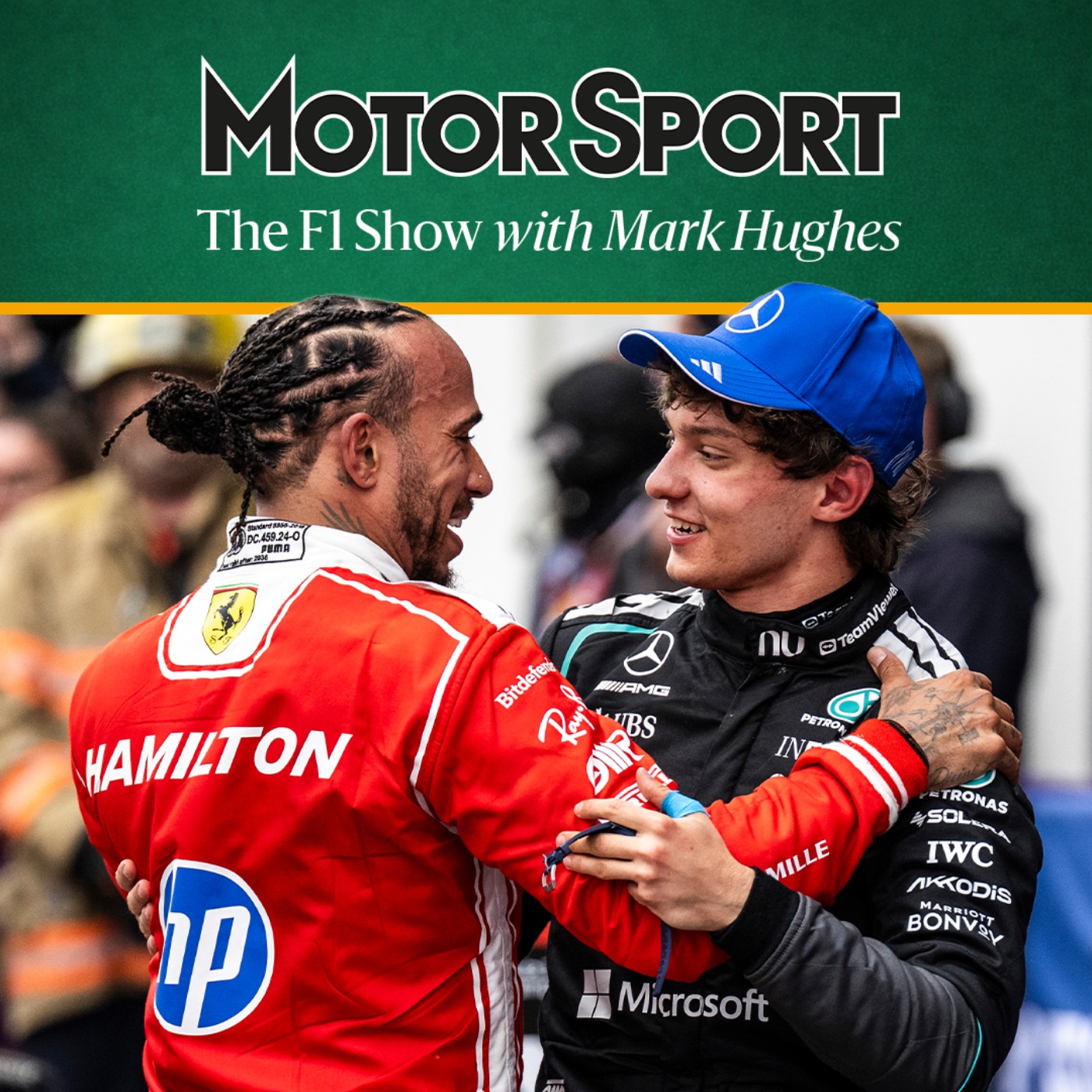
Will Ferrari snatch the 2026 F1 title from Kimi Antonelli?
About this episode
Ferrari’s Monaco prospects take center stage as the hosts link its Monaco-suited aero and hybrid power delivery to a potential reshuffle of the competitive order. They also dig into Ferrari’s late-season “Duo” upgrade plan, including an engine ready for Austria and further steps at Zanvoort and Monza, plus exhaust-blocking downforce ideas. The conversation widens to 2027 60/40-style rule timing, Ferrari’s likely opposition, and how an FIA downforce/FTM ban could create a “double whammy” for 2027.
Ferrari is favourite to win in Monaco this weekend - and that might just be the start of a Formula 1 title fightback.
Mark Hughes and Bryn Lucas reveal why the team could end the 2026 season with the fastest car, thanks to its innovative aerodynamic features, plus the prospect of two key engine upgrades that promise to put the team at least on a par with Mercedes — and potentially ahead of the current championship leaders.
But all is not well at Maranello, as unexpected rule changes, proposed for next year, could strip away the team's key advantages. Will Ferrari succeed then suffer a double whammy? Can it block the new regulations. All is explored in this latest episode of the Motor Sport F1 Show.
We also look ahead to the Monaco Grand prix where, in shock news, overtaking could once more be on the cards, giving the polesitter more than usual to worry about. McLaren's celebrating its 1000th grand prix too: don't miss Mark's whistlestop history of the current constructors' champions, plus his view on how Lando Norris and Oscar Piastri compare to its greatest team-mate line-ups/
Plus: your questions answered - what has been the greatest qualifying lap of the 21st century so far? And has one of our viewers come up with the solution to all of F1's current woes?
More on the stories that really matter, in the latest episode of the Motor Sport F1 Show.
Subscribe now for every weekly episode and tell us what you want to know from Mark. Send us a message on social media or find this podcast at https://go.motorsportmagazine.com/49GnWSV and drop your questions in the comments. He'll answer a selection of the best every week.
Read Mark's column every Wednesday at https://go.motorsportmagazine.com/49GnWSV
Hosted on Acast. See acast.com/privacy for more information.
trick aerodynamic rear end
"They've got their trick aerodynamic rear end, which in combination with a power unit that was equally potent would make them one hell of a combination."
This means Ferrari’s rear wing and other back-end aero parts are designed to push the car down onto the track. More downforce and better balance can make the car easier to steer through slow corners like Monaco’s.
In F1, the “aerodynamic rear end” refers to the back-end aero components (like the rear wing and diffuser area) that generate downforce and stability. Calling it “trick” suggests a more advanced, likely track-specific design that helps the car rotate and stay planted through Monaco’s slow corners.
power unit
"They've got their trick aerodynamic rear end, which in combination with a power unit that was equally potent would make them one hell of a combination."
In F1, the “power unit” is the car’s engine system, including the hybrid parts that store and reuse energy. If it’s “potent,” it means the car has strong acceleration and overall speed.
In modern F1, the “power unit” is the hybrid engine system: a combustion engine plus energy recovery (and related electronics) that provide both power and efficiency. When the host says it’s “equally potent,” they mean Ferrari’s hybrid power delivery is strong enough to complement the aero advantage.
Monaco
"It's not the fastest team at the moment, although it might well be a Monaco this weekend. Post-Covid, the Ferrari has been dynamite there..."
Monaco is a famous F1 race on a tight street track. The corners are slow and close together, so the car’s handling and balance matter a lot more than raw top speed.
Monaco refers to the Circuit de Monaco, a street circuit known for tight corners, short straights, and very low average speeds. Because overtaking is difficult and traction/rotation matter more than top speed, teams often tailor aero and setup specifically for Monaco’s demands.
low-speed response
"Post-Covid, the Ferrari has been dynamite there and that sweet handling and that low-speed response is perfect for Monaco..."
This is how the car behaves when you’re going slowly, like in tight turns. A “good” low-speed response means it turns in and accelerates smoothly without feeling lazy or unpredictable.
“Low-speed response” describes how quickly and predictably the car reacts at slow corner speeds—typically involving throttle response, steering feel, and traction. Monaco’s tight layout makes this especially important because many corners are taken slowly and require precise control.
regeneration
"There's a little bit of a reset about Monaco for several reasons, but regardless of what's going on in terms of regulations and how the power outputs and regeneration have been configured..."
This is about the hybrid energy system in F1. The car can recover energy when slowing down and then use it later to help with acceleration and speed.
In F1 context, “regeneration” is shorthand for energy recovery—systems that capture energy during braking and other events, then “regenerate” it for later use. The host is saying that how this is configured for the circuit can change the competitive order.
competitive order
"There's a bit of a reset in terms of what we expect of the competitive order, just because it's a track which could almost have been configured to perfectly suit Ferrari..."
This just means which teams are currently strongest. The host is saying Monaco can change who’s on top compared to other weekends.
“Competitive order” is the pecking order of teams—who is fastest and most likely to fight for the front based on current car performance. The host suggests Monaco’s characteristics can reshuffle that order compared with other races.
snatch the world champion
"Are they going to snatch the world champion? Is it too early? Are they going to lose nose?"
They’re talking about winning the F1 championship for the season. It’s based on points from every race, so a team can still catch up if they’re improving at the right time.
This refers to winning the Formula 1 World Championship, which is decided by points accumulated across the season. The host is framing Ferrari’s situation as a potential late-season turnaround toward the title.
two extra upgrades
"power unit and as such will be granted two extra upgrades. So that would allow them to introduce an engine which they've got ready in time for Austria"
F1 teams usually get a limited number of upgrades. If a team is far behind, the rules can give them extra upgrade chances to help them catch up.
This refers to an F1 regulation mechanism that allows teams falling behind to receive additional development opportunities. The idea is to help them close the performance gap by permitting more upgrades than the usual limit.
Mercedes
"and the second one would bring them on parity with Mercedes. So if that is indeed the case, everything about the performance pattern of the car so far this year suggests"
Mercedes is being used as the top team to compare against. The speaker is saying Ferrari wants to get to the same level of speed as Mercedes.
Mercedes is referenced as the performance benchmark Ferrari is trying to match. In F1 discussions, teams often talk in terms of “parity” with the leading constructor, meaning similar overall speed and competitiveness.
shorter gearbox
"they've got their trick aerodynamic rear end, which is if they configure the whole car around to have a shorter gearbox"
A “shorter gearbox” means using gearing ratios that make the car reach higher engine speeds sooner, improving acceleration and drivability in specific speed ranges. In F1, gearing choices are closely matched to track characteristics and the car’s overall power delivery.
suspension
"and look at the suspension going as far raking as far forward as possible to give them this extra little bit of area within the regulation box at the rear"
Suspension isn’t just for comfort—it also affects how the car sits on the track. That can change the airflow under the car and how well the aero parts work.
Here, “suspension” refers to how the car’s suspension geometry and mounting positions are set up to influence aerodynamic behavior. In F1, suspension setup can affect ride height, airflow under the car, and how effectively the floor and rear aero work.
raking
"look at the suspension going as far raking as far forward as possible to give them this extra little bit of area"
“Raking” is how the car is tilted front-to-back. Teams use it to make the air under the car work better for grip, but it has trade-offs.
“Raking” in F1 aero terms means setting the car with a deliberate angle—typically changing ride height front-to-rear—to optimize underfloor airflow and the car’s aerodynamic balance. More rake can help the floor generate downforce, but it must be managed carefully for stability and tire wear.
regulation box
"to give them this extra little bit of area within the regulation box at the rear"
The “regulation box” is the space the rules allow teams to use for certain parts. Designers have to fit everything inside those limits, and clever packaging can still help performance.
The “regulation box” is the dimensional envelope defined by F1 rules that limits where certain components can be placed. Teams use it to design within constraints, and small packaging changes can unlock aerodynamic opportunities.
exhaust blocking
"under which they've been able to do this really effective that exhaust blocking which directs the airflow to the underside of the rear wing"
“Exhaust blocking” is a trick for using the exhaust flow to help the car’s aerodynamics. The goal is to push more air in the right direction so the rear wing can generate more grip.
“Exhaust blocking” is an aerodynamic technique where the exhaust area is shaped/positioned to manage how exhaust gases interact with the car’s airflow. In this context, it’s used to direct airflow toward the underside of the rear wing to increase downforce.
downforce
"gives them a downforce advantage. So that in combination with a power unit that was equally potent would make them one hell of a combination"
Downforce is the “suction” effect that presses the tires onto the road. More downforce usually means better grip and faster cornering.
Downforce is the aerodynamic force that pushes the car’s tires toward the track, improving grip. In F1, teams chase downforce because it directly affects cornering speed and stability, especially at high speed.
rear wing
"directs the airflow to the underside of the rear wing with much more force and gives them a downforce advantage."
The rear wing is a major aerodynamic device that generates downforce by accelerating airflow and creating pressure differences. In modern F1, it’s tightly integrated with the rest of the aero package, so changes to airflow (like exhaust management) can significantly affect its effectiveness.
duo
"Just so any listener, any viewer has just come across the duo for the first time, additional development and upgrade opportunities, that's what a duo stands for, the acronym"
“Duo” here is an F1 rule that gives struggling teams extra chances to bring upgrades. It’s meant to help them close the performance gap.
In this F1 context, “Duo” is an acronym for a regulation that provides additional development and upgrade opportunities to teams that are too far off the pace. It’s essentially a structured “catch-up” mechanism within the rules.
engine regs
"but we've also got the prospect of engine regs being changed in 2027, which Ferrari isn't happy about."
“Engine regs” are the rule changes about how F1 engines are allowed to be built. When those rules change, teams often have to redesign major parts of the car.
“Engine regs” means the upcoming rules governing F1 power units, including how engines and hybrid systems must be designed and operated. Changes to engine regulations can force major redesigns and shift competitive balance between teams.
27 implementation
"Last time we spoke about this was before the Canadian Grand Prix and we had only Mercedes and Red Bull were in favour of 27 implementation, [346.6s] the other three were against."
This is about when the new F1 rules for the 2027 season start being used. The teams are arguing whether to apply them right away in 2027 or push them back.
“27 implementation” refers to when F1’s 2027 regulation package is introduced and becomes mandatory. In this discussion, teams are debating whether that rule change should happen on the 2027 timeline or be delayed.
development time
"If Ferrari do get this additional time, this development time, this duo, and they are then not voting to agree to bring the new regulations in for 2027..."
This means the extra time teams have to improve their cars before the next big rule change. More time can help them get upgrades working better instead of wasting effort.
“Development time” here means the extra period teams get to design, build, and validate upgrades before the next regulation package takes effect. In F1, that window can strongly influence whether an upgrade pays off or gets nullified by new rules.
6040 regulation
"if I may say so. I have a Ferrari picture over my shoulder, by the way, just for fairness, [436.6s] you know. I mean, cynicism aside, why they would be, I think, feeling hard done by if they were implemented as early as 2027, rather as they would prefer 2028? [480.6s] They've spent a lot of effort and resource on producing this upgraded engine and the second upgraded engine, which will have a bigger turbo, we are told."
This is a set of F1 rules that changes how the car’s power is divided between the engine and the electric part. The idea is to shift more power to the engine and less to the electric system.
The “6040 regulation” is an F1 power-unit rules split that targets how much energy comes from internal combustion versus electrical power. The host connects it to “greater internal combustion engine power” and “reduced electrical power,” which is why it matters competitively.
turbo
"They've spent a lot of effort and resource on producing this upgraded engine and the second upgraded engine, which will have a bigger turbo, we are told. So they will have spent all this resource and effort..."
A turbocharger helps the engine make more power by forcing more air into it. More air usually means more fuel can be burned efficiently, so the engine can produce more thrust.
A “turbo” (turbocharger) uses exhaust gases to spin a turbine that compresses incoming air, allowing the engine to make more power from the same displacement. In this segment, Ferrari’s upgraded engine is said to use a “bigger turbo,” implying a targeted performance change.
early implementation
"So I would think that that is probably their main objection to the early implementation [532.1s] of the 6040 regulations."
“Early implementation” here means bringing new F1 technical regulations into effect sooner than expected. That can reduce the time teams have to validate upgrades and amortize development work. The host frames it as a key objection because it could leave teams—especially Ferrari—less prepared for the new competitive landscape.
FTM system
"So they're thinking of reducing downforce by banning Ferrari's FTM system, the flick tail mode. [555.4s] So Ferrari is potentially looking at a double whammy for 2027, if that happens, if they have"
Ferrari’s FTM system (mentioned here as part of a “flick tail mode”) is an aerodynamic device/control strategy intended to alter the car’s rear behavior. In this discussion, it’s specifically tied to generating downforce and therefore drag. The FIA is considering banning it as part of efforts to reduce downforce and improve energy efficiency.
flick tail mode
"So they're thinking of reducing downforce by banning Ferrari's FTM system, the flick tail mode. [555.4s] So Ferrari is potentially looking at a double whammy for 2027, if that happens, if they have"
“Flick tail mode” is described as the operating mode associated with Ferrari’s FTM system. The name implies a rapid rear-aero adjustment to change the car’s balance and aerodynamic load. In this segment, it’s treated as a key contributor to downforce, which the FIA wants to reduce by banning the system.
ICE
"If Ferrari have said that [605.8s] we've spent X amount of money on our power unit, the ICE part of the power unit, and our development [611.9s] of chassis, we've got two customers that use our power unit."
ICE means the traditional engine that burns fuel. In F1 today, that engine is part of a bigger hybrid system that also uses electric energy. The host is using “ICE” to be specific about which part Ferrari developed.
ICE stands for internal combustion engine—the gasoline or fuel-burning portion of the F1 hybrid power unit. In modern F1, the ICE works alongside electric energy systems, so changes to efficiency targets (like reducing drag) can influence how much energy is available and how the car is managed. Here, it’s used to clarify what Ferrari means by “power unit” development costs.
chassis
"we've spent X amount of money on our power unit, the ICE part of the power unit, and our development [611.9s] of chassis, we've got two customers that use our power unit."
The chassis is the main frame/structure of the race car. It’s what everything else mounts to, like the suspension and aero parts. The host is saying Ferrari also spent money developing that, so changing the rules can hurt them.
The chassis is the car’s structural platform—where the suspension, aerodynamic elements, and driver packaging are mounted. In F1, chassis development is tightly regulated and strongly linked to performance. This segment treats chassis development spending as part of why rule changes could create a competitive disadvantage for Ferrari and its customer teams.
neutral governor of the championship
"But really, the FIA should be just a neutral governor of the championship and it should be [676.2s] looking to address the criticisms of this category that we've had so far and just"
This phrase describes the FIA’s intended role as an impartial rule-enforcer rather than someone who tries to “steer” outcomes. The host argues the FIA should focus on addressing the stated criticisms of the regulations, even if interpretations end up affecting teams differently. It’s a governance concept about how rule changes should be applied consistently.
lag
"Because they have the small turbo so they have the great launch, less lag off the line, it has this clever diffuser and exhaust aero as well."
Turbo lag is the delay between when you demand power (throttle input) and when the turbocharger builds enough boost to deliver it. In F1 discussions, reducing lag is often linked to better launches and traction out of slow-speed corners.
diffuser
"Because they have the small turbo so they have the great launch, less lag off the line, it has this clever diffuser and exhaust aero as well."
A diffuser is a shape under the car that helps the air flow in a way that “sucks” the car down for better grip. More downforce usually means you can corner faster.
A diffuser is an aerodynamic device under the car that helps convert airflow speed into pressure, increasing downforce. In modern F1, the diffuser works with the floor and exhaust/airflow management to improve grip and stability, especially at speed.
exhaust aero
"Because they have the small turbo so they have the great launch, less lag off the line, it has this clever diffuser and exhaust aero as well."
“Exhaust aero” means the exhaust isn’t just for getting rid of fumes—it’s also used to help the car’s aerodynamics. Teams try to make the exhaust flow improve grip and stability.
“Exhaust aero” refers to using the exhaust gases and their heat/flow to influence aerodynamics—often to energize airflow and improve downforce. In F1, teams design exhaust placement and geometry to maximize the car’s aerodynamic efficiency.
natural progression
"Where it currently sits and looking at the long game, have they worked it out? They've got the natural progression that's allowed them to build through the season if there were no changes?"
In F1, teams often improve the car gradually during the season. “Natural progression” means they’re building on what they already learned, rather than making big sudden changes.
“Natural progression” in F1 usually means the team’s development plan—improving the car step-by-step through the season as data is gathered and parts are refined. It contrasts with a situation where performance is driven by major, disruptive changes rather than incremental upgrades.
regulations come in
"It's probably the most interesting design on the grid and probably the most innovative but it's not the fastest. We've seen over the years regulations come in not directly to hamper one team but maybe to slow down an advantage of one team and help the others catch up a little bit."
F1 rules change over time, and those changes can affect which cars are fastest. Sometimes the new rules are meant to prevent one team from dominating too easily.
When F1 “regulations come in,” they can reshape the competitive balance by changing what design approaches are allowed or how performance is measured. The host is arguing that rule changes can reduce one team’s advantage and give others a chance to catch up.
regulation change
"Is it striking you in a slightly different way though because of the way it's come around with the regulation change and the immediate look to the change of the regs?"
A regulation change means the F1 rules get updated. That can force teams to redesign parts, and some teams adapt faster than others.
A “regulation change” in F1 is a rule update that can alter car design constraints, aerodynamic allowances, and/or engine/technical requirements. Teams that interpret the new rules early can gain an advantage, while others may lag until their development catches up.
Ferrari
"we've seen in the past with Red Bull and we've seen it going back a few more years with Ferrari when they changed the tire regulations in 2005 ... If you were Toto Wolf would you be concerned about Ferrari looming ever so much larger ... it's about Ferrari but in the knock-on effect"
Ferrari is one of the biggest Formula 1 teams. The hosts are talking about whether Ferrari might get fast enough to challenge for the championship, especially if they improve their car’s performance.
Ferrari is one of Formula 1’s most historic constructors, and this segment frames them as a potential title threat. The discussion focuses on how regulation changes and upcoming performance adjustments could let Ferrari close the gap to Mercedes and grow dominance.
tire regulations
"we've seen it going back a few more years with Ferrari when they changed the tire regulations in 2005 in a way that really disadvantaged the bridged on users which of the major teams was Ferrari."
“Tire regulations” are rules about what tires teams can use and how they’re allowed to run them. Since tires affect grip and race strategy, changing the rules can make some teams less competitive.
“Tire regulations” are rules that define how tires are specified and used—such as construction, performance targets, and constraints on how teams can run them. Because tires strongly affect grip and strategy, changing them can disadvantage teams that were optimized for the previous tire behavior.
Toto Wolf
"If you were Toto Wolf would you be concerned about Ferrari looming ever so much larger in the mirrors they seem to be gaining ground."
Toto Wolf is the top leader at Mercedes’ Formula 1 team. The hosts are basically asking how he would react if Ferrari keeps getting faster and threatens Mercedes.
Toto Wolf is the team principal of Mercedes in Formula 1. In this discussion, his perspective is used as a proxy for how Mercedes might view Ferrari’s improving pace and potential title threat.
par units
"I'd be particularly concerned with Ferrari given that they have this ideal readjustment forthcoming we believe which McLaren won't do because they use Mercedes par units."
“Par units” here sounds like shared parts or a shared engine setup. The point is that McLaren may not be able to make the same big changes as Ferrari because it’s using a similar baseline.
“Par units” appears to refer to standardized or shared power-unit components used by multiple teams. The idea is that if McLaren is using Mercedes “par units,” it may be constrained in how much it can independently change compared with Ferrari.
boost and overtake functions
"So yes I would be given that they have this ideal readjustment forthcoming we believe which McLaren won't do because they use Mercedes par units. So yes I would be given that they're only half a second off the pace in the way that the boost and overtake functions work out speed enough to make them a real bother for Mercedes especially in the early races."
The “boost and overtake functions” are the car’s allowed bursts of extra power used to accelerate and pass. Teams have to use it wisely because it can’t be unlimited during the race.
The “boost and overtake functions” refer to the regulated hybrid energy deployment modes that temporarily increase performance for passing and acceleration. Teams must manage when and how they use this power because it affects both lap time and the remaining energy for later in the race.
qualifying lap
"what's the best qualifying lap you've ever watched ... if you're talking about the best qualifying lap there's the several candidates ... it was Leclerc at Singapore 2019"
A qualifying lap is the fastest lap drivers try to set before the race. The result decides where they start on the grid, and Mark Hughes is talking about the best ones he’s seen.
A qualifying lap is the single fastest lap a driver sets during the F1 qualifying session to determine starting position for the race. In this segment, Mark Hughes is ranking the most impressive qualifying laps based on technical precision and how close the cars were to the walls.
Sebastian Vettel
"there's so many candidates and the same names kept cropping up the names of Sebastian Vettel, Michael Schumacher, Lewis Hamilton, Max Verstappen, Charles Leclerc"
Sebastian Vettel is a top Formula 1 race driver from Germany. Mark Hughes is mentioning him as one of the drivers who’s done some of the most impressive qualifying laps.
Sebastian Vettel is a German Formula 1 driver known for multiple World Championships with Red Bull. In this segment, Mark Hughes lists him among drivers who’ve produced standout qualifying laps since 2000.
Lewis Hamilton
"Sebastian Vettel, Michael Schumacher, Lewis Hamilton, Max Verstappen, Charles Leclerc, ... he was fighting Lewis Hamilton for pole"
Lewis Hamilton is a famous British Formula 1 driver. Mark Hughes brings him up because Hamilton was fighting for pole in the qualifying lap he’s praising.
Lewis Hamilton is a British Formula 1 driver with a long record of pole positions and race wins. In this segment, Mark Hughes compares qualifying laps and specifically mentions Hamilton as a rival for pole at Singapore 2019.
Michael Schumacher
"the same names kept cropping up the names of Sebastian Vettel, Michael Schumacher, Lewis Hamilton, Max Verstappen, Charles Leclerc"
Michael Schumacher was one of the greatest Formula 1 drivers ever. In this discussion, he’s named as someone who’s produced memorable qualifying laps.
Michael Schumacher is a legendary German Formula 1 driver, famous for dominating the sport in the early 2000s. Here, he’s included in Mark Hughes’s shortlist of drivers with multiple entries for “best qualifying lap.”
Max Verstappen
"Sebastian Vettel, Michael Schumacher, Lewis Hamilton, Max Verstappen, Charles Leclerc, ... Verstappen in 2018 with a misfire at the last couple of corners"
Max Verstappen is a top Formula 1 driver from the Netherlands. Mark Hughes is talking about a qualifying lap where Verstappen had a problem late in the session.
Max Verstappen is a Dutch Formula 1 driver known for aggressive, high-speed driving and frequent contention for pole. Mark Hughes references Verstappen’s 2018 qualifying lap(s), including a misfire near the end that affected pole chances.
Charles Leclerc
"in terms of technical perfection it's so close ... I think for me it was Leclerc at Singapore 2019 when he had that big Larry moment over the Anderson bridge collected it all up and didn't lose any momentum"
Charles Leclerc is a Ferrari Formula 1 driver. Mark Hughes says Leclerc’s qualifying lap in Singapore in 2019 was the most exciting because he stayed extremely close to the walls and still got pole.
Charles Leclerc is a Formula 1 driver for Ferrari, noted for precise car control and strong qualifying pace. Mark Hughes highlights Leclerc’s Singapore 2019 qualifying lap as the most thrilling, describing a near-wall “big Larry moment” that still preserved momentum and earned pole.
Singapore
"I think for me it was Leclerc at Singapore 2019 when he had that big Larry moment over the Anderson bridge ... he was fighting Lewis Hamilton for pole"
Singapore is the location of an F1 race track that’s basically a street circuit. It’s known for being very tight with walls close by, so qualifying laps there are especially intense.
Singapore refers to the Singapore Formula 1 street circuit, famous for tight corners, heavy barriers, and very little margin for error. Mark Hughes uses Singapore 2019 as an example of how qualifying laps become thrilling when drivers are forced to run extremely close to the walls.
Anderson bridge
"Leclerc at Singapore 2019 when he had that big Larry moment over the Anderson bridge collected it all up and didn't lose any momentum"
The Anderson Bridge is a named spot on the Singapore F1 track. Mark Hughes is pointing to the exact area where Leclerc got into trouble but recovered without losing momentum.
The Anderson Bridge is a landmark section of the Singapore street circuit that crosses over a roadway and is part of the lap’s high-speed flow. Mark Hughes uses it to pinpoint where Leclerc had a big moment but still managed to keep momentum.
pole
"and he was just so close to the walls and the bar is all the way through and it was absolute full commitment around that track and he was fighting Lewis Hamilton for pole"
Pole means you start the race from the very front of the grid. Mark Hughes is saying Leclerc and Hamilton were battling to be first to start the race.
Pole refers to starting first on the grid, awarded to the driver who qualifies fastest. Mark Hughes says Leclerc fought Hamilton for pole at Singapore 2019, emphasizing the stakes of that qualifying performance.
misfire
"including Vettels Hamilton in 2018 Verstappen in 2018 with a misfire at the last couple of corners when he might have taken pole"
A misfire is when the engine doesn’t burn the fuel correctly. In racing, that can cost speed and make it harder to hit the perfect lap time.
A misfire is when an engine fails to ignite fuel properly in one or more cylinders, causing loss of power and rough running. Mark Hughes mentions Verstappen’s 2018 qualifying lap having a misfire near the end, which likely hurt the lap time and pole chances.
Gilles Villeneuve
"from from before that [1282.6s] time 70s 80s that's kind of yeah for me it was Gilles Villeneuve at 81 at Monaco"
Gilles Villeneuve was a famous F1 driver. The host is saying his Monaco lap in 1981 was so impressive because he could drive the car right at the limit and still manage it despite the turbo-era problems.
Gilles Villeneuve was a legendary Formula 1 driver known for fearless, high-commitment driving. Here, Mark Hughes highlights Villeneuve’s 1981 Monaco performance in a turbocharged Ferrari, emphasizing how skill can overcome the era’s turbo disadvantages.
Didier Perroni
"and he had a a real world-class teammate Didier Perroni um who [1312.3s] was qualified to 17th or something like that"
Didier Perroni is the teammate the host mentions for that Ferrari team. The point is that while Villeneuve was on the front row, the teammate was much further back in qualifying.
Didier Perroni is mentioned as Villeneuve’s teammate who qualified far back but still represented the team’s overall competitiveness. In F1, teammate qualifying positions can highlight how uneven a car’s performance can be across drivers and conditions.
Nelson Piquet
"and he was just hundreds [1318.6s] away from an underweight Brabham driven by Nelson Piquet um and went on to win the race"
Nelson Piquet was a top Formula 1 driver who won world championships. Here he’s mentioned because his Brabham was one of the cars Villeneuve was nearly matching in that race context.
Nelson Piquet was a multiple-time Formula 1 World Champion and a key figure in late-1970s/early-1980s racing. The host uses Piquet’s Brabham as a reference point for how close Villeneuve’s lap was to a very strong competitor at Monaco.
spec tyre and a spec fuel allocation
"why not a formula with [1355.8s] a spec tyre and a spec fuel allocation and see who can produce the best solution be it a hybrid v6 [1363.6s] or a lazy v8"
This is about making tires and fuel more standardized for every team. If everyone starts with the same basics, teams spend less and it’s easier to compare who’s doing the best job with the car itself.
A “spec tyre” and “spec fuel allocation” are rules ideas that standardize key performance inputs across teams. The goal is to reduce spending and make results depend more on car design and driver skill rather than who can buy the best bespoke consumables.
cost cap
"I think even when you it's a good question John but I think even when you [1374.7s] reduce the cost which is basically what the cost cap is done but it's obviously it's set"
A cost cap is a rule that limits how much money F1 teams are allowed to spend. The idea is to keep the competition closer and stop wealthier teams from outspending everyone else.
A cost cap is a spending limit imposed by F1 to restrict how much teams can spend in a season. The host notes that even with the cost cap reducing costs, the sport still needs further cost control to reach the “late 60s/DFV era” type of competitiveness.
6040 2027
"[1484.5s] Frank Harold says as an alternative to the currently proposed 6040 2027 powertrain regulation changes with the attendant engineering and cost increases"
“6040 2027” is shorthand for the 2027 rule idea about how much of the car’s power comes from the gas engine versus the electric system. It’s basically a planned balance change for the hybrid setup.
“6040 2027” refers to a specific F1 power allocation concept for the 2027 regulations, describing a target split between combustion and electric energy/power. The exact meaning depends on the regulation text, but it’s used here as shorthand for the proposed hybrid balance.
battery electric motor output
"[1489.2s] why not consider keeping the ICE engine power at the 2026 level and simply reduce the battery electric motor output while this would slow the car somewhat"
That phrase means how much power the electric motor can provide using electricity stored in the battery. If you turn that down, the car relies more on the gas engine and teams may have to manage energy more carefully.
Battery electric motor output is the amount of power the electric motor can deliver using stored energy from the battery. In hybrid F1 power units, changing this balance affects acceleration, energy management, and how aggressively teams can run in qualifying.
energy management
"[1502.2s] discernibly different for the viewer I think the danger with that is that if you restricted the electrical further and you didn't have much combustion engine power then you're gonna have [1513.5s] to save what little electricity you've got even more than you do at the moment"
Energy management means deciding when to use the electric power and when to save it. Since the battery can run out, teams have to plan their power use instead of using everything all at once.
Energy management is the strategy of deciding when and how to use limited battery electricity versus combustion power. In hybrid F1, it’s crucial because the battery has finite energy, so teams must balance lap-time performance against what they can afford to spend.
boost button
"so we're talking about between 125 miles an hour and 188 the boost button ditches all that so there's a bigger potentially a bigger difference between being on the boost button and not being on the boost button than before"
The boost button is a driver switch that gives the car a temporary power increase. It’s like tapping into extra stored energy so the car accelerates harder for a short time—often right when you’re trying to pass.
The “boost button” is the driver’s control for deploying extra power in an F1 car, typically by releasing stored energy from the hybrid system. The host argues that the gap between using boost and not using it could be larger under the new rules, making overtakes more likely.
overtake mode
"so maybe the boost button combined with the overtake mode might just be powerful enough to get your head on the run the sander vote or into the chicane out of the tunnel possibly"
Overtake mode is a special driving setting that tells the car to focus on getting you past. It changes how the car uses its extra power so you can accelerate harder when you need it.
“Overtake mode” is a selectable power/energy deployment setting that prioritizes maximum acceleration for passing. The host is combining it with the boost button to suggest it could be enough to make a difference at Monaco’s tricky corners.
chicane
"into the chicane out of the tunnel possibly i don't know um it's certainly different how it's been so you know new as we've seen new regulations can create all sorts of uh effects"
A chicane is a part of the track where the road zig-zags with quick turns. It forces cars to slow down and can make it easier to pass because drivers have to brake and line up carefully.
A chicane is a deliberate sequence of alternating turns designed to slow cars and create a technical section of track. At Monaco, the chicane is one of the key places where drivers may try to gain position because braking and cornering create passing opportunities.
corner adjustment
"it's ferrari has had the best sort of corner adjustment you can make make the angle of the the turn different as you go through the the corner it's very very adjustable"
It means the car can be set up so it turns the way you want throughout the corner. Instead of feeling the same from start to finish, the car can be made to respond differently as you go in and through the turn.
“Corner adjustment” here means the car’s setup and balance can be tuned so it changes how it turns as you move through the corner. By altering things like steering response and grip distribution, the driver can make the car behave differently at corner entry versus mid-corner.
power deficit
"whenever they've had a power deficit which they had in 21 and that they have this year it doesn't really matter it's such a power insensitive track"
A power deficit means the car isn’t as strong as the others in terms of acceleration and speed. The point here is that Monaco’s layout makes that weakness less obvious than on faster tracks.
A “power deficit” means the car is producing less power than its rivals, which can hurt acceleration and top speed. The host argues that Monaco is “power insensitive,” so a power deficit shows up less in lap times there.
gear up
"he was still fighting for pull and he's speed through tobacco where he was a gear up on everybody else it was just astonishing"
It means the driver was using a higher gear than others while still going fast. That can suggest the car had enough grip and power to keep pulling without needing as many gear changes.
“Gear up” here means being in a higher gear than competitors while still maintaining speed through a specific section. In F1, that can indicate better efficiency and traction, because you’re not relying on downshifts to keep the car moving quickly.
understeer
"Max Verstappen has traditionally not had a great red bull around there it tends to be a little bit understeer a bit bouncy over the curbs"
Understeer is when the car doesn’t “turn in” enough and feels like it wants to go straight instead of following the corner. It usually shows up when you’re trying to turn but the front tires can’t grip enough.
Understeer is when the car turns less than the driver expects, so it tends to push wide toward the outside of the corner. The host says Verstappen’s Red Bull has historically shown understeer at Monaco, which would make it harder to carry speed through the tight sections.
Red Bull
"Max Verstappen has traditionally not had a great red bull around there it tends to be a little bit understeer a bit bouncy over the curbs"
Red Bull is the F1 team being discussed. The host says their car has not suited Monaco as well because it doesn’t feel as stable over the track’s bumps and tight corners.
Red Bull is the Formula 1 team being discussed, specifically how its car has historically behaved at Monaco. The host claims it tends to be understeery and bouncy over curbs, which limits how well Verstappen can show his best performance there.
bouncy over the curbs
"it tends to be a little bit understeer a bit bouncy over the curbs so in its DNA red bull hasn't been a great car around monaco"
It means the car gets a bit jumpy when it hits the raised edges of the track. If the suspension can’t stay settled, the tires lose grip and the car feels harder to control.
“Bouncy over the curbs” describes a car that becomes unsettled when its tires ride over track curbing. That can reduce traction and make the steering feel inconsistent—especially on a street circuit like Monaco where curbs are frequent and close to the racing line.
ceiling
"that when you're judging driver performances you have to bear in mind that the the ceiling that the car is imposing on them not just in terms of its ultimate uh competitiveness but in in terms of its traits"
They mean the car itself sets a limit on how good the driver can be. If the car isn’t capable enough, the driver can’t perform at the very top level no matter how skilled they are.
In F1 driver analysis, the “ceiling” is the maximum level a driver can reach because of the car’s limitations. Even a great driver can’t fully overcome a car that lacks outright competitiveness or key handling traits.
precision
"and if precision is key which it you know is monaco you make us one tiny false move and that's it is game over if precision is key"
They’re talking about driving very accurately—hitting the right lines and braking points. On a track like Monaco, being off by even a little can cost you a lot.
“Precision” here means the ability to place the car accurately at turn-in, apex, and exit—especially on a street circuit like Monaco. In F1, that directly affects lap time consistency and how often you avoid mistakes.
Kimi Antonelli
"we've been talking over the last few weeks about kimmy antonelli he's got to be one of those very fancy drivers around someone like monaco because he's so so precise"
Kimi Antonelli is an up-and-coming Formula 1 driver. They’re saying he’s very precise, which could help at Monaco, but he still has to avoid taking too many risky chances.
Kimi Antonelli is a young F1 driver discussed here as a highly precise talent. The speaker argues he’s the kind of driver who could adapt to Monaco’s demands, but also that Monaco punishes over-aggression.
audacity
"ali was combining that with real audacity you know real taken risks and thrown himself in and and rescue in any little moments"
They mean the driver is willing to take bigger risks instead of playing it safe. That can lead to great saves, but it can also make things go wrong more easily.
In this context, “audacity” describes a driver’s willingness to take bigger risks—pushing for aggressive lines, late braking, or recovery attempts when the car is close to the limit. It can create highlight moments, but it also increases the chance of mistakes.
McLaren
"McLaren's 1000th Grand Prix this weekend at Monaco it's actually there 999th is going to be ... for a long long time and when that era came to an end the the the Zach Brown era began"
McLaren is a famous Formula 1 racing team with a long history. The host is talking about how the team stayed around for decades and how different leaders helped it become strong again.
McLaren is one of Formula 1’s most historically successful teams, and the episode highlights its long-running presence and dominance across multiple eras. The discussion also frames how different leadership periods (Ron Dennis vs. the later Zach Brown era) affected the team’s competitiveness.
Grand Prix starts
"it's actually there 999th is going to be but over there 998 current Grand Prix starts but we're going to say 999th"
This is basically a count of how many F1 races a team has started over the years. It’s a way of measuring how long they’ve been competing consistently.
“Grand Prix starts” refers to the number of race entries where a team’s cars actually begin the race. It’s a milestone-style stat often used to track a constructor’s long-term participation in F1.
constructors titles
"it's in the flesh it looks amazing but um they had 203 wins 261 podiums 10 constructors titles and five drivers titles"
In F1, there are two main championships. One is for the driver, and one is for the team. The constructors title is the team championship based on points from both cars.
In Formula 1, a constructors title is awarded to the team (constructor) that accumulates the most points over the season from both of its cars. It’s separate from the drivers title, which is awarded to an individual driver.
drivers titles
"they had 203 wins 261 podiums 10 constructors titles and five drivers titles"
A drivers title is the championship awarded to the individual driver who scores the most points across the season. It’s distinct from the constructors title, which is won by the team based on combined points.
Teddy Mayer
"the original Bruce McLaren team which was taken over by Teddy Mayer after Bruce was killed in testing"
Teddy Mayer is mentioned as the person who took over McLaren after Bruce McLaren. The host uses him to explain the team’s early leadership history.
Teddy Mayer is mentioned as the person who took over the original McLaren team after Bruce McLaren’s death. In the segment, he’s part of the early “generations” of McLaren leadership.
Ron Dennis
"that was Ron Dennis era McLaren just and then that would really it didn't just change the fortunes of of the team um the way he sort of built it radically"
Ron Dennis was a major leader at McLaren. In this segment, the host is saying his management and funding helped McLaren become a top team and stay ahead of others.
Ron Dennis is a key figure in McLaren’s modern history, strongly associated with the team’s “powerhouse” period. The host credits his vision and ability to fund and scale the operation as a major reason McLaren outpaced rivals like Tyrrell, Lotus, and Brabham.
James Hunt
"they had championships before well there was some football in James Hunt but the real juggernaut stuff"
James Hunt is a famous Formula 1 driver. The host is mentioning him as an example of McLaren having success before the later, more dominant era.
James Hunt is referenced as part of McLaren’s earlier success, described as “some football in James Hunt.” He’s used here as a shorthand for the team’s championship-winning driver era before the later Ron Dennis period.
Ayrton Senna
"the Alan Prost, Nicky Lauder, Ayrton Senna, Mega Hackerman years"
Ayrton Senna was one of the greatest Formula 1 drivers ever. The host is mentioning him to highlight how McLaren had world-class talent during its best era.
Ayrton Senna is named as one of the drivers tied to McLaren’s “juggernaut” years. Senna’s reputation as an elite, race-winning driver is part of why those seasons are remembered as a high point for the team.
Alan Prost
"the Alan Prost, Nicky Lauder, Ayrton Senna, Mega Hackerman years"
Alan Prost was a top Formula 1 driver and world champion. The host is listing him to show how strong McLaren’s driver lineup was during its most successful years.
The host lists Alan Prost among the drivers associated with McLaren’s dominant period. Prost is a multiple-time world champion, and his name here signals the level of driver talent McLaren had during that era.
Andrea Stella
"[2434.6s] it's a remarkable history isn't it yeah certainly is I mean I remember Andrea Stella saying that they [2440.7s] had to learn how to win because they hadn't there was no they just didn't know how to win"
Andrea Stella is a senior figure at McLaren. In this segment, he’s being quoted to explain that the team had to change how it operates to become consistently winning.
Andrea Stella is an F1 team leader and engineer associated with McLaren, known for his role in the team’s recent competitiveness. Here, he’s cited explaining that McLaren had to learn how to win—suggesting a cultural/operational shift rather than just a one-off technical fix.
Zach Brown
"[2490.3s] and rent it you know just just to keep their heads above so though yeah it was very very close [2495.6s] to uh to going under and it took uh a lot of very adept um sort of maneuvering from [2503.7s] Zach Brown"
Zach Brown is a top McLaren executive. The host is saying he helped manage the business side so the team didn’t go under.
Zach Brown is McLaren’s executive figure who’s credited with steering the team through difficult periods. The host links his “maneuvering” to preventing the team from collapsing financially during the early-2020s.
parity
"[2508.9s] what about driver pairings then they've had some incredible driver pairings and some not so [2513.7s] incredible driver pairings over the years as well as you know for for Yin Yang let's keep parity here [2518.1s] how do Lando Norris and Oscar Piastri compare to the best they've had"
“Parity” just means things are fairly equal. In F1 talk, it means the teams are close enough in speed that you can compare drivers without one team having a huge advantage.
In F1, parity refers to how evenly matched the teams are—how close their performance is. When hosts say “keep parity,” they mean comparing driver pairings without letting one era’s dominant car or team skew the discussion too much.
Oscar Piastri
"[2518.1s] how do Lando Norris and Oscar Piastri compare to the best they've had that's a very strong pair [2524.1s] but you compare and you're comparing it to a team that's had maybe the greatest ever pairing"
Oscar Piastri is an F1 driver. In this segment, he’s being discussed as part of Norris’s team pairing and compared to McLaren’s best past duos.
Oscar Piastri is an F1 driver, paired here with Lando Norris for a comparison of McLaren’s best driver combinations. The host frames the Norris–Piastri duo as a strong modern benchmark.
Lando Norris
"[2513.7s] incredible driver pairings over the years as well as you know for for Yin Yang let's keep parity here [2518.1s] how do Lando Norris and Oscar Piastri compare to the best they've had that's a very strong pair"
Lando Norris is an F1 driver. The host is comparing how good his partnership is compared to other famous driver duos.
Lando Norris is a current-generation Formula 1 driver, and the host uses him as part of a “driver pairing” comparison. The point is how Norris’s partnership with Oscar Piastri stacks up against McLaren’s historically strong lineups.
Alain Prost
"[2524.1s] but you compare and you're comparing it to a team that's had maybe the greatest ever pairing in [2532.2s] eight and center arm prost you know so I think that's got to go down as that the top pairing"
Alain Prost is a legendary F1 driver. The host is bringing him up to compare how strong different driver duos have been over the years.
Alain Prost is mentioned in the context of one of F1’s most legendary driver pairings. The host is using the Prost-era lineup as a yardstick for how good modern McLaren pairings are.
1000th Grand Prix
"[2571.6s] Bruce McLaren passing away um just you know this 1000th Grand Prix coming up on the on the um [2579.6s] on the halo there's the really nice logo…"
The “1000th Grand Prix” is a big historical milestone in Formula 1. It means it’s the 1000th race in F1’s long history.
This refers to a milestone Formula 1 race count—an event marking the 1000th Grand Prix in the sport’s history. It’s a context-setting moment for why the show is discussing special branding and commemorations.
halo
"…this 1000th Grand Prix coming up on the on the um [2579.6s] on the halo there's the really nice logo the original Bruce McLaren motor racing [2584.5s] logo on the car which is absolutely fantastic…"
In Formula 1, the halo is a protective frame mounted around the driver’s head. It’s there to help keep the driver safer if something hits the car.
The halo is a safety device fitted to modern Formula 1 cars. It’s a protective titanium structure around the driver’s head designed to reduce the risk of serious injury from debris or impacts.
Request an Explanation
Heard something you'd like explained? We'll add it to this episode.
Sign in to request explanations for terms you heard.
Want to learn more?
Browse our glossary for plain-English explanations of automotive terms, jargon, and concepts.
Help improve this episode
See something that's not quite right? Our annotations are AI-generated and can sometimes miss the mark. Click the flag icon on any annotation to suggest a correction.