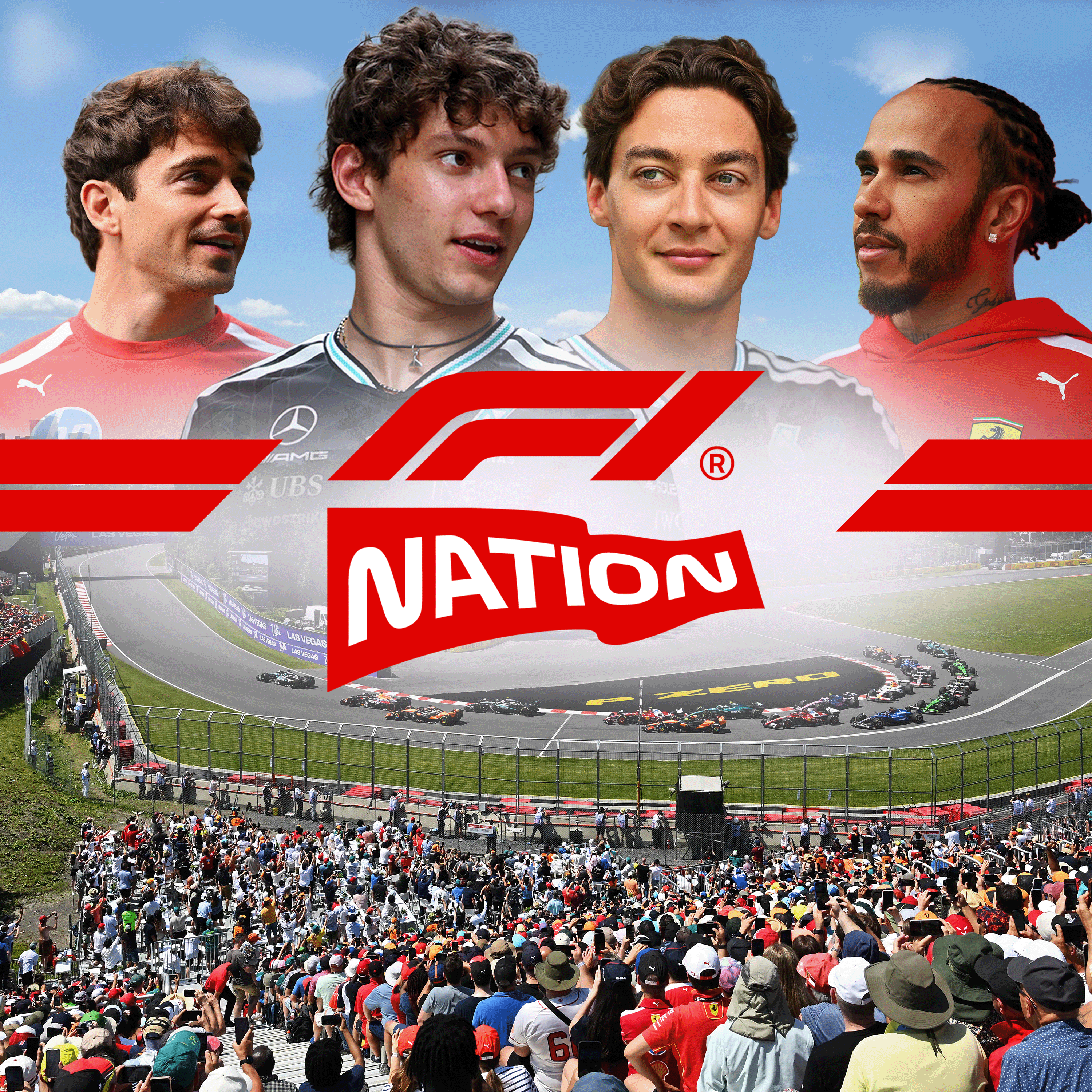
Will Kimi’s momentum continue? Big weekends for George, Lewis + Charles? - Canadian GP Preview with Palmer + Hinchcliffe
About this episode
Montreal is framed as a pivotal Canadian GP swing point for championship momentum—especially for George Russell and Lewis Hamilton—while the hosts weigh whether Kimi Antonelli’s breakthrough can keep building. The discussion zooms in on Circuit Gilles Villeneuve’s chicane-heavy, curb-riding demands, where late braking and longitudinal grip matter, and where small mistakes in the final chicane can cost tenths. Upgrades, rubber buildup, and sprint/race predictions all feed into the big question: can the momentum last?
Tom Clarkson, Jolyon Palmer and James Hinchcliffe are back to preview this weekend’s Canadian Grand Prix.
After three wins on the bounce, Kimi Antonelli leads George Russell by 20 points at the top of the World Championship standings, so how crucial is it for George to beat Kimi in Montreal? If he doesn’t and more teams get in the mix, will Mercedes have some tough decisions to make?
For Ferrari, is Canada a defining moment in Lewis Hamilton’s season? Will Charles Leclerc be thinking about his future if they’re unable to fight at the front in this next run of races?
Plus, the guys debate the topic of driver insecurities and share their personal experiences after Jenson Button discussed the topic on the latest F1 Beyond The Grid podcast.
Listen to more Official F1 Podcasts
Drivers tell their stories on F1 Beyond The Grid - click here for latest episodes
Experts answer your questions on F1 Explains - right here on this podcast feed
LAS VEGAS. FORMULA 1. LIKE NOTHING BEFORE.
The Las Vegas Grand Prix returns November 19th – 21st, 2026.
Get your tickets for the fastest weekend of the year at f1lasvegasgp.com/tickets.
complex circuit
"It looks like it should be simple. It's not. It's a really complex circuit to drive. And if you get it right, you feel like a bit of a legend there."
Some race tracks are just easier to drive than others. A “complex circuit” means the track has many different kinds of turns and braking spots, so you have to get both your driving and the car setup just right.
In Formula 1, a “complex circuit” usually means a track with lots of different corner types, braking zones, and setup demands. That complexity makes driving technique and car balance harder to get right, so small mistakes can cost a lot of time.
Miami
"Montreal is a track that we know George does run well at. It's not an excuse like we had at Miami."
They’re talking about a previous race weekend in Miami as a contrast point. It’s basically used to explain how confident they are about what might happen next.
Miami is referenced here as a recent race where the hosts felt things didn’t go as expected. In F1 coverage, comparing weekends like this helps frame whether a driver’s performance is improving or slipping.
Canadian Grand Prix
"From Miami to Montreal, it's race week. Once again, welcome everyone to F1 nation's preview of the Canadian Grand Prix."
This episode is previewing the Canadian Grand Prix, the Formula 1 race in Montreal. Track conditions and layout can make some cars and driving styles do better than others.
The Canadian Grand Prix is the F1 race at Circuit Gilles Villeneuve in Montreal. It’s a key weekend because track characteristics can strongly influence which teams and drivers look competitive.
chicanes
"It's really characterful, I think. I would say it's pretty much all chicanes. So every corner, apart from the hairpin, the really slow speed towards the end of the lap is a sequence of corners."
A chicane is a set of corners that zig-zag to slow the car down. Instead of going fast in one direction, you have to turn, unwind, and turn again quickly.
Chicanes are a sequence of alternating corners designed to slow cars down and break up straight-line speed. On a track like the Circuit Gilles Villeneuve, they force drivers to manage braking, steering changes, and traction repeatedly in a short space.
hairpin
"It's pretty much all chicanes. So every corner, apart from the hairpin, the really slow speed towards the end of the lap is a sequence of corners."
A hairpin is a super tight turn that you take slowly compared to most corners. It usually requires strong braking and careful acceleration out.
A hairpin is a very tight, slow corner—typically a near-180-degree turn—that demands heavy braking and precise throttle control. It stands out from faster corner sequences because it tests how well the car can rotate and then accelerate out without losing traction.
turn one
"It's even turn one, you go left and immediately you carry into walls turn two. It's all about curb riding."
Turn one is the first big corner of the lap. Because it comes right before the next tricky corner, drivers have to be careful not to get the car out of shape too early.
“Turn one” is the first corner drivers encounter after the start/finish or grid exit, and it often sets up the entire lap’s rhythm. When it’s immediately followed by a demanding next corner, drivers must balance early speed with car control to avoid carrying too much momentum into the following impact zone.
curb riding
"It's all about curb riding. It's all about getting the right balance, having the right attitude of steering and momentum and everything else as you bounce over the curbs and get right up to the walls."
Curb riding means driving as close as possible to the raised edge of the track. Drivers do it to stay fast through corners, but it can make the car bounce and feel unstable.
Curb riding is the technique of using the track’s curbs aggressively while cornering to help maintain speed and tighten the racing line. It’s demanding because the car can bounce, lose grip, or upset its balance if the suspension and tires aren’t set up to handle the impacts.
steering and momentum
"It's all about getting the right balance, having the right attitude of steering and momentum and everything else as you bounce over the curbs and get right up to the walls."
Momentum is basically how the car keeps moving through a corner sequence. Good steering helps the car stay stable so it doesn’t slow down too much or get out of shape.
In circuit driving, “momentum” refers to the car’s speed and rotational stability as it transitions between corners. The driver has to coordinate steering inputs so the car stays composed over bumps/curbs and carries enough speed without over-rotating or losing traction.
late braking
"drivers love being the last of the late breakers, but that could come at the cost of the exits... So it tempts you into just wanting to brake later and brake later, but sometimes eventually that payoff doesn't work out anymore."
Late braking means you wait longer before slowing down for a corner. It can make you faster, but it’s harder on the tires and can hurt your corner exit if you brake too aggressively.
Late braking is the technique of delaying braking as close to the corner as possible. It can improve lap time by keeping the car faster for longer, but it increases the risk of unstable turn-in and poor exit if the tires can’t handle the sudden deceleration.
brake zones
"brake zones, right? And drivers love being the last of the late breakers, but that could come at the cost of the exits."
A brake zone is the part of the track where you slow down for a corner. Drivers try to brake as late as they safely can to keep more speed going into the turn.
In racing, a brake zone is the specific section of track where drivers slow down for a corner. The goal is to brake late enough to carry speed into the turn, but not so late that you miss the corner or lose control on exit.
excluded from the final results
"I'll never forget the 2004 race there when both Toyota and Williams were excluded from the final results, both for brake infringements."
Sometimes after the race, officials can decide a car shouldn’t be counted in the final standings. That can happen if they find a rules issue during checks after the race.
In F1, being “excluded from the final results” means the stewards removed the car’s classification after the race. This often happens after post-race technical or regulatory checks, such as brake-related infringement allegations.
Toyota
"I'll never forget the 2004 race there when both Toyota and Williams were excluded from the final results, both for brake infringements."
Toyota is mentioned as one of the teams involved in an F1 race where the cars were disqualified after the race. The reason given was a brake rules issue.
Toyota is referenced here as an F1 constructor that, in 2004, had cars excluded from the final results due to brake infringements. In F1 context, “Toyota” points to the team/constructor involved in that regulatory decision.
Williams
"I'll never forget the 2004 race there when both Toyota and Williams were excluded from the final results, both for brake infringements."
Williams is mentioned as the other team in that 2004 example where cars were removed from the final standings. The stated reason was a brake rules problem.
Williams is referenced as an F1 constructor whose car(s) were excluded from the final results in 2004 due to brake infringements. This highlights how strict F1 is about brake compliance and how it can affect race classification.
brake stabs
"It definitely is. You could just load of these just stabs on the brakes and you don't pick up huge speed until basically you come back round to the final chicane or into the first braking zone as well."
Brake stabs are quick, hard brake applications. They can help you control speed for tricky corners, but they can also wear out the brakes and make the car less stable.
“Brake stabs” are short, sharp applications of the brakes rather than a smooth, continuous squeeze. On tracks with frequent braking demands, these can help drivers manage speed and positioning, but they also stress the braking system and can affect tire grip.
brake trace
"A lot of it is you're building up reasonable speed and then slamming on the brakes with a bit of a sort of spiky brake trace, 90 degree corners, and then you get out to the next one."
Brake trace is basically how you press the brake pedal as you slow down. If it’s “spiky,” it means you’re braking in a more jerky/aggressive way, which can be tougher on the brakes and harder to drive smoothly.
A brake trace is the pattern of braking inputs over time—how the driver applies and releases the brake through a braking zone. A “spiky” brake trace suggests repeated, aggressive modulation, which can increase brake wear and make the car harder to balance into the next corner.
brake calling
"It's tricky. And you're always, I don't know if the brake calling is always at a bit of a premium there."
Brake calling is choosing the right moment to start braking for the corner. If it’s “at a premium,” it means you have to be very precise—braking too early or too late hurts your lap time.
“Brake calling” refers to the driver’s decision-making about when to start braking and how hard to brake for the next corner. When it’s “at a premium,” it means small timing errors can cost a lot of time because the track demands precise braking points.
efficient on the brakes
"I think being efficient on the brakes is certainly a strength here. I think George is one of the drivers that is good at being a late breaker."
Being “efficient on the brakes” means braking in a way that doesn’t cost you time. The goal is to slow down smoothly and then start accelerating again quickly.
“Efficient on the brakes” in F1 means using braking force in a way that slows the car with minimal wasted time and minimal disruption to the car’s balance. Drivers aim to keep the tires working effectively so they can transition from braking to acceleration without losing too much speed.
late breaker
"George is one of the drivers that is good at being a late breaker. Lewis was always very good here."
A “late breaker” is a driver who waits longer before braking into a corner. That can keep the car faster for longer, as long as they slow down safely and still exit the corner well.
A “late breaker” is a driver who brakes later than most competitors, closer to the corner entry. The idea is to maximize speed before braking, then use traction and car balance to slow down efficiently without losing too much exit speed.
longitudinal grip
"it is that balance because you still have to get off the corners, right? It's all about longitudinal grip here."
Longitudinal grip is how well the tires can grip when you’re braking or accelerating. If a track doesn’t have many high-speed turns, this matters even more than grip for turning.
Longitudinal grip is the tire’s ability to generate traction in the forward/backward direction—during braking and acceleration. On tracks with fewer high-speed corners, performance often depends more on how well the car can slow down and then get back onto the throttle than on cornering grip alone.
lateral setup
"There's really no high-speed corners at all. It's not about the lateral setup."
“Lateral setup” is how the car is tuned for turning forces—basically how it behaves when you’re pulling left or right through corners. They’re saying this track doesn’t rely on that as much as braking and acceleration.
“Lateral setup” refers to how an F1 car is adjusted to perform well when cornering side-to-side (turn-in, holding a line, and resisting lateral forces). The hosts argue this circuit is less about that and more about braking/acceleration traction.
ride the curbs
"and then how you ride the curbs. Being able to judge how much curve to take at a few of these places is so, so difficult."
“Ride the curbs” means using the track’s edge bumps/kerbs to help you go faster through corners. But you have to do it carefully because too much curb can throw the car off balance.
“Ride the curbs” means using the kerbs at the edge of the track as part of the racing line, often to help rotate the car and maintain speed through a corner. It requires finesse because hitting too much curb can upset the car, damage the setup, or trigger loss of traction.
buckle up
"So you buckle up as you're heading up to that final chicane. So you've got a such a long run."
They’re basically saying “get ready,” because this part of the track is intense and unforgiving. If you brake or turn wrong, there’s not much room before you hit the wall.
“Buckle up” here is a dramatic cue tied to a high-risk braking zone near the wall at the exit of the final corner. It underscores that the driver’s approach into that chicane/combination is constrained by how close the car runs to barriers.
releasing the brakes
"But then the trick, I think, generally is, okay, you can't brake early, but releasing the brakes is where you're going to gain the speed through the minimum."
This is about the moment you stop braking and start accelerating again. Doing it at the right time helps the car keep traction and carry more speed through the slowest part of the corner.
In F1, the transition from braking to acceleration is crucial: releasing the brakes at the right moment helps the car rotate and regain traction. The hosts emphasize that the speed gain comes not just from braking, but from how and when you release the brakes to carry momentum through the minimum-speed point.
minimum
"releasing the brakes is where you're going to gain the speed through the minimum."
“The minimum” means the slowest point of the corner. The better you manage braking and steering, the less time you lose at that slowest speed.
Here, “the minimum” refers to the lowest-speed point in the braking/turning phase of a corner. Drivers try to manage braking release and traction so the car spends as little time as possible at that slowest moment, improving overall lap time.
runoff
"So, early on in practice, you get a chance to build up on the brakes there because you've got a bit of runoff."
Runoff is the extra space next to the track if you go off the racing line. It can make drivers more confident to push braking in practice because there’s room to recover.
Runoff is the area beside the track designed to reduce the consequences of going off-line, giving drivers space to slow down if they miss a braking point. The hosts mention runoff because it affects how aggressively drivers can practice braking and how late they can brake safely.
qualifying
"When you get to qualifying and you're trying to be a hero, last, last throws of qualifying..."
Qualifying is the session where drivers try to set the fastest lap to determine their starting position for the race. It’s more about one-lap speed than experimenting.
Qualifying is when F1 cars run timed laps to set the grid positions for the race. The hosts contrast practice versus qualifying, noting that in qualifying drivers manage braking and risk differently because they’re chasing the best single lap time.
track rubbers up
"apexes. To do that, you need a bit more grip. The track rubbers up."
“Rubbers up” means the track gets more grippy as cars drive over it. Tires leave rubber behind, and that usually makes the racing line faster over time.
“Track rubbers up” describes how rubber laid down by cars increases grip as sessions progress. As more tires transfer rubber to the racing line, the surface becomes more consistent and faster, especially in dry conditions.
apex speed
"Let's go for it. Let's attack with another couple of KPH apex speed. And you know at that point, you're going to risk just running out of space on the exit."
Apex speed is your speed at the tightest part of a corner. Going faster there can help you carry momentum, but it can also make it easier to lose control or run out of room on the exit.
Apex speed is how fast a car is going at the apex of a corner (the point closest to the inside). In lap-time terms, higher apex speed usually means better momentum through the turn and onto the exit, but it can increase the risk of running wide or losing traction.
Montreal lap strategy: final corner and chicane
"But that's basically what you do in Montreal... you're just going to lose a couple of tenths in the final chicane... you have to nail it twice for one good lap, because it is the final corner."
They’re describing how you have to drive Montreal to make a fast lap. The key is getting the last corner right and then carrying that speed into the final chicane.
This part breaks down the Montreal lap-time challenge, especially the final corner and how it feeds into the last chicane. The discussion emphasizes attacking the right line, managing exit space, and repeating the “nail it twice” idea for a clean lap.
final chicane
"if you're cautious there, you're just going to lose a couple of tenths in the final chicane."
A chicane is a sequence of tight turns designed to slow cars down and change direction quickly. The “final chicane” is the last such complex before the finish, so getting it right is crucial for overall lap time and momentum into the straight.
tenths
"if you're cautious there, you're just going to lose a couple of tenths in the final chicane."
In racing timing, “tenths” refers to one-tenth of a second (0.1s). Drivers and teams talk in tenths because small differences in braking points, cornering speed, and traction can add up to meaningful lap-time gaps.
track grip conditions
"What are track grip conditions like? And this year, we've got F2, of course."
Track grip conditions are basically how “sticky” the road feels for the tires. More grip means you can brake later and corner faster; less grip means you have to be gentler.
Track grip conditions describe how much traction the tires can generate on the surface. Grip is influenced by factors like rubber buildup, temperature, weather, and whether the racing line has been cleaned or contaminated.
Canadian GP track grip and rubber buildup
"What are track grip conditions like? And this year, we've got F2, of course... I'd expect it'll be actually quite nice for the F1 drivers to have an F2 session on before..."
They’re talking about how grippy the track should be this weekend in Montreal. They explain how earlier sessions and weather can change tire grip for later F1 running.
This segment focuses on how grip levels are expected to change at the Canadian GP, including the effects of weather and prior racing sessions. It also connects support-series running to how quickly the racing line gets rubbered in.
Pirelli rubber
"start to clear it up. Because"
“Pirelli rubber” means the tire material left on the track by Pirelli tires. As more tires run, they leave rubber behind that can make the racing line grippier.
“Pirelli rubber” refers to tire compound material left on track by Pirelli tires. In F1, the tire supplier’s compounds and the way they wear affect how quickly grip builds and how clean the racing line becomes for later sessions.
intra-team battle
"Let's talk about this championship fight now, the intra-team battle between the leader, Kimmy Antonelli and George Russell, who's in P2."
That means two drivers on the same team are racing each other for the best results. Since they’re in the same team’s car, it’s a pretty direct test of who’s doing better right now.
An intra-team battle is when two drivers from the same Formula 1 team fight for position and points against each other. Because teammates share the same car platform and strategy resources, it often becomes a direct comparison of driver performance and setup preferences.
P2
"Kimmy Antonelli and George Russell, who's in P2. Now, Hinch, you said in our Miami review that it's not panic mode yet for George..."
P2 just means second place. In this context, it’s where George Russell sits in the championship picture.
In Formula 1, P2 means second place in the standings or in a session, depending on context. Here it’s used to describe George Russell’s position in the championship fight.
suspension
"We saw it last year with their suspension that they brought that sort of knocked Kimmy a little bit down and didn't affect George quite as much, but if we get to Montreal..."
Suspension is what helps the car handle bumps and keep the tires planted. If the team changes it, the car can feel different—sometimes one driver adapts better than the other.
Suspension is the system of springs, dampers, and linkages that controls how the car moves over bumps and how tires stay in contact with the track. In F1, suspension changes can strongly affect grip, tire wear, and balance, which is why an upgrade might “knock” one driver down more than the other.
Grand Prix weekend
"Miami was by far, I think, his most complete Grand Prix weekend and he's just going to keep getting better."
A Grand Prix weekend is the whole event from the first practice sessions through qualifying and then the race. Doing well across the weekend usually means you’re strong in both speed and race execution.
In Formula One, a “Grand Prix weekend” is the full event schedule leading up to the race, including practice sessions, qualifying, and the race itself. Performance across the whole weekend matters because qualifying position and race pace both influence the final result.
starting grid
"He does go well at this circuit. On top of that, Mercedes are really good around Montreal."
The starting grid is the order cars line up in before the race. Where you start matters because passing other cars can be tough, so starting near the front is often an advantage.
The starting grid is the lineup of cars for the race, determined primarily by qualifying results. In F1, the grid position can strongly affect race outcomes because overtaking is difficult on many circuits.
championship lead
"One of George's strongest circuits on record and the championship lead will go over 25 points."
The championship lead is who’s currently winning the overall season points race. Since points are earned at every Grand Prix, the lead can change after one weekend.
The championship lead is the driver who currently has the most points in the F1 Drivers’ Championship standings. Because points are awarded race-by-race, a single weekend can swing the lead by a meaningful margin.
podium
"I mean, the gap to George, I think, was 0.4 in qualifying and then, of course, he finishes third and gets his first podium in Formula One."
A podium finish means you end up in the top three—first, second, or third. It’s a big deal in F1 because you earn lots of points and show the car and driver performed well.
A podium in Formula One means finishing in the top three positions (1st, 2nd, or 3rd). It’s a major performance milestone because it brings maximum points compared with lower finishes and reflects strong race pace and strategy.
upgrade
"Worst-case scenario for George Russell now is that McLaren are bringing the second part of the upgrade that they started in Miami last time out."
In F1, an upgrade means the team adds new parts or changes to make the car faster. Here they’re saying McLaren is bringing another step of those improvements.
In F1, an upgrade is a planned set of technical changes to the car—often aerodynamic parts, cooling, or other performance components—introduced over multiple races. The “second part” phrasing suggests the team is rolling out improvements in stages rather than all at once.
Mercedes
"Antonelli beats George, and Mercedes suddenly realize that they've got a serious fight on their hands with McLaren."
Mercedes is the F1 team being discussed. The idea is that if their driver gets beaten, the team will realize McLaren is a real threat and they need to respond.
Mercedes is an F1 constructor/team that designs and fields cars and manages its own performance development. The segment frames Mercedes as reacting to results—if Antonelli beats Russell, Mercedes would recognize it has a serious competitive fight with McLaren.
data set
"And when you and I had this conversation, I said George Russell. And that was pre-Miami to be fair. But I think I'd still, if you had to put everything on one guy today, I still look at the data set, the data sample size that we have of Russell's performances."
A data set is the collection of performance results being considered when making a prediction. Here, the hosts argue that George Russell’s larger data set (more observed performances) makes him the safer bet compared with Kimi Antonelli’s smaller sample.
over the year
"I would go George because I just think history has shown us that he is able to be consistent over the year."
“Over the year” here means how someone performs across the whole season. It’s about getting good results regularly, not only occasionally.
In motorsport analysis, “over the year” usually means sustained performance across the full season, not just a single race weekend. It’s about minimizing bad results and maximizing points consistency.
doing it over a season
"But in terms of actually doing it over a season, not having a blooper race, not having an Oscar Baku race where he just had a terrible half lap and the whole thing was blown."
They mean proving you can stay competitive for many races, not just one weekend. In F1, one big mistake can hurt your points a lot, so steady results matter.
“Doing it over a season” refers to maintaining competitive results across many races, accounting for variability like traffic, tire wear, strategy calls, and driver errors. In F1, a single catastrophic mistake can swing the championship, so consistency is crucial.
bloopers race
"But in terms of actually doing it over a season, not having a blooper race, not having an Oscar Baku race where he just had a terrible half lap and the whole thing was blown."
They’re using “bloopers race” to mean a race where the driver messes up or something goes seriously wrong. In F1, those bad races can cost a lot of points.
A “bloopers race” is a slang way to describe a race where something goes badly wrong—often due to a driver mistake, poor execution, or an avoidable incident. The point here is that such races can derail a season’s momentum.
diminishing returns
"And I think George is now at the point where it's diminishing returns and so therefore the steps get smaller."
They mean that as a driver gets more experience, the improvements don’t keep growing at the same rate. Early on you learn a lot quickly, but later the gains can get smaller.
“Diminishing returns” means the improvement you get from experience starts to shrink over time. In driver development, early progress can be large, but later gains become harder, so the gap between two drivers may stop widening.
Toto Wolf
"I think he's protected by Toto Wolf brilliantly... Toto Wolf, even post-Miami, is still saying we have to protect him."
Toto Wolf is the team principal of Mercedes-AMG Petronas Formula One Team. In F1, a team principal manages strategy, resources, and driver messaging—so his “protect him” comments reflect how teams manage pressure on drivers.
protect him
"We've got to make sure he stays grounded... the good days don't big him up too much, that the bad days don't get him down too much."
“Protect him” here means the team tries not to overwhelm a young driver with too much pressure. They want him to stay confident after good races and not get crushed after bad ones.
In F1 driver management, “protect him” refers to shielding a less-experienced driver from excessive pressure and expectation. Teams try to keep a driver’s confidence stable by controlling messaging after both strong and poor results.

Subaru Uncharted
"...be a very real threat for the whole year. This is uncharted waters though, isn't it, for Kimi? I think that's..."
“Subaru Uncharted” doesn’t clearly match a standard car model name you’d find in normal catalogs. In the podcast, it’s likely being used as a label for a specific Subaru-related car or situation that feels new and unfamiliar. The “uncharted” wording suggests it’s not something the driver has dealt with before.
The “Subaru Uncharted” isn’t a specific, widely documented production car model; it sounds like a named entry or concept tied to a Subaru-related context in the podcast. It’s being discussed as something new or unfamiliar—“uncharted waters”—which is why it comes up in a conversation about facing an unusual situation for a driver. If the episode is referencing a particular car build or event name, that’s likely what the term points to.
title-winning season
"And I think with George, the season that he ran last year was a title-winning season if he had the right car."
A title-winning season means a driver is performing at a level that can realistically secure the championship over many races, not just win a few events. In F1, that depends on consistent results, the car’s competitiveness, and how well the team manages upgrades and strategy across the calendar.
low-grip tracks
"George potentially still has in his locker. At the same time as Oscar started to struggle, maybe it was a run of low-grip tracks."
A low-grip track is one where the tires don’t grip the road as well. That makes the car harder to drive consistently, so drivers and teams have to adjust how they brake and accelerate.
Low-grip tracks are circuits where the tires lose traction more easily due to factors like surface texture, weather, or track evolution. That changes car behavior—drivers often need different braking points, throttle application, and setup choices to stay consistent over a race weekend.
swap at Monza
"Well, I'll then say then Monza happened. I think the ramifications of the swap at Monza really affected Oscar Piastri."
A “swap” here means something changed at Monza—like who got the better position or result. The hosts think that moment hurt Oscar Piastri’s momentum afterward.
A “swap” at Monza refers to a change in who is leading or who gets the better outcome—often tied to race strategy, on-track position, or team orders. The hosts say the ramifications of that swap affected Oscar Piastri, implying it influenced his momentum and results.
summer break
"Otherwise, Mercedes might have to start making some difficult decisions come the summer break."
The summer break is the break in the middle of the F1 season. Teams use it to regroup and make decisions before the final part of the year.
The summer break is the mid-season pause in the F1 calendar when teams regroup before the second half of the year. It’s often when teams make bigger operational decisions—like driver evaluations, upgrade priorities, and staffing changes—because they can reset and plan for the next stretch.
give the place back
"We saw with Valtteri and Lewis, the famous, give the place back."
“Give the place back” means a driver gives up a position they gained, so the race result matches the rules. The hosts are referencing a past Mercedes situation involving Valtteri and Lewis.
“Give the place back” refers to a driver returning a position after a rules/strategy issue—commonly when a team believes the earlier gain wasn’t fully compliant or was achieved under a penalty-related situation. In F1, it’s a way to correct race outcomes to align with sporting regulations.
Monaco being the one you're going to bounce back
"So you don't want to rely on Monaco being the one you're going to bounce back, because you might just be kicking the can down the road."
They’re basically saying Monaco might not be the easy race people hope for. It’s a tough track where mistakes and small differences matter a lot.
The hosts are talking about Monaco as a potential “bounce-back” race—meaning a weekend where a team expects to recover from recent poor results. In Formula 1, Monaco is uniquely difficult because it’s a slow, tight street circuit where small setup and driving differences can decide everything.
incident
"Only a handful of laps left to go in the race when Lando Norris tried to sneak up the left-hand side of Oscar between him and the Will. And, of course, it hits his teammate, race over Lando to his credit, apologised immediately."
In racing, an “incident” usually means something went wrong on track—like cars touching. They’re asking whether that kind of moment makes drivers think differently next time.
In F1, an “incident” is a racing event like contact between cars, often with consequences for positions and points. The hosts discuss how a teammate-to-teammate collision can affect driver psychology and decision-making in later races.
bank it
"I think you bank it, though, as a driver. If you're Oscar, you bank it."
“Bank it” means to take what happened and learn from it. The host’s point is that drivers use it as experience for next time.
“Bank it” here means to mentally store the lesson from an incident and move forward with it. The idea is that drivers treat difficult moments as experience to apply later, rather than letting them linger emotionally.
wheel to wheel
"But now I know how you're going to race, and I don't love it. So next time we go wheel to wheel, I'm going to be that little bit more aggressive."
“Wheel to wheel” means two cars are right next to each other while racing. It usually happens during overtakes and it’s tense because there’s very little room for error.
“Wheel to wheel” describes two cars running side-by-side at the same time, typically during overtaking or defending. It’s a common F1 phrase for close, high-risk racing where drivers must judge space and timing precisely.
steering rack
"Hinch, after what you saw in Miami with the Red Bull upgrade, of course, Max now much happier with the steering rack and the feeling he's getting through the wheel."
It’s the part that turns your steering wheel inputs into the front wheels moving. If it’s adjusted or upgraded, the car can feel more precise and easier to drive fast.
The steering rack is the mechanism that converts the driver’s steering-wheel rotation into left/right movement at the front wheels. Its setup affects how quickly the car responds and how much “feel” the driver gets through the wheel, which can change confidence and lap times.
low-grip circuit
"But I think, again, it's another kind of low-grip circuit like we had in Miami. We know he is comfortable on the absolute limit."
Low-grip means the tires don’t grip the track as well as usual. When that happens, the car has to be set up to stay stable, and driving “on the limit” becomes harder.
A low-grip circuit is one where the tires generate less traction due to surface, temperature, or track characteristics. That forces teams to tune the car for stability and predictable handling because pushing too hard can quickly lead to wheelspin or loss of control.
absolute limit
"We know he is comfortable on the absolute limit. So if the car continues to improve and they can continue to dial in performance, now they've got it handling in a way that is speaking to him, yeah, there's no reason why he can't be in the mix."
It means the car is being driven as hard as it can go while still staying under control. Beyond that point, grip disappears and the car starts to misbehave.
“Absolute limit” refers to the maximum performance boundary where the car is still controllable—right before traction is fully exhausted and the driver can’t correct the car. On low-grip tracks, that limit can be reached sooner, so setup and driver confidence become crucial.
24-hour race
"Hinch, you've done some endurance racing, right? Now, Max was doing the Nurburgring 24 hours last weekend. How long does it take you to get over a 24-hour race?"
A 24-hour race is endurance racing where the car has to keep going for a whole day, with drivers taking turns. It’s physically and mentally demanding, so the hosts are wondering if it affects an F1 driver’s sharpness.
A 24-hour race is endurance racing where cars run continuously (with driver stints) for an entire day, emphasizing consistency, tire/fuel management, and mechanical sympathy. The question here is whether the physical and mental demands of that format carry over to an F1 weekend.
sim races
"I mean, he's been doing 24-hour sim races during Grand Prix weekends in the past. He'll be just fine."
Sim races are races you do in a computer racing setup. Drivers use them to practice and stay sharp when they can’t be on track.
“Sim races” are competitive races run in a racing simulator environment, typically used to practice lines, braking points, and car setup changes. In modern motorsport, they help drivers stay sharp during the week and adapt to circuits quickly.
Canadian GP Preview with Palmer + Hinchcliffe
"Now, look, guys, what about Ferrari, right? So this is a Hamilton track... It feels in the same way that it's a big weekend for George Russell..."
This part is a preview of the Canadian Grand Prix. They’re talking about which drivers look strongest and what to watch for this weekend.
This segment previews the Canadian Grand Prix and focuses on how recent form and qualifying performance could shape the weekend for top drivers. It compares Lewis Hamilton’s Canada record with the current gaps between teammates and rivals.
outqualified
"He has only been outqualified by a teammate three times out of 16 attempts. So it's a pretty good track record. Outqualified Charles last year..."
“Outqualified” means one driver got a faster qualifying lap than another. That usually means they’ll start the race ahead, which can be a big advantage.
“Outqualified” means one driver beats another in qualifying—typically by setting a faster lap time and earning the better starting position for the race. In F1, qualifying performance is a major indicator of car competitiveness and driver form.
Q3
"Outqualified Charles last year, although I think Charles had a kind of a better pace and missed it right at the end of Q3."
Q3 is the final qualifying session in an F1 weekend. The fastest cars and drivers fight for the top grid positions there, so missing out on Q3 (or making a mistake in it) can directly affect race strategy and results.
new rules
"After those early few races, very upbeat Lewis loves the new rules, input in the cars good."
When they say “new rules,” they mean the sport changed the guidelines for how the cars can be built and run. That can make teams’ cars behave differently, so performance can swing while everyone adapts.
In Formula 1, “new rules” usually refers to a regulation update that changes how cars are designed and how they’re allowed to operate. When rules change, teams often need time to find the right setup and performance direction, so early-season results can look uneven.
poles
"Canada's circuit, he's always been really strong at seven wins, six polls."
A “pole” means the driver qualified fastest and starts the race from the very front. Starting first can make the race easier because you’re in control early.
A “pole” (pole position) is awarded to the driver who qualifies fastest and starts the race from the front of the grid. It’s a key stat because starting first often improves control of the race, especially on tracks where passing is difficult.
pecking order
"this coming weekend is the moment where we're going to see sort of the pecking order as I think it probably will stay for the rest of the year..."
“Pecking order” just means who’s currently on top versus who’s behind. They’re saying this weekend may confirm the team rankings going forward.
“Pecking order” is the informal way to describe the current ranking of teams by performance—who is fastest, who is next, and so on. In this context, the hosts expect the Canadian GP to clarify that hierarchy for the rest of the season.
Ferrari
"Mercedes are bringing their upgrades. Ferrari are hopefully going to understand the upgrades they brought to Miami a little better."
Ferrari is one of the famous F1 teams. They’re talking about Ferrari learning from upgrades they tried at Miami and whether that will translate into better results in Canada.
Ferrari is a historic F1 constructor brand known for frequent technical development and strong driver talent. The hosts tie Ferrari’s performance to how well it understands and applies upgrades introduced at Miami, suggesting a potential performance step at Montreal.
McLaren
"We're going to see McLaren bring the second half of their upgrades."
McLaren is another F1 team. They’re saying McLaren has more new parts coming—basically the next step in its upgrade plan.
McLaren is an F1 constructor brand that develops its own chassis and race strategy and brings performance upgrades across the season. The hosts say McLaren will bring the “second half” of its upgrades, implying a staged development plan that could improve results later in the year.
Red Bull
"Red Bull are going to bring a bit more."
Red Bull is an F1 team. The hosts are saying they’ll have additional updates on the car this weekend to try to stay near the front.
Red Bull is an F1 constructor brand associated with rapid car development and frequent technical updates. The hosts mention Red Bull bringing “a bit more,” suggesting further performance gains are expected at the Canadian GP.
Aston Martin
"Have Aston Martin made him a bid for him? Have Red Bull Racing made a bid for him? You just wonder with the driver's silly season starting to kick into gear..."
Aston Martin is one of the Formula One teams. They can offer a driver a seat and a car to race for the season.
Aston Martin is a Formula One constructor/team that can sign drivers and build the car they race. In this segment, it’s mentioned as a potential employer if Charles Leclerc’s current situation at Ferrari changes.
driver's silly season
"Have Aston Martin made him a bid for him? Have Red Bull Racing made a bid for him? You just wonder with the driver's silly season starting to kick into gear..."
In F1, “silly season” is when driver contracts and team changes are being talked about a lot. It’s mostly rumors and negotiations before anything is official.
“Driver’s silly season” is the informal term for the period when Formula One teams and drivers negotiate contracts and announce moves. It’s called “silly” because rumors and speculation often run ahead of official confirmations.
big-aero platform difference
"So typically in a season, you get this sort of Miami weekend, Montreal weekend, this sort of used to be Spain, didn't it, where you bring this sort of first major upgrade package, and then you'll see something around ... Austria-Silverston could be Spa now weekend mid-summer for a conventional big-aero platform difference..."
“Aero” is short for aerodynamics—how the car cuts through air. A “big aero” change usually means major updates that can make the car stick better to the track and feel different to drive.
A “big-aero platform difference” means a major aerodynamic redesign—changing how the car generates downforce and manages airflow. In F1, aerodynamics are a primary performance lever, so a large aero change can noticeably affect lap times and balance.
new floor
"...mid-summer for a conventional big-aero platform difference and a new floor, and new aero surfaces that'll spruce the car for a few tents."
The “floor” is the bottom of the car. In F1 it’s designed to push the car down onto the track using airflow, so a new one can improve grip and handling.
In F1, the “floor” is the underside panel that shapes airflow under the car to help generate downforce. A “new floor” is a significant aerodynamic update because it can change the car’s efficiency and stability at speed.
aero surfaces
"...and new floor, and new aero surfaces that'll spruce the car for a few tents, and then it'll be little bits and bobs of tweaking through the rest of the year."
Aero surfaces are the parts of the car that are shaped to affect airflow. Updating them can help the car grip the road better and feel more stable.
“Aero surfaces” are the wings, bodywork elements, and other shapes designed to control airflow and generate downforce. Changes to aero surfaces are common mid-season because they can fine-tune balance and performance for different circuits.
tweaking
"...and then it'll be little bits and bobs of tweaking through the rest of the year. So Charles will know if Ferrari are telling him..."
“Tweaking” means making smaller adjustments after the big updates. It’s how teams keep improving the car as they learn from races.
In this context, “tweaking” means smaller, incremental adjustments to the car—often aerodynamic or setup-related—after the first major upgrade package. Teams do this to extract more performance from the new baseline as the season continues.
set a regs
"And I think this is the time you set a regs. If it's not Ferrari, then where can I go to try and mount this?"
“Set a regs” means new rules coming into effect. When the rules change, the cars can become very different, so it can change who’s competitive.
“Set a regs” is shorthand for the moment when a new set of regulations (rules) takes effect. In F1, regulation changes can reset performance trends, so drivers and teams often plan their long-term competitiveness around them.
restructure the team
"You want to know who they're bringing in to restructure the team to take it back towards the championship, because if he doesn't have a lot of faith that Ferrari are going to be champions..."
When people say a team needs to restructure, they mean they’re changing how the team is organized and who does what. In F1, that’s often done to improve how the car is developed and how race strategy is handled.
In F1, “restructure the team” usually means reorganizing personnel and workflows—often including hiring new race engineers, changing how data is used, and adjusting technical leadership. These changes aim to improve development direction and race execution quickly enough to challenge for championships.
power units
"They're doing a good job. Their rock grade package for Miami was great. Their power units really impressive. But you're leaving Ferrari who are capable of race wins this year..."
In F1, the power unit is basically the car’s engine system. It’s not just the engine—it's also the hybrid parts that store and reuse energy to help the car go faster.
In Formula 1, the power unit is the car’s complete hybrid engine system: a turbocharged internal-combustion engine plus energy-recovery components and an electric motor. It’s a major performance limiter because it affects both outright speed and how much energy you can deploy lap after lap.
sprint
"Predictions time. Both of you guys. I want a sprint winner and then the top three for the Grand Prix on Sunday. Who wants to go first? ... I think George will win the sprint. It's a short run from pole."
A sprint is a shorter race during the F1 weekend. It decides where cars start on Sunday, so teams push hard even though it’s not the full Grand Prix.
A sprint is a shorter F1 race held on the weekend (typically before the Grand Prix) that determines grid positions for Sunday. Because it’s brief, teams often optimize for short-run pace and tire/energy management rather than full-race strategy.
starts
"And he's been still a little bit better on the starts than Kimmy... whether Mercedes can get on top of their starts a little bit more as well."
“Starts” means how well the car gets moving right after the lights go out. A good start can help you stay ahead; a bad one can put you behind other cars.
In F1, “starts” refers to how well a car launches off the grid—reaction time, clutch/launch behavior (where applicable), and traction management. Strong starts can help a driver lead the first lap, while poor starts can drop them into traffic.
race craft
"but I think he's shown great race craft so far."
Race craft is how good a driver is at racing smart, not just fast. It’s about knowing when to pass, when to defend, and how to handle tricky moments.
Race craft is a driver’s skill at managing pace, positioning, and decision-making during a race. It includes choosing when to defend, when to attack, and how to handle traffic and changing grip.
drivers' championship
"So while the gap will start to shrink in the drivers' championship, I think Antonelli will come out of this race feeling like he's had a good one"
The drivers' championship is the overall points race between drivers across the season. If the gap shrinks, it means the points difference between them is getting smaller.
The drivers' championship is the season-long points battle between individual drivers. When the transcript mentions the gap shrinking in the drivers' championship, it means the points difference between those drivers is expected to narrow after this race.
title charge
"And then he'll get all the backing from the Mercedes team to go on the title charge for the next 18 races."
A 'title charge' means going all-in to win the championship. Here, it suggests the driver will be fighting for the top points over many races.
A 'title charge' is a phrase for a sustained push to win the championship. In this context, it means the driver is expected to accumulate enough points over the remaining races to seriously contend for the title.
back of the grid
"Canada always brings back memories for me of Jensen Button's sensational victory from the very back of the grid in what turned out to be the longest F1 race in the history of the sport back in 2011"
Starting from the back means you begin near the last cars. That’s tough because it’s harder to pass, so a win from there is especially impressive.
Starting 'from the back of the grid' means the driver begins the race near the last positions. It’s a big deal in F1 because overtaking is difficult, so coming through the field requires pace, strategy, and often favorable race circumstances.
longest F1 race in the history of the sport
"Canada always brings back memories for me of Jensen Button's sensational victory from the very back of the grid in what turned out to be the longest F1 race in the history of the sport back in 2011, more than four hours."
That 2011 Canadian GP lasted unusually long because of race interruptions (like weather). When a race runs long, teams have to adjust strategy and how they manage tires and fuel.
The 2011 Canadian Grand Prix is remembered for being exceptionally long, largely due to weather and race interruptions that extended the total time. In F1, long races can change tire usage, fuel strategy, and how teams manage risk.
mental health
"And that's what amazed me with Lando, you know, the way he's been outspoken over the last couple of years of mental health."
Mental health here means how drivers handle stress and confidence. The hosts are saying it can affect how well someone performs, even if they’re very talented.
In high-level motorsport, 'mental health' refers to psychological well-being and stress management that can affect focus, confidence, and performance. The transcript frames it as something drivers have been reluctant to discuss, but which can be a source of strength.
Request an Explanation
Heard something you'd like explained? We'll add it to this episode.
Sign in to request explanations for terms you heard.
Want to learn more?
Browse our glossary for plain-English explanations of automotive terms, jargon, and concepts.
Help improve this episode
See something that's not quite right? Our annotations are AI-generated and can sometimes miss the mark. Click the flag icon on any annotation to suggest a correction.