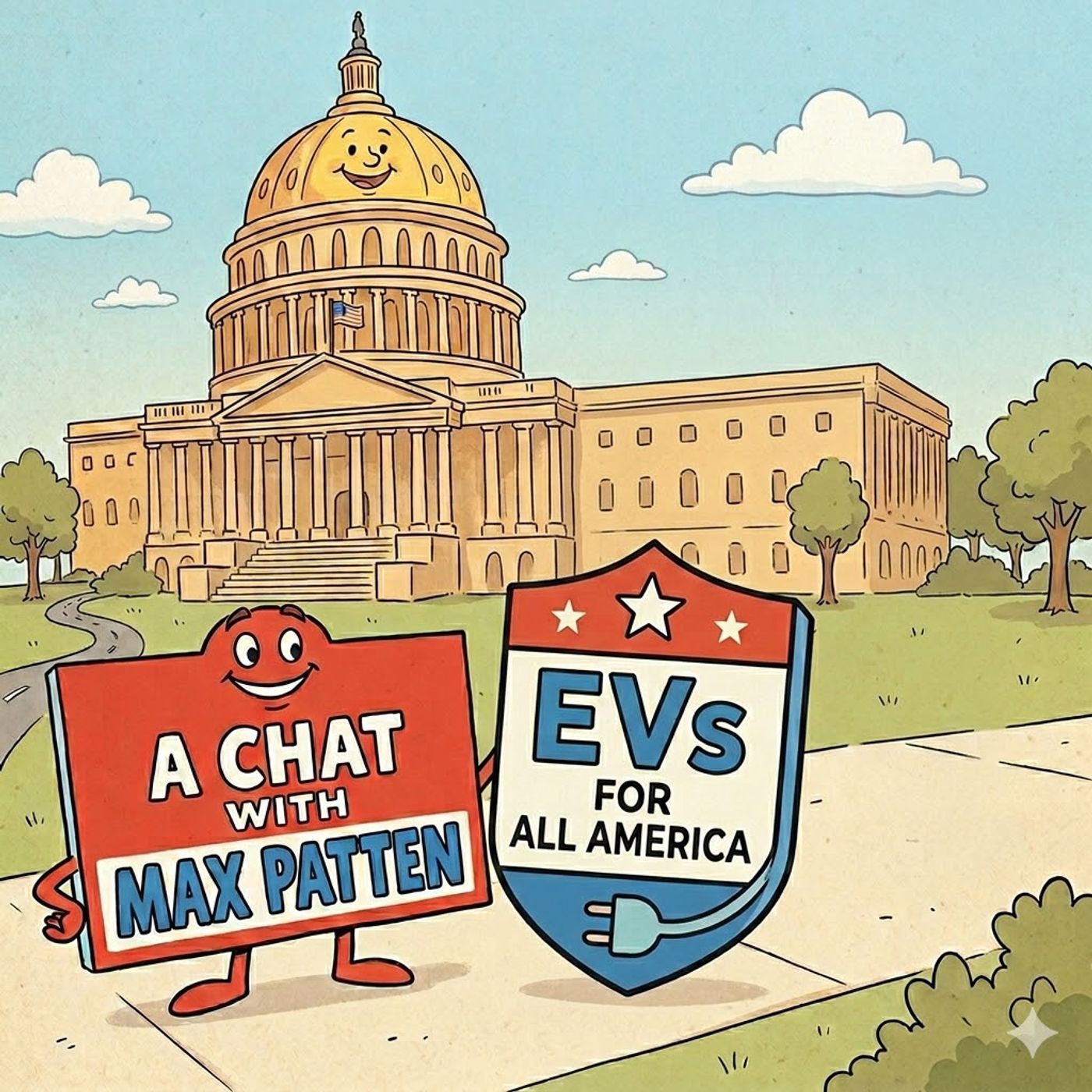
A Chat with Max Patten
About this episode
Max Patten of EVs for All America walks through how electric vehicles have become less politically rigid, even as national debates stay polarized. He shares polling that shows Republican resistance easing, Tesla’s customer base shifting, and younger buyers caring more about price, charging speed, and familiar brands than ideology. The discussion also turns practical: home and apartment charging, permitting delays, and how policy could make installation easier without overcomplicating access.
In this episode of Kilowatt, we sit down with Max Patten from EVs for All America to chat about the political dynamics surrounding electric vehicle adoption in the United States. Max tells us the history of this politicization, examining how early marketing strategies inadvertently created consumer divides that persist today. Max provides unique insights into the shifting perceptions among Republican politicians, particularly as the economic benefits of local EV manufacturing plants begin to hit home. We also discuss recent polling data that suggests growing acceptance across political lines, even as infrastructure challenges remain a key hurdle. Finally, Max emphasizes the critical role of consumer education and facilitated dialogue in driving broader EV ownership and national progress.
Support the Show https://www.supportkilowatt.com/
Other Podcasts:
News Links:
*Show Art Created By Gemini
Hosted by Simplecast, an AdsWizz company. See pcm.adswizz.com for information about our collection and use of personal data for advertising.
EVs for all America
"My name is Bode and I am your host and today [32.5s] I am joined by Max Patton. Max is with a bipartisan organization called EVs for all America. And their goal is to depoliticize how your car is propelled..."
“EVs for all America” is the name of a group that works on electric-vehicle issues. Here, they’re trying to keep the conversation about EVs from becoming just partisan politics.
“EVs for all America” is a named organization involved in shaping public discussion around electric vehicles. In this episode, it’s presented as a bipartisan group focused on how EVs are discussed and adopted.
de-stigmatizing EV adoption
"And yeah, nonprofit sector, our goal is effectively de-stigmatizing EV adoption from a partisan point of view and looking at roadblocks to adoption that exist."
“De-stigmatizing” just means making something feel more normal and less judged. Here, it means helping people feel comfortable buying and using electric cars.
This refers to efforts to reduce negative perceptions and social friction around buying and using electric vehicles (EVs). In practice, it often involves sharing data, addressing misconceptions, and framing EVs as normal consumer choices rather than partisan symbols.
partisan point of view
"And yeah, nonprofit sector, our goal is effectively de-stigmatizing EV adoption from a partisan point of view and looking at roadblocks to adoption that exist."
“Partisan” means tied to political sides. The speaker’s point is that EVs shouldn’t be judged as “for one side” or “against another.”
This phrase describes treating EVs as a political identity rather than a technology and consumer product. The discussion frames EV adoption as something that should be evaluated on practical factors (cost, infrastructure, benefits) instead of party alignment.
roadblocks to adoption
"And we do a lot of polling market insights and research. Again, though, nonprofit sector, our goal is effectively de-stigmatizing EV adoption from a partisan point of view and looking at roadblocks to adoption that exist."
“Roadblocks” are things that make it harder for people to switch to electric cars. They could be rules, charging availability, or just confusion about how EVs work.
“Roadblocks to adoption” are barriers that slow down how quickly people switch to EVs. These can include policy issues, charging access, upfront cost concerns, and misinformation that affects consumer decisions.
power train
"Where did we go wrong that we made how a vehicle is propelled? A political thing, like it drives me crazy. You don't, it doesn't matter how you get your car from one place to another, what powers it."
Your powertrain is what makes the car move. In a gas car it’s the engine and related parts; in an electric car it’s the electric motor and battery system.
A powertrain is the set of components that produce and deliver motion to the wheels—like an engine/motor, transmission, driveshaft, and related systems. In EVs, the “powertrain” typically centers on an electric motor and battery system rather than a gasoline engine.
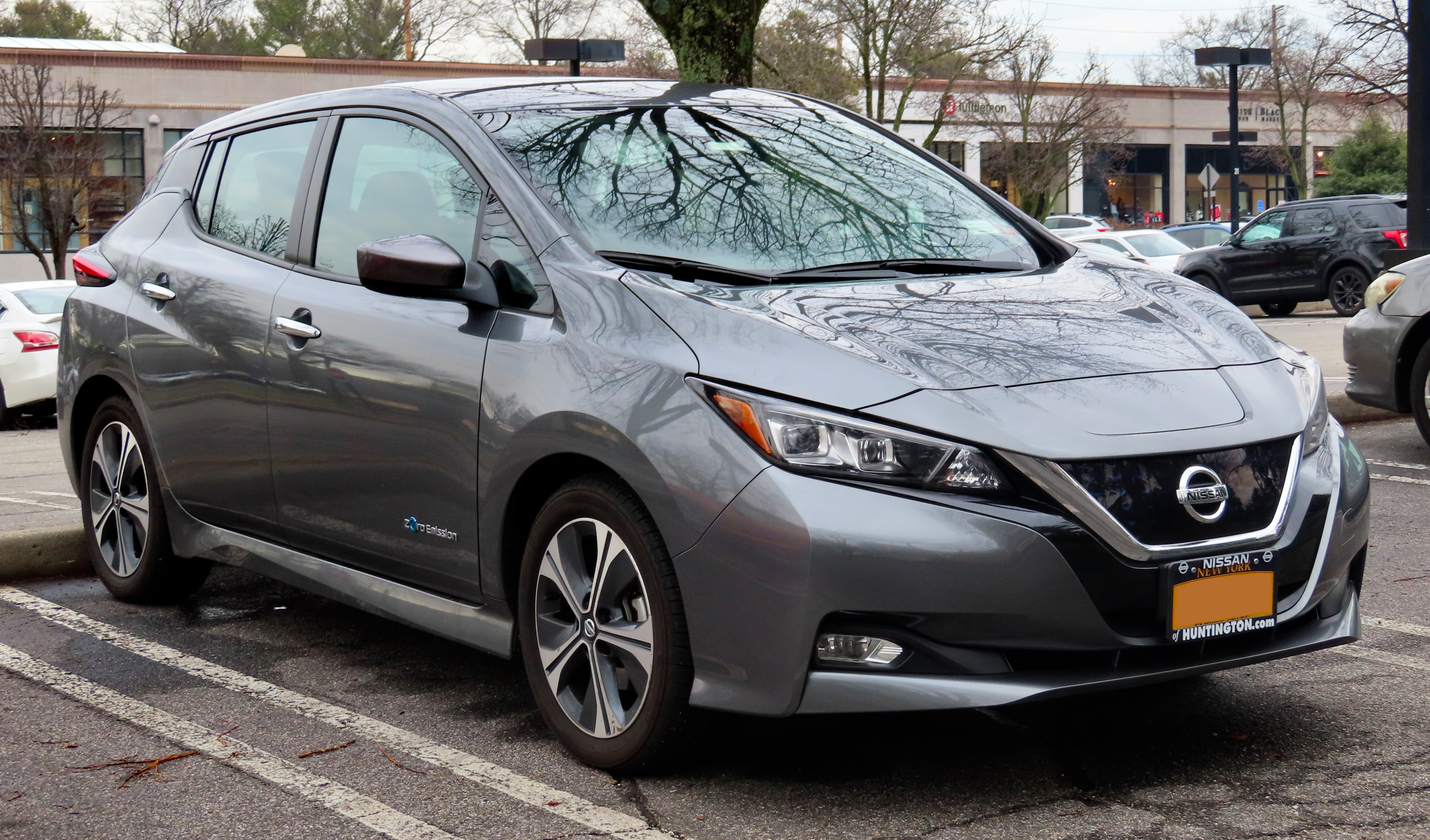
Nissan Leaf
"...round 2010, 2011, I want to say, with the Nissan Leaf in the US market. So not the great Leaf we have t..."
The Nissan Leaf is an all-electric car made by Nissan. In the early 2010s, it was one of the first widely sold EVs in the U.S., so many people learned about electric driving through it. The podcast is likely talking about that early version and what it was like to own.
The Nissan Leaf is a fully electric compact car that became one of the early mainstream EV options in the U.S. The podcast’s mention of the “round 2010, 2011” Leaf points to the first-generation era, when it helped introduce many drivers to EV ownership. It’s often discussed because it was a key volume model and a common reference point for how early EVs handled real-world range and charging.
compliance car
"...So not the great Leaf we have today, this was very much a compliance car. For its time, very innovative, right?"
A “compliance car” is basically a car a company builds mainly to meet rules or requirements. It’s not always meant to be the most popular or best-selling product at the time.
A “compliance car” is a vehicle produced primarily to meet government regulations (like emissions or EV mandates) rather than because it’s expected to be a huge seller. In early EV years, some automakers offered limited EVs to satisfy requirements while focusing most resources elsewhere.

Toyota Prius
"...re you trying to get? You were trying to get the Prius customer. You were trying to get the left of cent..."
The Toyota Prius is a car that uses both a gasoline engine and an electric motor to improve fuel economy. It’s often bought by people who want to spend less on gas than a typical car. The podcast mentions it because it represents a common type of buyer for more efficient, electrified vehicles.
The Toyota Prius is a hybrid electric car known for being a high-volume, fuel-efficiency-focused model. In the podcast context, it sounds like the discussion is about targeting the “Prius customer,” meaning people who want better efficiency and are used to hybrid ownership. Even though it’s not a pure EV, it’s relevant in an EV podcast because it represents a major segment of buyers transitioning toward electrified vehicles.
greenwash marketing
"...the EV movement very early on got caught up in this idea of a holier-than-thou greenwash marketing and saying, oh, EVs are great for the environment, aren't they?"
“Greenwash” is when companies market something as “green” in a way that may be exaggerated or misleading. The point here is that some EV ads talked like they were morally superior rather than explaining the real details.
“Greenwash” refers to marketing that makes a product seem more environmentally friendly than it really is. The hosts argue early EV messaging sometimes leaned on moral-sounding claims (“holier-than-thou”) instead of focusing on measurable benefits and tradeoffs.
cost of ownership
"...there's so many other benefits, including cost of ownership, driving experience, and other things. And we saw Tesla's success in the early days was largely"
Cost of ownership means what it really costs to keep a car over time. For EVs, it usually includes things like charging costs and how much maintenance you need.
Cost of ownership is the total cost to run and maintain a vehicle over time, not just the purchase price. For EVs, it often includes electricity costs, charging efficiency, maintenance needs, and sometimes incentives or resale considerations.
Tesla
"...However, there's so many other benefits, including cost of ownership, driving experience, and other things. And we saw Tesla's success in the early days was largely"
Tesla is a company that makes electric cars. The hosts are saying Tesla helped show that EVs could really catch on with regular buyers.
Tesla is an EV-focused automaker whose early success helped prove that battery-electric cars could be popular and commercially viable. The hosts attribute much of the early EV momentum to Tesla’s impact on consumer perception and adoption.
partisan divide
"but we still see at times a partisan divide that I'm happy to go into more detail on."
A partisan divide means people’s views line up with political parties. Here, it’s about EVs being talked about differently depending on politics.
A partisan divide is when opinions split along political party lines. In this context, it refers to how EVs are sometimes supported or dismissed differently depending on political affiliation rather than on the technology itself.

Ford F150 Lightning
"He drives an F-150 Lightning. He's had several in his, the time that I've known him."
The Ford F-150 Lightning is a fully electric pickup truck. It’s built on the F-150 platform, but instead of a gas engine it uses electric power, so it can still work like a normal truck.
The Ford F-150 Lightning is an all-electric version of the popular F-150 pickup. It’s known for being practical for everyday driving and for work use, including towing and jobsite needs.
E-rev
"like he knows what an E-rev is. I mean, he's a 70 year old man who had no interest in EVs when I met him."
“E-rev” usually means an electric vehicle that can also use a small engine to generate electricity when the battery is low. That can help the vehicle go farther without needing to charge as often.
“E-rev” is shorthand for an electric vehicle concept where the car primarily runs on electricity, but uses an onboard engine generator to extend range. It’s a way to reduce range anxiety without relying solely on charging.
power export
"turns out electric trucks with the power export, all that stuff can actually be really good."
Power export means the truck can share electricity with other things outside the vehicle. Think of it like having a power outlet you can use at a worksite.
Power export is the ability for an electric vehicle—especially electric trucks—to send electricity back out to external devices or jobsite equipment. It’s often used like a mobile generator, powering tools, lights, or other loads.
towing
"Even if they have their limitations still look towing, that's not the only thing people do with trucks."
Towing means pulling a trailer behind the truck. With electric trucks, towing can use more battery power, so range may drop compared to normal driving.
Towing refers to pulling a trailer behind a vehicle. For EV trucks, towing is a key real-world use case because it can increase energy consumption and affect range.
battery plants
"there was a huge investment in factories and battery plants, particularly in the southeast. And a lot of that has to do with taxes and not having to be subject to union laws."
A battery plant is a factory that makes the batteries EVs need. Where these factories are built can change how fast EVs can be produced and how much they cost.
Battery plants are factories dedicated to producing EV batteries (cells and modules, and sometimes pack assembly). Their location matters because it affects supply chains, costs, and how quickly automakers can scale EV production.
union laws
"And a lot of that has to do with taxes and not having to be subject to union laws. But for better or worse, lots of companies decided we're going to invest in America."
This is about labor rules—how workers can organize and how negotiations work. The speaker suggests some companies prefer locations where those rules are less restrictive.
“Union laws” here refers to labor rules and collective bargaining requirements that can affect how companies staff and operate factories. The speaker frames them as one factor companies consider when choosing where to build EV-related manufacturing.
Bipartisan Past Infrastructure Reduction Act
"there was some incentives and there were some government pushes like the Bipartisan Past Infrastructure Reduction Act to do that, basically giving huge tax credits and incentives for companies to invest in America, particularly as they went about in the next generation of transportation, building EVs, both the batteries and the trucks and the cars themselves."
This is a U.S. government law meant to encourage big investments. For EVs, it includes money incentives that help companies build factories and create jobs in the U.S.
This refers to a U.S. federal policy package aimed at accelerating infrastructure and industrial investment. In the EV context, it’s described as providing tax credits and incentives that make it cheaper for companies to build battery and vehicle manufacturing in the U.S.
tax credits and incentives
"like the Bipartisan Past Infrastructure Reduction Act to do that, basically giving huge tax credits and incentives for companies to invest in America, particularly as they went about in the next generation of transportation, building EVs, both the batteries and the trucks and the cars themselves."
These are government programs that give companies financial help. The speaker says they make it easier for automakers to build EV factories in the U.S.
Tax credits and incentives are government financial tools that reduce the effective cost of building factories and producing EVs. In the segment, they’re presented as a major driver behind the surge in U.S. EV and battery manufacturing investment.
Hyundai's plant in Georgia
"You saw huge plants like Hyundai's plant in Georgia, Kia has one there too, Ford's huge Blue Oval project in Tennessee."
They’re talking about Hyundai building factories in Georgia. The point is that EV production is increasingly happening inside the U.S., often because of government incentives.
The speaker is referencing Hyundai’s manufacturing investment in Georgia as part of the broader EV battery/vehicle factory buildout. It’s an example of how automakers are relocating or expanding production to the U.S. to take advantage of incentives.
Kia has one there too
"You saw huge plants like Hyundai's plant in Georgia, Kia has one there too, Ford's huge Blue Oval project in Tennessee."
They mention Kia is also investing in factories in that area. It’s part of the larger trend of more EV-related manufacturing in the U.S.
This is a follow-on reference to Kia also building manufacturing capacity in the same region (Georgia) as part of the EV production push. It supports the episode’s theme of battery and vehicle manufacturing expansion in the U.S. Southeast.
Ford's huge Blue Oval project in Tennessee
"Ford's huge Blue Oval project in Tennessee. You have Polestar in Volvo's effort in South Carolina."
Ford is investing in a big manufacturing effort in Tennessee called “Blue Oval.” The idea is to build more of the vehicles and EV-related components closer to where they’ll be sold.
Ford’s “Blue Oval” project is Ford’s large-scale manufacturing and industrial initiative, described here as expanding EV production in Tennessee. The “Blue Oval” branding ties to Ford’s strategy of building plants to support next-generation vehicles and batteries.
Polestar in Volvo's effort in South Carolina
"You have Polestar in Volvo's effort in South Carolina. Very interesting too, given that company is owned by Geely, a Chinese conglomerate."
They’re saying Polestar is involved in manufacturing tied to Volvo’s factory plans in South Carolina. It’s used as an example of EV companies creating jobs through new plants.
The speaker links Polestar’s presence to Volvo’s manufacturing effort in South Carolina, illustrating how multiple EV brands can share or benefit from the same regional industrial buildout. It’s part of the discussion about jobs and factory investment.
Geely, a Chinese conglomerate
"Very interesting too, given that company is owned by Geely, a Chinese conglomerate. And yet there you have American jobs in the South being created for EVs."
They’re pointing out that Volvo is owned by Geely, which is a big Chinese company. That ownership can affect how Volvo and related EV brands make investment decisions.
Geely is described as the owner of Volvo, highlighting cross-border ownership in the EV industry. This matters because it influences where companies invest, how supply chains are managed, and how EV brands operate globally.
EV transition
"[741.9s] was really bad for the EV transition and undid a lot of the progress we [747.5s] made in the early 2020s. And so those factories are still there."
“EV transition” just means the move toward electric cars replacing gas cars. It’s not one thing—it’s a whole change in how cars are made, sold, and supported.
“EV transition” refers to the shift from internal-combustion vehicles to electric vehicles across the market and infrastructure. It usually involves policy, manufacturing, and consumer adoption happening together over time.
write downs
"[753.4s] Even [753.4s] though you read about write downs, there's still lots of jobs and there's this whole idea of a [757.9s] battery belt in the U.S. largely driven by these plants in the Southeast."
A “write down” is when a company admits something it owns is worth less than they thought. It can happen even if the factory is still operating.
“Write downs” are accounting adjustments where a company reduces the value of an asset on its books because it’s worth less than previously expected. In this context, it’s used to suggest financial setbacks without necessarily meaning the physical factories disappear.
battery belt
"[753.4s] though you read about write downs, there's still lots of jobs and there's this whole idea of a [757.9s] battery belt in the U.S. largely driven by these plants in the Southeast. So I think to the extent [762.5s] that we continue to see this bipartisan rhetoric of, hey, American manufacturing is a good thing."
“Battery belt” means the parts of the country where EV battery factories are being built in big numbers. It’s like a manufacturing hotspot for batteries.
“Battery belt” is a nickname for the U.S. regions where a lot of EV battery manufacturing is concentrated. The term is used to describe how new plants cluster geographically—here, largely in the Southeast.
Autopacific
"...we confirmed this with a recent guest on our podcast who has a separate consulting firm, Autopacific, their data also showed this Tesla has moved more right in the sense of their customers."
Autopacific is a company that studies car-buying trends. In the episode, they’re mentioned as having data that backs up what the hosts are saying about Tesla customers.
Autopacific is referenced as a consulting firm that collects and analyzes automotive market data. Here, it’s used to support the claim that Tesla’s customer demographics have shifted.
General Motors
"The people who had Teslas before and don't want to buy Teslas, now they're buying EVs from forward or General Motors or they're still very much on board with the EVs."
General Motors is a big automaker. The hosts are saying that if someone doesn’t want a Tesla, they might still buy an EV from GM instead.
General Motors (GM) is referenced as an alternative EV brand that some former Tesla buyers may choose. The point is that EV adoption can expand when people who don’t want Tesla still decide to buy an EV from another automaker.

Tesla Cybertruck
"The people who never thought they would have an EV, maybe they want a Cybertruck now because that's become the thing in their red county."
The Cybertruck is Tesla’s electric pickup. The hosts are saying that some people who never expected to buy an EV might now want one because the model has become popular in their community.
The Tesla Cybertruck is an electric pickup truck. In this segment, it’s used as an example of how a specific EV model can pull in people who previously didn’t plan to buy an EV at all.
brand loyalty
"...it shows you brand loyalty still has a huge effect. And then, when people think of what the most American make is, they still say things like Ford."
Brand loyalty means people stick with the same car brand they already trust. Here, the hosts say that this loyalty can strongly influence which EVs people are willing to buy.
Brand loyalty is the tendency for customers to prefer a particular automaker or brand when making a purchase decision. In this segment, the hosts argue that brand loyalty strongly affects whether people choose an EV from a given manufacturer.
OEM
"Also, in terms of OEM and brand influence, we find that guess what? People really like Toyota and they really want a Toyota EV."
OEM means the main car company that makes the vehicle. In this context, they’re talking about how the automaker’s brand and offerings affect whether people want an EV.
OEM stands for “original equipment manufacturer,” meaning the company that designs and builds the vehicles (as opposed to aftermarket parts makers). The segment uses OEM to discuss automaker influence on EV demand.
price sensitive
"Now, I'll nuance that and say, when we look at younger demographics, people are less brand sensitive or they're more price sensitive. And that's where we find people are not only open."
Price sensitive means the price matters a lot to the buyer. The hosts are saying younger shoppers may care less about the brand and more about whether the EV fits their budget.
Being price sensitive means a buyer’s decision changes a lot based on cost and affordability. The hosts use this to explain why younger demographics may be less focused on brand and more focused on price when considering EVs.
Chinese brands
"...We do find younger people, as you might expect, are more open to EVs and powertrains. They're also more open to the idea of Chinese brands. They don't necessarily have as much affiliation or"
Chinese brands are car makers from China. The hosts are saying younger people seem more willing to consider EVs from those brands than older buyers might be.
“Chinese brands” refers to electric-vehicle and automaker brands based in China. The hosts say younger buyers are more open to them, suggesting brand familiarity and perceived value can matter more than national origin.
BYD
"I want to save money. If BYD can come in here and I can get a $15,000 cheaper car that charges in 10 minutes, sign me up."
BYD is a car company (from China) that makes electric cars. The point here is that if BYD can sell a cheaper EV and it charges quickly, it could attract more buyers.
BYD is a Chinese automaker known for making electric vehicles and batteries. In this segment, it’s mentioned as a brand that could undercut prices and offer fast charging, making EVs more appealing to cost-conscious buyers.
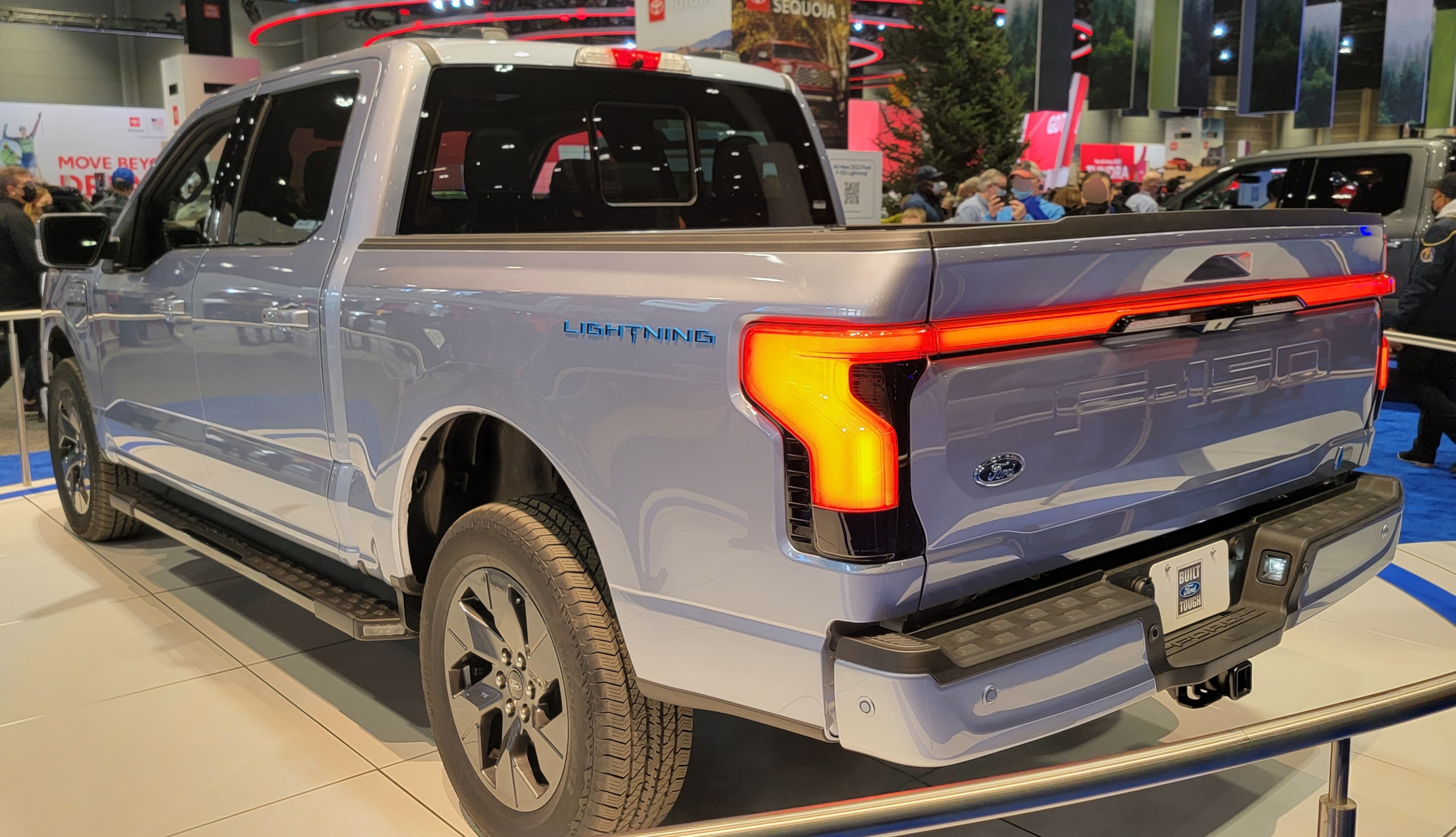
Ford Lightning
"They sold more EVs than Ford did with two, and the lightning was still in those sales numbers. Brand loyalty means a heck of a lot, especially for Toyota folks,"
The Ford Lightning is Ford’s electric truck. Here, it’s mentioned because it’s one of the EVs that still shows up in Ford’s sales results.
The Ford Lightning is Ford’s electric pickup truck. In this segment, it’s used as the key example of Ford’s EV sales presence (“the lightning was still in those sales numbers”).

Toyota Highlander
"...a lot, especially for Toyota folks, and with the Highlander coming out, and some of the other things that Toy..."
The Toyota Highlander is a midsize SUV, usually chosen for family use and everyday comfort. The podcast is likely mentioning it because a new version or update was coming and it could influence what buyers choose. That matters in an EV discussion because SUV shoppers are a big part of the market.
The Toyota Highlander is a midsize SUV aimed at families and everyday practicality. The podcast’s reference to “the Highlander coming out” suggests they’re discussing a new release or update and how it fits into Toyota’s broader lineup strategy. It’s relevant because SUVs often compete for the same buyers who might otherwise consider electrified alternatives.
EV war
"I think Toyota might end up, at least maybe for the second half of the 2020s, winning the EV war because they're really good at engineering."
“EV war” just means the competition between car companies to sell the most electric cars. The speaker thinks Toyota might do especially well because it builds EVs that a lot of people find easy to live with.
“EV war” is a metaphor for the competitive race between automakers to win market share in electric vehicles. The speaker argues Toyota could be positioned to win because of its engineering and ability to build cars that many people will like.
lived experience
"Yeah. That shows you, right? It's the lived experience matters so much to people in the sense of, what do their neighbors drive? What have they had good experiences with?"
“Lived experience” means what people actually see and hear from real owners, not just ads. If neighbors have good experiences with a brand, it makes other people more confident buying it.
“Lived experience” refers to how people’s real-world experiences with a brand (or what their neighbors drive) shape buying decisions. The speaker suggests that if many owners report good results—like long mileage with normal maintenance—others will be more willing to buy the same brand.
normal schedule maintenance
"If people have realized, hey, every one of my neighborhood has a RAO4, they're able to drive 200,000 miles or more with normal schedule maintenance."
This means doing the regular, planned service that the car maker recommends. The speaker’s point is that if you keep up with routine maintenance, the car can last a long time.
“Normal schedule maintenance” means following the manufacturer’s recommended service intervals (like inspections and fluid/part replacements) rather than doing extra work. The speaker uses it to argue that owners can rack up very high mileage without unusual problems.
Toyota EVs
"hybrids. That explains, I think, a lot of why people are so receptive to Toyota EVs, even though [1171.3s] you're right. I agree with you. Particularly, their early EV efforts were very half-baked."
They’re talking about Toyota’s electric cars and why some buyers trust them more. The idea is that Toyota’s EVs feel familiar, and Toyota has been improving over time.
The hosts discuss why people are receptive to Toyota’s approach to electric vehicles. They contrast Toyota’s earlier EV efforts with newer EV product plans, including manufacturing in America.
Rivian
"that. They look at certain other EVs. You get into, of course, not even excluding factors like cost, [1200.0s] but you look at something like a Rivian or a Tesla. These vehicles are full of screens."
Rivian is used as an example of an EV company that leans heavily on screens and apps. The point is that some people love that, while others prefer something more familiar.
Rivian is mentioned as an example of a modern EV brand that uses a lot of digital interfaces. The discussion highlights how screen-heavy, software-driven features can feel exciting but may be less familiar to some buyers.
software-defined features
"but you look at something like a Rivian or a Tesla. These vehicles are full of screens. They're full [1205.5s] of what we call software-defined features. That's very exciting, especially maybe for those younger [1210.8s] customers."
This means some car features are run by software, like an app. Instead of everything being fixed in the car’s hardware, the software can change how the car behaves and what features you can use.
“Software-defined features” refers to vehicle functions that are controlled primarily by software rather than fixed hardware. In many EVs, this enables frequent updates and a more app-like experience through the infotainment system and other electronic controls.
polling quarterly
"Sometimes it's hard to look at the causation that specifically we do the polling [1252.9s] quarterly. What we notice is a trend, and it's probably a bit of a lagging indicator."
They’re talking about surveys they run every few months. The goal is to track how people’s opinions about EVs change over time.
“Polling quarterly” indicates the hosts rely on repeated survey measurements taken every three months. They use these trends to discuss how public resistance to EVs is shifting over time.
EVs are not for someone like me
"but it's like we have this response of EVs are not for someone like me. That used to be much [1281.9s] higher for Republicans. We noticed that dropped 20 points."
This phrase describes a survey response category where people feel electric vehicles don’t fit their identity or lifestyle. The hosts use it to explain how attitudes toward EVs are changing, especially among Republicans.
environmental regulations of emissions
"Now, you go into the market where now, where frankly, the US has lacks to know environmental regulations of emissions. There's no immediate threat."
Some governments set limits on how much pollution cars can put into the air. EVs don’t have exhaust from the tailpipe, so they don’t create the same kind of air pollution while driving.
Emissions regulations are rules that limit how much pollution a vehicle can produce, typically measured at the tailpipe. For EVs, the key point is that they produce no tailpipe emissions, so the regulatory pressure shifts from exhaust pollutants to things like electricity generation and lifecycle impacts.
federal scrutiny over regulations
"...there is much less federal scrutiny over regulations. People don't feel the burden as much."
This is about how closely the federal government checks whether companies and products follow the rules. If enforcement is lighter, people may feel less pressure to change what they buy.
“Federal scrutiny” refers to how closely the federal government monitors and enforces rules. In this context, less enforcement can make EV adoption feel less urgent to consumers and automakers, at least temporarily.
gas prices being much higher
"...but we are in this stasis point right now... And you know, topically now, we don't have the polling date on this yet... but you look at the headlines and the state of the world being what it is, gas prices being much higher, turns out people do warm to EVs..."
Higher gasoline prices change the cost comparison between driving a gas car versus an EV. Even if EVs cost more upfront, the ongoing “fuel” cost can look better when gas is expensive, which can improve consumer sentiment.
tax credit existed
"...despite your stereotype and what you may think about government stimulus, when the tax credit existed, Republicans liked that too, because it turns out everyone likes money."
A tax credit is money off your taxes from the government. If it applies to EVs, it can make the car cheaper to buy, which can convince more people to purchase one.
A tax credit is a government incentive that reduces the amount of tax you owe, effectively lowering the purchase cost of eligible EVs. The transcript suggests that when the credit was available, it improved EV sales across political groups, even if messaging still mattered.
focus groups
"...we try to advise automakers, their focus groups and in our conversations with them..."
A focus group is a small group of people who talk with researchers about what they think. Companies use it to learn what messages and pricing ideas work best for different kinds of customers.
Focus groups are small, guided discussions where people share opinions about products or messaging. In automotive marketing, they’re often used to test how different audiences react to EV branding, pricing, and incentive programs.
affordability metrics
"...hey, you need to change your marketing or consider programs that focus on affordability metrics for customers..."
Affordability metrics are numbers that help you judge whether a car fits your budget. The point here is that marketing should focus on what people can actually afford, not just general arguments about EVs.
Affordability metrics are ways to measure whether a vehicle fits a buyer’s budget, such as monthly payments, total cost of ownership, or incentives that reduce upfront price. The speaker argues automakers should tailor marketing and programs around these measures rather than purely ideology or general “EV benefits.”
range anxiety
"[1528.2s] I think the other thing I'll say is also the knowledge. And it's the sense of, and this is some of the other work we do, a lot of this is based off, you know, I think there's the now an industry term for this. It used to be range anxiety. Now it's the charging anxiety."
Range anxiety means being worried your EV battery won’t last long enough to get where you’re going. People often think about it when planning trips.
“Range anxiety” is the fear that an EV won’t have enough battery charge to reach a destination or a charging station. It’s a common early concern that shaped EV adoption conversations.
charging anxiety
"[1528.2s] I think the other thing I'll say is also the knowledge. And it's the sense of, and this is some of the other work we do, a lot of this is based off, you know, I think there's the now an industry term for this. It used to be range anxiety. Now it's the charging anxiety."
Charging anxiety is when people feel nervous about charging their EV—like not knowing where to plug in or whether it’ll be available. It’s different from worrying about how far the battery can go.
“Charging anxiety” is the worry or stress people feel about finding and using EV charging when they need it. It’s become a newer, more specific version of the older “range anxiety” concern.
EPA data
"[1541.1s] I think folks are well aware now that many EVs on the market can reach 300 miles of range [1548.0s] or more, right? Using EPA data. And on a highway, it's close to that high, if not even higher, with some vehicles."
EPA data is the government’s standardized way of estimating how far a car can go on a full charge. Your actual range can be different depending on how you drive and conditions.
EPA data refers to the U.S. Environmental Protection Agency’s standardized testing and reporting used to estimate an EV’s driving range. It’s meant to be comparable across vehicles, though real-world results can vary with speed, weather, and driving habits.
home charging
"[1565.4s] weren't really quite aware of the convenience for many people. The EV thing felt like sacrifice [1570.2s] because it's this idea of an extra burden, an extra thing you have to do to go and fill up. [1575.5s] When you tell people how home charging works, they love EVs."
Home charging means plugging your EV in where you live—often at night. If you can do that, you usually don’t have to worry as much about finding public chargers.
Home charging is the ability to charge an EV at your residence, usually overnight. When people can charge at home, it removes much of the day-to-day hassle and makes EV ownership feel more convenient.
EVSEs
"[1581.8s] but I feel like the industry hasn't reckoned with this enough. And I do want to give another shout out to Ford, who I think a year or two ago started the program of giving people EVSEs or, [1592.3s] you know, charging equipment for their EV when they bought a Mach-E or a Lightning"
EVSEs are the charging equipment for an EV—basically the charger you plug the car into. It’s the hardware that delivers power to your vehicle.
EVSEs (Electric Vehicle Supply Equipment) are the charging stations and hardware used to supply electricity to an EV. They’re what you install at home or use at public locations to charge the vehicle.

Ford Mach-E
"[1585.7s] And I do want to give another shout out to Ford, who I think a year or two ago started the program of giving people EVSEs or, [1592.3s] you know, charging equipment for their EV when they bought a Mach-E or a Lightning"
The Ford Mach-E is Ford’s electric SUV. The host is saying Ford helped some Mach-E buyers by providing home charging equipment.
The Ford Mach-E (often written as “Mach-E”) is Ford’s electric crossover/SUV. In this segment, it’s mentioned as the vehicle whose buyers were offered EV charging equipment (EVSEs).

Ford Mustang
"RIP discontinued for the moment, right? But when they buy a Mustang Mach-E to this day still, you can get a charging equipment from Ford free of charge, not just the equipment itself,"
The Ford Mustang Mach-E is an electric SUV made by Ford. The hosts mention it because Ford can help pay for charging gear and the electrician work needed to install it at home.
The Ford Mustang Mach-E is an all-electric SUV. In this segment, it’s used as an example of how EV buyers may receive help for home charging equipment and installation costs.
charging equipment
"you can get a charging equipment from Ford free of charge, not just the equipment itself, but they'll cover reasonable electrician install costs,"
Charging equipment is the device you install at home to plug in and charge your EV. It’s more than just a cable—it includes the charger hardware and the electrical setup to make it work safely.
“Charging equipment” refers to the hardware used to charge an EV, typically a home charging unit (often called a wallbox) plus its electrical connections. In this context, Ford provides the equipment and also helps with installation costs.
electrify America
"...but they have to go to electrify America every week or twice a week, depending on how much they drive."
Electrify America is a company that runs public fast-charging stations for EVs. The hosts bring it up to show how relying on public charging can be less convenient than charging at home.
Electrify America is a public EV fast-charging network in the United States. In this segment, it’s mentioned as the alternative to home charging—something drivers might need to use weekly or more.
multi-family units
"...folks who live in what's called multi-family units or like condos and apartments, many of those people cannot do the overnight charging thing because their landlord doesn't know what to do."
Multi-family units are apartment-style buildings where many people share the property and electrical systems. The hosts say it can be hard for residents to get EV chargers installed because the landlord and building rules can complicate it.
Multi-family units are residential buildings with multiple separate homes or apartments (e.g., apartment buildings). The segment highlights that residents often can’t install overnight EV charging easily because of landlord control, permitting hurdles, and shared electrical infrastructure.
permitted
"...It's hard to get it permitted. There's all these barriers to installing that when frankly, particularly what we call level two charging..."
Permitted means the installation has to be approved by local rules and inspectors. The hosts say this approval process can slow down or block EV charger installs in apartments.
“Permitted” refers to getting official approval from local authorities before installing electrical equipment. The hosts mention permitting as a barrier for EV charger installations, especially in shared residential settings.
level two charging
"There's all these barriers to installing that when frankly, particularly what we call level two charging in the nerd sphere or like that kind of overnight EV charging, that is not that expensive to install compared to DC fast charging."
Level 2 charging is the common “home charger” style setup for EVs, usually using a 240-volt outlet. It charges more slowly than fast chargers, but it’s ideal for topping up overnight.
Level 2 charging is an EV charging method that uses alternating current (AC) power and typically runs from a 240-volt home or workplace circuit. It’s slower than DC fast charging but is well-suited for overnight charging and daily driving needs.
DC fast charging
"...level two charging ... is not that expensive to install compared to DC fast charging. And we're the opinion we need much more of it."
DC fast charging is the kind of public charging that can add a lot of range quickly. It’s faster than home charging, but it’s not as convenient for frequent daily use as charging at home.
DC fast charging is a high-power EV charging method that uses direct current (DC) to rapidly add range. It’s typically used at public charging stations and is much faster than Level 2, but it’s usually more expensive to build and can be harder to access regularly.
panel
"...if you have an established apartment complex and you want to have this space in on the property that is this is reserved for EVs, but it's really far away from the panel. And then you want more space than what your panel can handle"
The panel is the building’s main electrical box that controls how power is distributed. If the EV charger needs more power than the panel can support (or it’s far away), the installation can get complicated.
In EV charging discussions, “panel” usually means the electrical service panel (breaker box) that distributes power to a building. The segment notes that if the charger location is far from the panel and the panel can’t handle the added load, installation becomes more difficult.
DC fast charger
"Like it won't be as much as a DC fast charger, right? But it's going to be a high tens, if not the low hundreds, depending on how far away it is..."
A DC fast charger is a public EV charger that can charge your car quickly. It uses high-power electricity to get energy into the battery faster than slower chargers. In this segment, they’re talking about how the bill can be different from slower charging.
A DC fast charger is an EV charging station that uses direct current (DC) to deliver high power directly to the car’s battery. It’s typically much faster than standard home charging, but it can be more expensive to install and operate. The episode contrasts it with slower charging options for cost and billing.
orange
"...But there are other options available like orange chargers, a company for instance, that will just install a regular outlet at a normal charging spot..."
They mention “Orange” as a company that helps install EV charging in a simpler, cheaper way—like adding a normal outlet where cars can plug in. The idea is that you don’t always need the most expensive fast-charging hardware to get started. They’re using it as an example of a lower-cost approach.
“Orange” is referenced as a company that installs charging infrastructure by putting in a regular outlet at a charging spot and enabling slower charging. In this segment, it’s used as an example of an alternative approach to expensive charger installs. The key point is the business model for making charging cheaper and more scalable for property owners.
48 amps
"...Maybe you don't have one area for charging. Maybe you have multiple areas for charging and maybe they don't charge at 48 amps. Maybe they charge at 20 amps."
“48 amps” is how much electrical current the charger can push to your car. More amps usually means faster charging. They’re saying some setups can charge at lower amps (like 20) to make installs cheaper and easier.
“48 amps” refers to the charging current a charger can deliver, which directly affects how quickly an EV can charge. Higher amperage generally means more power (and faster charging), assuming the car and charger support it. The segment contrasts 48-amp charging with lower-amperage options like 20 amps to reduce installation and grid strain.
20 amps
"...maybe they don't charge at 48 amps. Maybe they charge at 20 amps."
“20 amps” means the charger is sending a smaller amount of electricity to the car. That usually charges slower than a higher-amp charger, but it can be easier and cheaper to install—especially in apartment buildings.
“20 amps” is a lower charging current setting compared with 48 amps, which typically reduces charging speed but can make installations easier. In multi-unit buildings, lower amperage can help avoid overloading electrical service and can reduce the need for expensive upgrades. The hosts use it as an example of alternative charging configurations.
pandemonium
"Yeah. I think it's important to be technology agnostic to your point. There's companies like orange and I think there's also pandemonium."
They also name “pandemonium” as a company trying to make EV charger installations cheaper. The point is that some companies are finding smarter ways to set things up without building more equipment than needed. It’s an example of innovation in how charging gets installed.
“Pandemonium” is mentioned as another company working on EV charging installs with a focus on reducing cost. The segment credits these companies with making installations cheaper by avoiding unnecessary infrastructure build-out and by rethinking assumptions about charging hardware and power needs. It’s presented as part of a broader ecosystem of charging providers.
Grid distribution
"Grid distribution is a big bottleneck with our aging grid in lots of areas of the country..."
“Grid distribution” is basically the power lines and electrical system that bring electricity to your area. If that system can’t handle more demand, it can slow down or block new EV charging installs. That’s why they’re saying the grid is a big limiting factor.
Grid distribution is the electrical network infrastructure that delivers power from the utility to neighborhoods, buildings, and charging sites. The segment calls it a bottleneck because aging grid capacity can limit how much charging equipment can be added without upgrades. This is especially relevant in dense areas where many EVs are expected.
multifamily bind
"...including urban parts of California where you think lots of people will be ready to adopt TVs, but they can't yet because of this multifamily bind."
“Multifamily bind” means it’s harder to add EV charging in apartment buildings than in single-family homes. The electrical setup is shared, and the decision-making and costs are spread across different people. So even if residents want EVs, charging can be slow to roll out.
“Multifamily bind” refers to the practical difficulty of adding EV charging in apartment and other shared-housing settings. Challenges include shared electrical infrastructure, permitting, and coordinating costs among property owners, managers, and residents. The hosts frame it as a reason EV adoption can lag even when demand exists.
permitting
"...when the state helps, let's say, subsidize and install or make it easier with permitting, there should also be some guidance or some flexibility..."
Permitting is the paperwork/approval you need from the city or local authorities before installing EV chargers. It can slow projects down and add cost. They’re saying rules should be flexible so different charging setups can qualify for help.
Permitting is the official approval process required before installing EV charging equipment, often involving local building and electrical authorities. It can add time and cost, especially when projects require trenching, electrical upgrades, or new equipment. The segment argues for flexibility in policy to support different charging technologies.
kilowatt hour
"The neighborhood of 20 to 30 cents a kilowatt hour with maybe some off-peak accommodations, people are fine with that. That's still a lot cheaper than fast charging."
A kilowatt-hour (kWh) is a way to measure how much electricity you used. If charging costs “per kWh,” then the price goes up or down based on how much energy your car pulls from the charger.
A kilowatt-hour (kWh) is a unit of energy. When electricity is priced “per kWh,” it means the cost depends on how much energy your EV uses to charge, not just how long it’s plugged in.
off-peak
"The neighborhood of 20 to 30 cents a kilowatt hour with maybe some off-peak accommodations, people are fine with that. That's still a lot cheaper than fast charging."
Off-peak is the time of day when electricity is cheaper. If you charge your EV during those cheaper hours, your charging bill is usually lower.
Off-peak refers to electricity pricing periods when demand is lower, so the utility charges less per kWh. EV owners can benefit by scheduling charging to happen during off-peak hours to reduce costs.
equity driven incentives
"The way the regulations are written in certain states, a lot of the incentives are really only equity driven, which is fine. It's based on income, but when you think of, let's say, a pragmatic environmental standpoint,"
Equity-driven incentives are discounts or benefits aimed at helping certain people based on need or income. The point being made is that the program might focus on who qualifies rather than on maximizing EV adoption for cleaner air.
Equity-driven incentives are EV-related financial programs designed to prioritize people or communities based on income or other eligibility criteria. The speaker argues that, while this approach is acceptable, it may not directly target the emissions goal of getting more EVs on the road.

Dodge Charger
"...e they have or does it matter that they can get a charger if they live in their luxury condo or if they li..."
The Dodge Charger is a car that’s usually known for strong performance and a traditional gasoline setup. In the podcast, it sounds like they’re talking about whether someone has a place to plug in a car at home. That question matters when comparing electric options to what people are used to driving.
The Dodge Charger is a performance-oriented sedan that’s typically associated with higher power and a more traditional gas-car ownership experience. The podcast mention of “if they can get a charger” suggests the conversation is about whether a driver has access to home charging—something that matters for electric vehicles. Even though the Charger itself isn’t an EV, it may be referenced as a familiar alternative that certain buyers might consider when thinking about charging access and vehicle fit.
charging infrastructure
"It's funny that you say get the electricians on board because every single person I've had on to talk about charging infrastructure, they say, well, we're making money, but it's really the electricians"
Charging infrastructure is the “system” that lets EVs plug in and charge. It includes the chargers themselves and the work needed to install them, especially in places like apartment parking lots.
Charging infrastructure is the network of hardware and services that make EV charging possible—things like chargers at homes, workplaces, and public locations, plus the installation and permitting around them. In apartment settings, it often means getting chargers installed in individual parking spots.
power of government
"That's where we think the power of government is actually best used. Let's try to streamline this as much as possible."
The “power of government” means what city/state rules can do to help EV charging get installed faster. The idea is to make the process simpler without cutting safety corners.
“Power of government” here refers to how public agencies can shape EV adoption by streamlining permitting and policy for charging installations. The speaker suggests government is best used to reduce complexity while still prioritizing safety.
safety installs
"Remove as many, obviously, still prioritizing safety installs, and you can advance policy priorities..."
“Safety installs” means the charger is installed in a way that’s safe and follows electrical rules. Even if the process is made easier, it still has to be done correctly.
“Safety installs” refers to EV charger installations that meet electrical and code requirements to reduce risks like fire, shock, or improper wiring. Even when bureaucracy is reduced, the speaker emphasizes keeping safety as the priority.
red tape
"...remove the excessive red tape and considerations that we think have been slowing things down. That will vary a lot, locality to locality..."
“Red tape” is extra paperwork and rules that make something take longer or be harder than it should. Here, it’s about making EV charging installs slower for people who live in apartments.
“Red tape” means excessive bureaucracy—paperwork, approvals, and rules—that slow down EV charging installs. The speaker argues that reducing unnecessary administrative friction can make it easier for apartment residents and others to adopt EVs.
Directly Current
"The podcast is Directly Current, and so that's in YouTube and all the podcast apps. Like I said, we try to have monthly guests on there."
They mention a podcast called “Directly Current.” It’s where the guest says they talk about EV topics, especially policy and obstacles.
“Directly Current” is the name of the podcast the guest references. The discussion frames it as a show that brings in monthly guests and focuses on EV-related policy issues and roadblocks.
Request an Explanation
Heard something you'd like explained? We'll add it to this episode.
Sign in to request explanations for terms you heard.
Want to learn more?
Browse our glossary for plain-English explanations of automotive terms, jargon, and concepts.
Help improve this episode
See something that's not quite right? Our annotations are AI-generated and can sometimes miss the mark. Click the flag icon on any annotation to suggest a correction.