
About this episode
Brakes take center stage as the hosts warn listeners about the right parts for a JLJT, tying brake wear and breakage to driving style, axle setups, and model-generation changes around the JK era. They compare JK rear brake wear rates, explain how drum-rear/disc-front history shaped expectations, and walk through brake codes (BRY vs BR guest) using VIN lookups. The conversation also covers why bedding matters, how caliper/slide issues affect rotors, and what to watch for when choosing OE vs aftermarket.
We want to hear from you, Send us a Text
Join Neil, Scott, and Jeff on a discussion of JL/JT Brakes. Are manufacturer brakes better than box store? Are today's brakes less in quality than before? Tune in to learn why you may have bought the wrong brakes. Learn about the B R codes and how they can vary in the platform.
Thanks for listening, give us a review and check us out on YouTube -SFJ4x4 and visit our website to grab some great gear or products for your Jeep, SFJ4x4.com. Don't forget, you can email [email protected] for special content requests, blind react videos, suggestions, special guests, or general questions. Check out our Patreon patreon.com/ISpeakJeep

Ford Expedition
"...e saying that they're on the road From Trail Hero Expedition Season 2 Still about 1,300 miles to go"
The Ford Expedition is a large SUV meant for carrying people and gear. It’s built for longer trips and towing, so it’s commonly used for family travel and outdoor activities. The podcast mentions it in the context of an adventure-focused setup.
The Ford Expedition is a full-size SUV designed for family hauling, towing, and long-distance driving. It’s significant in the conversation because it’s the kind of vehicle people choose for road trips and outdoor adventures, including off-road-oriented trims. The podcast context suggests it’s being referenced as part of a larger “Trail Hero Expedition” theme.

Wrangler Rubicon
"... of the time And JK, it didn't matter if you were Rubicon, Sahara Base model, Aquarium, you had the same br..."
The Jeep Wrangler is an SUV designed for off-road driving. It’s made to handle rough trails and still be usable day to day. The podcast is pointing out that different versions can share the same basic off-road setup.
The Wrangler is Jeep’s iconic off-road SUV line, built around a rugged body-on-frame design and four-wheel-drive capability. It’s significant because many trims share the same core off-road hardware, which makes it a common subject when discussing what matters for trail use. The podcast context mentions JK and different trims, emphasizing that the off-road foundation is similar across versions.
Jeep JK
"The Jeep JK is probably the best everyday multi-purpose Jeep Around And that would be from a DIY serviceability stamp"
A Jeep JK is a Wrangler generation. The host is saying it’s a good everyday Jeep because it’s versatile and easier to work on yourself than some other Jeep setups.
The Jeep JK refers to the Wrangler JK generation, known for being a practical “daily driver” Jeep with strong aftermarket support. In this segment, it’s being compared as an all-around, multi-purpose choice, especially for DIY-friendly ownership.
DIY serviceability
"And that would be from a DIY serviceability stamp You're just biased"
“DIY serviceability” means how easy it is to work on the vehicle yourself. The host is saying the Jeep JK is easier to maintain if you do your own work.
“DIY serviceability” refers to how easy it is for owners to do maintenance or repairs themselves. The host uses it as a criterion for why the Jeep JK is a strong everyday choice.

JT Gladiators
"Now, I can probably make a similar argument Loosely enough about JT Gladiators Because you only got two engine platforms"
The Jeep Gladiator JT is a specific generation of the Gladiator pickup. The discussion is about how its different configurations can make things less consistent than the Wrangler JK.
“JT Gladiators” refers to the Jeep Gladiator JT generation. The host is using it to discuss how the lineup’s powertrain and axle/packaging choices affect consistency and DIY serviceability.
engine platforms
"Loosely enough about JT Gladiators Because you only got two engine platforms And arguably you got a consistent axle package"
“Engine platforms” here means the main types of engines a vehicle uses. If there are only a couple, it’s usually easier to know what parts and repairs will apply.
“Engine platforms” means distinct engine families or architectures that a vehicle lineup uses. When a model has only a couple engine platforms, it can be easier to predict parts compatibility and service procedures across trims.
axle package
"Because you only got two engine platforms And arguably you got a consistent axle package Now the problem is you get narrow"
An “axle package” is the vehicle’s rear/front axle setup (the parts that help deliver power to the wheels). Different packages can mean different parts and different repair complexity.
An “axle package” is the combination of axle hardware and related drivetrain setup used on a vehicle. It can vary by trim and towing/off-road configuration, affecting how consistent parts and repairs are across the lineup.
tow packages
"Now the problem is you get narrow You get wide, you get tow packages You get max tow packages"
A “tow package” is a set of factory upgrades meant to help the truck or Jeep tow more safely. It can include extra hardware and changes that make the vehicle different from other trims.
“Tow packages” are factory option bundles that add towing-related components and calibration. They often change cooling, wiring, hitch/receiver hardware, and sometimes braking/axle gearing, which is why the host says the lineup starts to get complicated.
towing limits
"That's where we do start to get a little gobbly cook In the process Made up with the towing limits And that kind of thing"
“Towing limits” are the maximum amounts a vehicle is rated to tow. Different tow packages can change those ratings because the vehicle may have different supporting parts.
“Towing limits” are the maximum trailer weight and related constraints a vehicle can safely tow. In practice, they’re tied to the specific tow package and the vehicle’s cooling, brakes, and drivetrain setup.
rear axle
"So one thing that we learned from the JK Breaks [870.9s] Was that all of a sudden [874.5s] JKs go through breaks in the rear axle [878.8s] Twice as fast, and this is a generality, twice as fast as front brakes"
The rear axle is basically the part that connects the two back wheels. If the rear brakes wear out faster, it means the back wheels are doing more of the braking work in that situation.
The rear axle is the assembly that connects the rear wheels and carries drive/braking forces. When the speaker says the JKs go through rear axle brakes faster, they’re talking about brake wear happening on the rear wheels rather than the front.
drum rear
"Historically, when disc brakes became a thing [888.1s] And certainly from having drum rear and disc front"
“Drum rear” means the back brakes use a drum mechanism instead of a disc. Different brake types can wear at different rates, so the host is pointing to that difference.
“Drum rear” means the rear brakes are drum-style, where brake shoes press outward inside a drum. Drum brakes typically behave differently from disc brakes in heat handling and wear, which can affect how quickly rear brakes need replacement.
front brakes
"We would go through the front brakes more often Yes Than rear"
Front brakes are the brakes on the front wheels. When you stop, the car’s weight shifts forward, so the front brakes usually do more work than the rear brakes.
Front brakes are the braking components at the front axle, where most stopping force is typically generated due to weight transfer under braking. This segment contrasts how often the front brakes needed service versus the rear.
drums
"Drums were, you know, depending on the size of the truck If you had a three-quarter ton truck"
“Drums” means drum brakes. They work by pushing brake pads (shoes) against the inside of a metal drum when you brake.
“Drums” refers to drum brakes, where brake shoes press outward against a rotating drum. In this discussion, drums are contrasted with disc brakes and are described as lasting longer on certain trucks depending on size and setup.

Chevrolet S10
"I remember my S10 from high school days Had 120, 130,000 miles on it And the rear shoes were still the Delco originals"
The Chevrolet S10 is a small pickup truck. The host is using it to show that, on some trucks, the rear drum brakes can wear much more slowly than the front brakes.
The Chevrolet S10 is a compact pickup that was commonly used as an everyday truck in the 1990s and early 2000s. In this segment, it’s used as an example of how the rear drum brakes (with “rear shoes”) could last a very long time compared to the front brakes.
rear shoes
"And the rear shoes were still the Delco originals So, and I had put like four sets of front brakes on it"
Rear shoes are the braking surfaces inside drum brakes. They press against the inside of the drum when you brake to slow the truck down.
Rear shoes are the friction pads inside drum brakes. When the brake pedal is pressed, the shoes press outward against the inside of the drum to slow the vehicle.
disc
"Mindset was in the drum rear to disc front And in fact, in our XJs and our TJs"
“Disc” means disc brakes. They use a spinning metal rotor and a clamp to squeeze brake pads against it to slow the vehicle.
“Disc” refers to disc brakes, which use a rotor and caliper to clamp pads against the rotor. The segment frames a common mindset of the era: drum brakes in the rear paired with disc brakes in the front.

Jaguar Xjs
"...n the drum rear to disc front And in fact, in our XJs and our TJs We were that through 2001, 2002"
The Jaguar XJ-S is a sports coupe made for long-distance driving and performance. People talk about it because it has a specific brake setup that can change depending on the year. The podcast is referencing that brake configuration as part of how these cars are maintained.
The Jaguar XJ-S is a grand touring coupe that was built for comfortable high-speed cruising with a focus on performance and style. It’s discussed in enthusiast circles because it has a distinctive layout and a long production history, which can lead to varied maintenance needs. The podcast context mentions brake setup changes (drum rear to disc front), which is a common topic when keeping these cars safe and up to date.
catalyst shift
"Sure, an application, absolutely But as a large, I remember this catalyst shift Happening between 01 and let's call it 05"
A “catalyst shift” is basically a turning point. In this case, the host is saying the brake setup on trucks started changing around the early 2000s.
A “catalyst shift” here describes a transition period in brake technology and packaging—moving away from the earlier drum-rear/disc-front norm. The speaker places this change between 2001 and about 2005, implying more widespread adoption of newer brake setups.
brake lathes
"I've passed on so many brake lathes at this point Because you also could turn drums There was other brake lathes that could turn drums"
A brake lathe is a tool shop machine that cleans up and smooths worn brake parts. It can be used to rework rotors, and some machines can also rework drum brake surfaces.
A brake lathe is a machine used to resurface brake components so they have a smooth, even surface again. In practice, it can be used to turn (machine) rotor surfaces and, on some setups, drum brake surfaces too.
multi-process lathes
"Or multi-process lathes, right So there was some that were just rotors And some that were drum oriented"
A multi-process lathe is a machine that can do multiple kinds of machining jobs. Here, it’s being described as able to work on different brake parts, not just one type.
A multi-process lathe is a machine configured to do more than one type of machining operation. In this context, it refers to lathes that can handle different brake component types—like rotors and drum surfaces—rather than only one.
rotors
"So there was some that were just rotors And some that were drum oriented I actually used to turn them"
Rotors are the disc-brake friction surfaces that clamp under the brake pads to slow the car. When rotors get uneven or glazed, they may be resurfaced (turned) to restore a consistent braking surface.

Chevrolet C10
"Just for a good example My C10 I just sold That had rotors from a 71 C10"
The Chevrolet C10 is an older pickup truck, especially known from the early 1970s. People keep them running by replacing wear items like brakes and rotors. The podcast is bringing it up as an example of that kind of maintenance.
The Chevrolet C10 is a classic full-size pickup from the 1960s and 1970s era, known for its simple, durable design and strong enthusiast following. It’s often discussed in the context of restoration and maintenance because older trucks can need parts like brakes and rotors as they age. The podcast specifically mentions a “71 C10” and rotors, which fits that kind of ownership conversation.
ceramic
"And I'd argue a little bit of the fall in ceramic Right There's a value to ceramic"
Here “ceramic” is about the material used in some brake pads. It’s often marketed as making brakes quieter and producing less dust, but results can vary by brand and design.
In brake discussions, “ceramic” usually refers to ceramic-based brake pads. Ceramic pads are marketed for quieter operation and reduced dust, but their real-world performance depends on the specific compound and rotor/pad pairing.
brake types
"And we did a whole episode I think just in the last year About all the different brake types Correct"
“Brake types” means different kinds of brake pad materials. Different materials can feel different (quiet vs. noisy, more dust vs. less dust) and can wear rotors differently.
“Brake types” refers to different brake pad and rotor material/technology families (for example, ceramic vs. semi-metallic vs. organic formulations). Each type can change dust output, noise, cold bite, fade resistance, and how aggressively the pad wears the rotor.
heavily recycled materials
"We get into this really uncomfortable world Of heavily recycled materials So the actual product"
They’re talking about brake parts being made from a lot of recycled material. The concern is that recycled inputs can change how consistent the braking material is and how well it holds up over time.
“Heavily recycled materials” in brake components suggests the friction material and/or base metals are sourced from recycled feedstock rather than purely virgin materials. That can affect consistency of the compound, long-term wear behavior, and performance under heat compared with higher-quality formulations.
white box
"Especially when it comes to the white box No name, bottom barrel"
“White box” usually means the part is sold in plain packaging with no big brand name on it. People often use it to describe cheaper, more generic replacement parts.
“White box” is an industry term for unbranded or minimally branded replacement parts sold through generic packaging. Enthusiasts often associate “white box” parts with lower-cost sourcing and variable quality versus parts sold under a recognizable brand.
pitting
"Can see pitting and you can see a bad Contact patch and so on and so forth On her breaks and I remember that"
Pitting means the surface has little holes or craters. That kind of damage can make things work less smoothly and can be a sign of wear or corrosion.
Pitting refers to small pits or craters in a surface, often caused by corrosion, heat, or abrasive wear. In a tire/braking context, pitting can indicate surface damage that may reduce traction or performance.
contact patch
"Can see pitting and you can see a bad Contact patch and so on and so forth On her breaks and I remember that"
The contact patch is the part of the tire that’s touching the road. If it’s worn or damaged, the tire can grip worse and wear unevenly.
The contact patch is the portion of a tire that actually touches the road. Its size and condition affect grip, braking, and how evenly the tire wears.
axle swap
"Then how do you manage that with an Axle swap vehicle example JLU Sport With a 392 axle swap off Marketplace"
An axle swap means taking the axle assembly from one vehicle and putting it into another. It’s a bigger job than just changing a part—because the axle has to match what the rest of the car is expecting.
An axle swap is replacing an axle assembly (front and/or rear) from one vehicle with the axle from another. It often requires matching axle components and vehicle identifiers so the swapped axle is compatible with the rest of the drivetrain and wiring.
VIN
"You have to use the VIN off of that Previous vehicle Axle"
VIN is a vehicle’s unique ID number. When you’re swapping parts between cars, the VIN helps confirm exactly which vehicle the parts came from.
VIN stands for Vehicle Identification Number, a unique 17-character code assigned to a specific vehicle. For swaps and registrations, people use the VIN to identify the exact donor vehicle so the correct axle and related components can be matched and documented.
Rubicon axles
"Now, with that said, the 392 It was going to have Rubicon axles Yeah Nine times out of ten"
Rubicon is a Jeep trim that’s built for off-roading. “Rubicon axles” means using the axle parts from that Rubicon model, which can be different from the axles on other trims.
Rubicon axles come from the Jeep Wrangler Rubicon, a trim known for off-road hardware. In axle-swap discussions, “Rubicon axles” usually implies you’re using the Rubicon’s axle assemblies (and their associated gearing/brake hardware) rather than the standard axles.
HD brake kit
"I don't know that the 392 Comes with anything that doesn't Have the HD brake kit We can't say for certain on anything"
“HD brake kit” means a stronger, upgraded set of brakes. They’re talking about which brake package comes on certain Jeep trims, especially for off-road use.
An “HD brake kit” means an upgraded heavy-duty brake package. It’s typically higher-capacity hardware intended to handle more demanding driving (like off-road use), and in this segment they’re saying the Rubicon setup is usually paired with that HD brake hardware.
HD package
"But Rubicon's should Air quotes should be the easier To figure out You should have the HD package Which those HD brakes were Available right away"
An “HD package” is an option bundle that adds stronger, heavy-duty parts. In this case, they’re saying it should include the upgraded HD brakes.
An “HD package” is a bundled option group that adds heavy-duty components—often including things like brakes—rather than a single standalone part. Here, they’re connecting the HD package to the presence of the HD brakes being available on the vehicle.

Dodge Ram
"Crossover is or was It was a ram of some kind It was, it was"
The Dodge Ram is a pickup truck. It’s made for hauling and towing, and it can be set up for different needs depending on the model. The podcast is referencing it as a truck “Ram” rather than a specific SUV.
The Dodge Ram is a full-size pickup truck line built for work and towing, with configurations that range from everyday commuting to heavy-duty hauling. It’s frequently discussed because it’s a common choice for people who need a truck for real-world tasks. In the podcast context, it’s mentioned as “a ram of some kind,” pointing to the truck category rather than a specific year or trim.
brake pads got low
"That started chirping [1885.5s] When your pads got low [1888.9s] Some do, some don't"
Brake pads wear out as you drive. Some cars have a built-in warning that starts making a chirping sound when the pads are getting too thin.
Brake pads wear down over time, and many brake systems include a wear indicator. When the pads get low, the indicator can contact the rotor and create a chirping or squealing sound to warn you.
noise complaints
"Probably just because they dealt with [1912.6s] Noise complaints [1914.4s] And it was easier just to"
Sometimes drivers complain when brakes make annoying sounds. To avoid that, brake parts may be designed so the warning chirp happens less or differently.
“Noise complaints” refers to customer feedback about unwanted sounds—often brake squeal or chirp. Manufacturers and suppliers may change brake hardware (like wear-indicator design) to reduce these noises, even if it means the chirp happens less often.
tow capacities
"And tow capacities and all that kind of stuff I think Jeff has to use Rubicon brakes"
Tow capacity is how much weight your vehicle is rated to tow safely. When you tow more, you need brakes that can handle the extra stopping effort.
Tow capacity is the maximum weight a vehicle is rated to pull safely. It matters for brakes because towing increases stopping demands and heat buildup, so the right brake hardware is part of meeting the vehicle’s overall towing capability.
Rubicon brakes
"I think Jeff has to use Rubicon brakes On his"
“Rubicon” is a Jeep Wrangler trim made for serious off-roading. “Rubicon brakes” means the brake setup that matches that tougher, off-road-oriented version.
“Rubicon” refers to the Jeep Wrangler Rubicon trim, which is built for tougher off-road use. When someone says “Rubicon brakes,” they’re usually talking about the factory brake hardware (or brake spec) associated with that off-road-focused model.
HD
"Yeah, I think they are always the HD Until you get into the big big brake kits"
“HD” means “heavy-duty.” It’s a stronger brake setup meant to last longer and handle more heat, like when you tow or drive off-road.
“HD” here means “heavy-duty,” a brake setup intended to handle more heat and stress than standard components. In practice, heavy-duty brakes are often used for towing, off-road use, or vehicles that see frequent hard stops.
big big brake kits
"Until you get into the big big brake kits Which then get more confusing"
A “big brake kit” is an upgrade that gives you bigger, stronger brakes. It helps the brakes stop better and stay cooler when you’re working them hard.
A “big brake kit” is an aftermarket brake upgrade that typically includes larger rotors and upgraded calipers (and sometimes pads and lines). The goal is more braking capacity and better heat management for demanding driving like towing or off-road use.
bedding the surfaces
"And so ultimately you need Two clean mating surfaces And then you have to go through the process Of bedding the surfaces Which is matching them up to each other"
When you “bed in” new brakes, you’re basically breaking them in properly. It helps the pad and rotor wear together in a controlled way so braking feels smoother and lasts longer.
“Bedding the surfaces” is the brake-in process where new brake pads and rotors are gradually heated and conditioned to create an even transfer layer. This helps the pad and rotor work together consistently, improving bite and reducing noise or uneven wear.
break in process
"If you are unfamiliar with bedding Or the break in process And I'll just kind of keep it kind of light and simple"
The “break in process” for brakes is the early-use procedure that conditions new pads and rotors. Done correctly, it helps establish a stable friction surface and reduces issues like uneven wear or noise.
pad rotor combination
"It is a process of superheating The pad rotor combination In order to allow the two mating surfaces"
Brakes work as a pair: the pad and the rotor. Bedding helps them “match up” so they stop more evenly and predictably.
Brake performance depends on the “pad-rotor combination,” meaning the specific pairing of pad material and rotor surface. Bedding-in is designed to make those two mating surfaces develop a consistent friction interface together.
ABS pulsing
"And then applying the brakes in an aggressive fashion [...] Without triggering the ABS pulsing"
ABS is the system that prevents the wheels from locking up during hard braking. During brake bedding, you try not to trigger ABS because it can interfere with the break-in process.
“ABS pulsing” refers to the anti-lock braking system rapidly modulating brake pressure to prevent wheel lockup. During bedding, you generally want to avoid ABS intervention because it can interrupt the steady heat-and-friction conditioning the pads/rotors need.
parking brake assemblies
"Do you want to fill us in on the challenges That we're seeing with parking brake assemblies"
The parking brake assembly is the mechanism that keeps the car from rolling when it’s parked. It’s made up of multiple parts, and if those parts don’t work well, the parking brake may not hold as strongly.
A parking brake assembly is the set of parts that holds the car in place when you’re parked. In many modern designs, it’s integrated into the rear brake hardware, so wear or design changes can affect how well it applies force over time.
drum brake
"When we went to the little drum brake Inside the rotor hat Way too long ago"
A drum brake is a brake system where pads (shoes) push against the inside of a metal drum to slow the car down. If the drum is smaller, there’s less friction surface to do the work.
A drum brake uses brake shoes that press outward against the inside of a drum to create stopping force. The speaker is contrasting an older rear drum setup with a newer arrangement that uses a smaller drum inside the rotor hat, which changes how much friction surface is available.
rotor hat
"When we went to the little drum brake Inside the rotor hat Way too long ago"
The rotor hat is the part of the brake rotor that bolts to the hub. In this design, the parking brake drum is built into that area, which can affect how strong the parking brake feels.
The rotor hat is the center section of a disc brake rotor that connects the rotor to the wheel hub. Some designs package a small parking-brake drum inside the rotor hat, so the parking brake uses a different (often smaller) friction area than older rear drum brakes.
surface area
"We did inherently have some challenges Because we now have less surface area We grew up"
Surface area is basically how much “grippy” contact you have between the brake parts. If there’s less contact area, the brake may not hold as strongly.
In braking, “surface area” refers to how much contact area exists between the brake friction material and the braking surface. Less surface area can reduce how much braking force the system can generate for a given pressure, which is why the speaker says the newer setup has “less surface area.”
e-brake
"Well if you're our age You grew up expecting your e-brake to act Kind of like your real brakes"
“E-brake” is what people commonly call the parking brake. It’s the brake you use to keep the car from rolling when it’s parked.
“E-brake” is shorthand for the electronic or emergency/parking brake system, depending on the vehicle. In this context, the speaker is talking about the parking brake’s role and how it used to work more like the service brakes when rear drum brakes shared similar hardware.
parking brakes
"And we're seeing people's e-brakes Or parking brakes not adjusted correctly Also"
Parking brakes are what keep your car from rolling when it’s parked. If they’re not adjusted right, they may not hold the car securely.
Parking brakes (often called the handbrake) are designed to hold the vehicle stationary when parked. The adjustment matters because an under-adjusted parking brake may not grip reliably.
caliper
"I'm not a big fan of electric stuff in brakes When you have the parking brake As part of the caliper"
In disc brakes, the caliper is the part that clamps down on the brake pads to slow the car. The episode is saying some setups build the parking-brake function into that same caliper.
A caliper is the clamp in a disc-brake system that squeezes brake pads against the rotor. In this discussion, the host mentions the parking brake being “part of the caliper,” which changes how the parking-brake mechanism is packaged and applied.
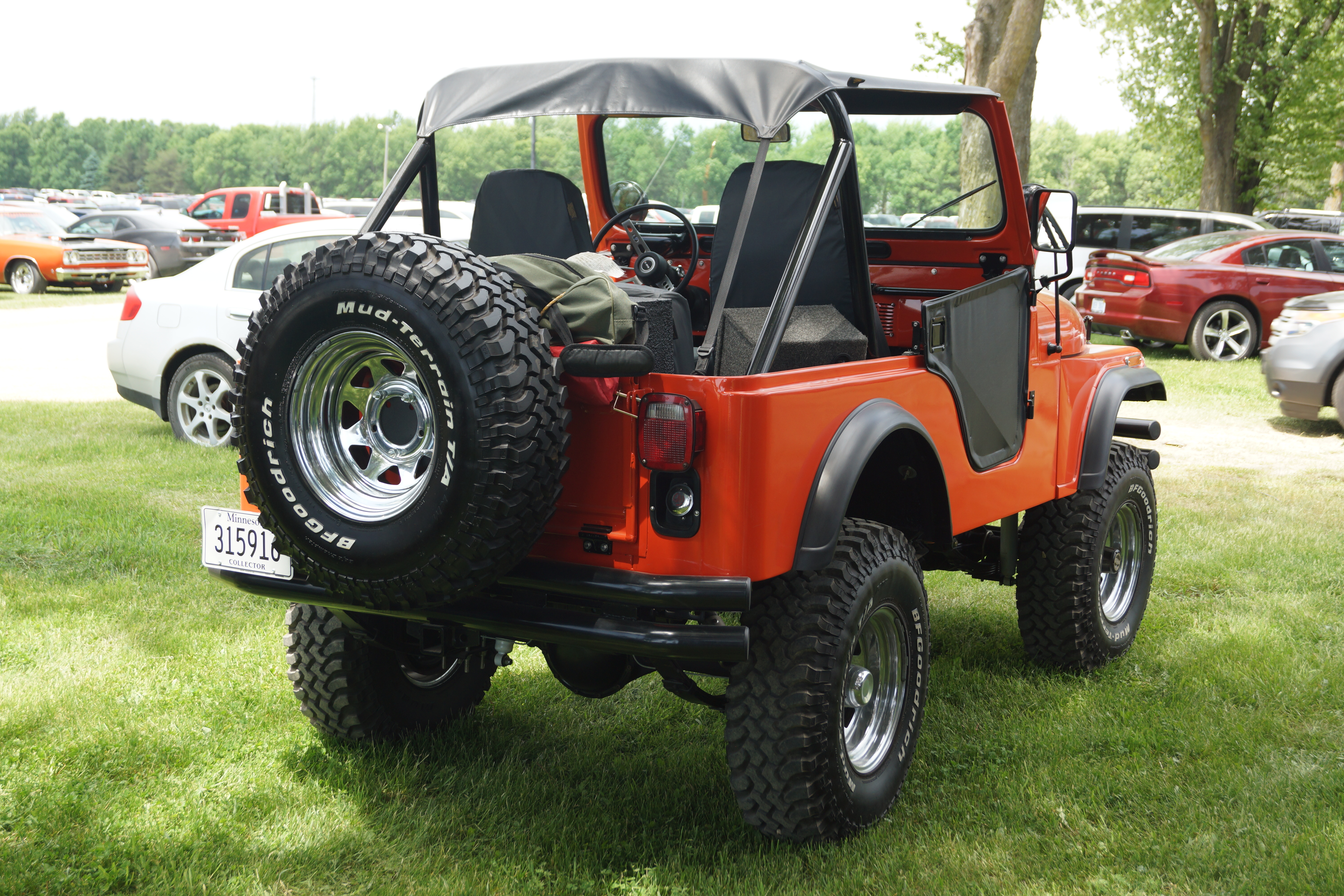
Jeep Cj7
"Like my wife CJ7 I put disc brakes on that"
The Jeep CJ7 is a classic off-road Jeep that many owners modify. Here, the host talks about upgrading it by switching to disc brakes.
The Jeep CJ7 is a classic, open-air-capable off-road Jeep from the CJ lineup, known for being popular with enthusiasts who modify them. In this segment, the host mentions swapping from one brake system to another by putting disc brakes on a CJ7.
stick shift
"It's stick shift And the parking brakes don't work"
“Stick shift” means a manual transmission. You choose gears with a shifter and use the clutch pedal to change gears.
“Stick shift” is a common way to refer to a manual transmission, where the driver selects gears using a clutch and gear lever. It’s relevant here because the speaker is describing a Jeep brake setup in the context of a manual-equipped vehicle.
mechanical brakes
"I changed from mechanical brakes To hydraulic brakes"
Mechanical brakes use physical linkages (like cables or rods) to move the brakes. They can get weak or unreliable if the linkage stretches or isn’t adjusted well.
Mechanical brakes use cables or rods to transmit force from the pedal to the brake mechanism. They’re older-style compared with hydraulic systems, and they can be sensitive to linkage wear, alignment, and leverage.
hydraulic brakes
"I changed from mechanical brakes To hydraulic brakes"
Hydraulic brakes use brake fluid to send pressure from the pedal to the brake parts. That usually makes braking feel more consistent and effective.
Hydraulic brakes use brake fluid to transfer pedal force through pressurized lines to the calipers or wheel cylinders. This typically provides stronger, more consistent braking response than purely mechanical linkages.
bell cranks
"People remove the bell cranks And the torque multipliers"
Bell cranks are small lever parts that help move force from the pedal to the brakes. If you remove them, the brakes may not get enough movement to work properly.
Bell cranks are pivoting lever arms in a brake linkage that convert pedal/lever motion into the correct movement at the brake mechanism. Removing or altering them can reduce mechanical advantage, which can make the brakes ineffective.
torque multipliers
"And the torque multipliers And that And then the brakes don't work"
Torque multipliers are parts that help “multiply” the force from your foot or hand so the brakes can clamp down. If they’re removed, the brakes may not work because there isn’t enough force.
Torque multipliers are mechanical leverage devices in some brake linkage systems that increase the effective force applied to the brakes. If they’re removed, the driver may not be able to generate enough braking force for the parking brakes to work.

Jeep XJ
"And that is for our TJ, CJ, YJ, XJ guys When I did my XJ swap"
The Jeep XJ is the Cherokee generation that a lot of people build and modify. The speaker brings it up because they did a swap on an XJ and had to deal with brake setup details.
The Jeep XJ refers to the Cherokee (XJ generation), a unibody Jeep known for being a popular base for swaps and upgrades. The speaker mentions an “XJ swap,” tying the brake-linkage discussion to real-world Jeep project work.
internal parking brake
"Another important note [3520.0s] When you do have that internal parking brake [3523.6s] The metal of the backing plate"
This is the parking brake mechanism that’s built inside the brake setup. They’re saying the metal backing plate is important because it supports the small pins and parts that make the parking brake work.
An internal parking brake is a parking-brake mechanism packaged inside the vehicle’s braking assembly rather than mounted externally. Here, the hosts emphasize that the backing plate’s metal matters because it holds the brake pins and related hardware.
backing plate
"When you do have that internal parking brake [3523.6s] The metal of the backing plate [3526.7s] Is exceedingly important"
A backing plate is the metal base the parking-brake parts bolt or sit on. If it’s not right, the pins and hardware can’t be held securely.
A backing plate is the metal support surface that the parking-brake hardware mounts to. In this discussion, the hosts stress that the backing plate’s condition/material is critical because it holds the parking-brake pins.
pins
"The metal of the backing plate [3526.7s] Is exceedingly important [3529.3s] Because that is what holds your pins [3531.8s] And that kind of stuff"
Pins are small metal pieces that keep the parking-brake parts positioned correctly. They’re saying the backing plate must be strong enough to hold those pins.
In a parking-brake mechanism, pins are the small locating/retaining components that hold the hardware in place and allow the mechanism to function correctly. The hosts connect backing-plate integrity to the pins’ ability to stay supported.
ABS sensor
"And get caught and snap the ABS sensor And we haven't traditionally seen"
The ABS sensor helps your car know how fast each wheel is spinning. If it’s broken or not set up right, the anti-lock brakes may not work properly.
An ABS sensor is part of the anti-lock braking system and measures wheel speed. If it’s damaged or installed incorrectly, the ABS can malfunction or fail to activate when you need it.
aftermarket support
"Good aftermarket support for those parts either Where other brands"
Aftermarket support means there are lots of parts available from other brands, not just the car maker. That can make repairs easier and cheaper.
Aftermarket support refers to how many replacement parts, upgrades, and accessories are available from companies other than the original manufacturer. Strong aftermarket support usually means easier repairs and more options for DIY work.
DIY friendly service
"That now Brakes can still be A DIY friendly service But you have to prioritize"
A DIY-friendly service is a repair or maintenance job that’s practical for an owner to do at home with reasonable tools and instructions. The speaker is emphasizing that brakes can be DIY, but the details matter.
high quality installation
"But you have to prioritize A high quality installation And follow through process"
High quality installation means following the correct procedures when installing brake components—torque specs, proper seating, and correct alignment. Poor installation can cause noise, uneven wear, or reduced braking performance.
approved brake grease
"And that you do need Approved brake grease You do need to make sure that everything is super clean"
Approved brake grease is a specialized lubricant formulated for brake hardware (like caliper slides and contact points). Using the wrong grease can contaminate brake pads/rotors or break down under heat, leading to sticking or noise.
fluid
"And that you do need Approved brake grease You do need to make sure that everything is super clean And fluid in the process"
Brake fluid is the hydraulic fluid that transfers force from the brake pedal to the calipers. If it’s contaminated or handled incorrectly during service, braking feel and performance can suffer.

Jeep Liberty
"And I run an oversized Jeep Liberty oil filter Yes"
The Jeep Liberty is an SUV made by Jeep. The podcast mentions using a larger oil filter, which is something owners may do to help with routine maintenance. It’s a practical example of how people keep these vehicles running.
The Jeep Liberty is a Jeep SUV that was sold in multiple generations, typically positioned as a smaller alternative to larger Jeep models. It’s being mentioned in the podcast in the context of an oil filter upgrade, which highlights how owners sometimes tailor maintenance to their driving needs. That kind of discussion is common with older or enthusiast-owned vehicles.

3 Three Wheeler
"Then it would push it forward Like a three wheeler And I remember we were"
A three wheeler is a vehicle that has three wheels instead of four. In the podcast, it’s used as a simple comparison for how something would move or push forward. It’s not a specific brand—just the idea of a three-wheel vehicle.
A “three wheeler” refers to a vehicle with three wheels, often used for small, lightweight transport or specialized applications. In the podcast context, it’s being used as a comparison for how something moves or pushes forward. It’s not a specific model, but rather a general reference to the behavior of a three-wheel setup.
Request an Explanation
Heard something you'd like explained? We'll add it to this episode.
Sign in to request explanations for terms you heard.
Want to learn more?
Browse our glossary for plain-English explanations of automotive terms, jargon, and concepts.
Help improve this episode
See something that's not quite right? Our annotations are AI-generated and can sometimes miss the mark. Click the flag icon on any annotation to suggest a correction.