
Bonus Episode: KDM Week at Escondido Cars & Coffee
About this episode
Rainy Korean-car theme week at Escondido Cars & Coffee kicks things off with a Hyundai vs Genesis debate, starting from the Hyundai Elantra N. The conversation widens to Genesis engine options, Kia’s K900 positioning, and how “badge” value can sway buyers. Warranty coverage and shared parts between Hyundai and Kia come up, alongside platform talk. They also speculate on Hyundai’s racing engine displacement rules, then compare Genesis coupes to Nissan Z and discuss exhaust and component sourcing.
A special bonus episode of Cool Cars with Chris recorded live from KDM Week at Escondido Cars & Coffee in Southern California.
Despite rainy weather, enthusiasts still showed up to celebrate Korean performance and automotive culture, featuring Hyundai N models, Genesis sedans and coupes, Kia performance cars, and more from the growing KDM scene.
This episode explores how Hyundai, Kia, and Genesis evolved from budget-friendly brands into serious competitors in the worlds of performance, luxury, and motorsports. The conversation covers the Genesis Coupe legacy, Hyundai N performance engineering, luxury comparisons with BMW and Mercedes-Benz, reliability debates, future turbocharged N engines, and the rise of Korean car culture in the enthusiast community.
Topics include:
• KDM Week at Escondido Cars & Coffee
• Hyundai Elantra N and Kona N discussion
• Genesis G70, G80, and Genesis Coupe talk
• Korean luxury cars vs BMW and Mercedes
• Hyundai and Kia reliability perceptions
• Hyundai N performance rumors and racing development
• Korean automotive culture and community growth
00:00 – Bonus Episode Intro from KDM Week
00:38 – Rainy Start at Escondido Cars & Coffee
01:20 – KDM Turnout Despite the Weather
02:05 – What Counts as a KDM Car?
02:45 – Hyundai, Kia, Genesis & Daewoo Discussion
03:50 – Genesis Luxury Cars vs BMW & Mercedes
05:05 – Badge Culture and Brand Perception
06:15 – Hyundai & Kia Reliability Debate
07:35 – Hyundai vs Kia Marketing Strategies
08:30 – Favorite Korean Performance Cars
09:15 – Kona N, Elantra N & Genesis Coupe Talk
10:00 – Future Hyundai N Engine Rumors & Outro
#KDM #HyundaiN #GenesisCoupe #CarsAndCoffee #CoolCarsWithChris #Hyundai #Genesis #Kia #ElantraN #CarPodcast
KTM
"Having us out and then also having that KTM Korean car week out here. Got some folks that braved it."
KTM is usually known for motorcycles, not cars. In this episode, it sounds like “KTM” is being used as the name of the event or group, not the car brand itself.
KTM is referenced here as “KTM Korean car week,” but in automotive contexts KTM is most commonly known as a motorcycle brand. The transcript appears to be using “KTM” as a shorthand for the event name rather than a car brand being discussed.

Hyundai Veloster
"... You were the old one. Yeah, it was just me and a Veloster in over on that side. But yeah, it looks like we ..."
The Hyundai Veloster is a smaller car that’s meant to be practical but still look sporty. It’s not a large luxury car—more of an everyday vehicle with a unique design. People may bring it up because it’s a noticeable, affordable option in its class.
The Hyundai Veloster is a compact car known for its sporty styling and practical everyday size. It’s often mentioned because it’s a more affordable option in the “fun-to-drive” segment and stands out with its distinctive body shape. In the podcast, it’s referenced as a specific car present in the scene, likely as an example of what people were looking at or driving.

Hyundai Genesis
"...'s Hyundai. Is there anything else? Yeah, you got Genesis, which is... Well, Genesis is Hyundai though. Yea..."
Genesis is Hyundai’s luxury brand, so it makes nicer, higher-end versions of cars than Hyundai’s regular lineup. The idea is to offer more comfort and premium features. It comes up when people talk about luxury cars that are still connected to Hyundai.
Genesis is Hyundai’s luxury brand, and the Genesis lineup is built to compete in the premium segment with more upscale interiors, comfort-focused features, and a higher-end driving experience. It’s discussed in automotive conversations because it represents Hyundai’s push into luxury, often aiming to offer more features and refinement. In the podcast context, it’s being mentioned as a luxury alternative alongside other large, feature-rich sedans.
Daywoo
"But you also, I love that Mike actually included Daywoo in there. Like you got Daywoo. I've heard of Daywoo. They're Korean?"
Daewoo (spelled “Daywoo” in the transcript) was a Korean car brand that used to show up in the U.S. more than it does now. It’s the kind of older brand people might still recognize from past years.
Daywoo (Daewoo) was a Korean automaker that had a presence in the U.S. in earlier decades, but it’s much less common today. The mention matters because it highlights how “Korean car week” can include older brands that enthusiasts remember from the past.

Genesis G70
"I really wanted the G70. The G70 is a little bit more of the equipment... but the G70 has a 3.3. They have one with a 3.3-liter turbo."
The Genesis G70 is a luxury sedan that’s meant to feel sporty. Here they’re talking about the 3.3-liter turbo version, which is the stronger engine option.
The Genesis G70 is a luxury sport sedan from Genesis (Hyundai’s luxury brand), known for offering a performance-focused setup at a lower price than some German rivals. In this segment, they specifically mention a 3.3-liter turbo version, which is the model’s higher-output engine option.
3.3-liter turbo
"They have one with a 3.3-liter turbo. And those things, you know, put out a lot of power."
A turbo adds extra air to the engine using exhaust pressure. That usually makes the car feel stronger without needing a bigger engine.
A turbocharged engine uses exhaust gases to spin a turbine, forcing more air into the cylinders. That lets a relatively smaller displacement engine (like 3.3 liters) make more power than a non-turbo setup.
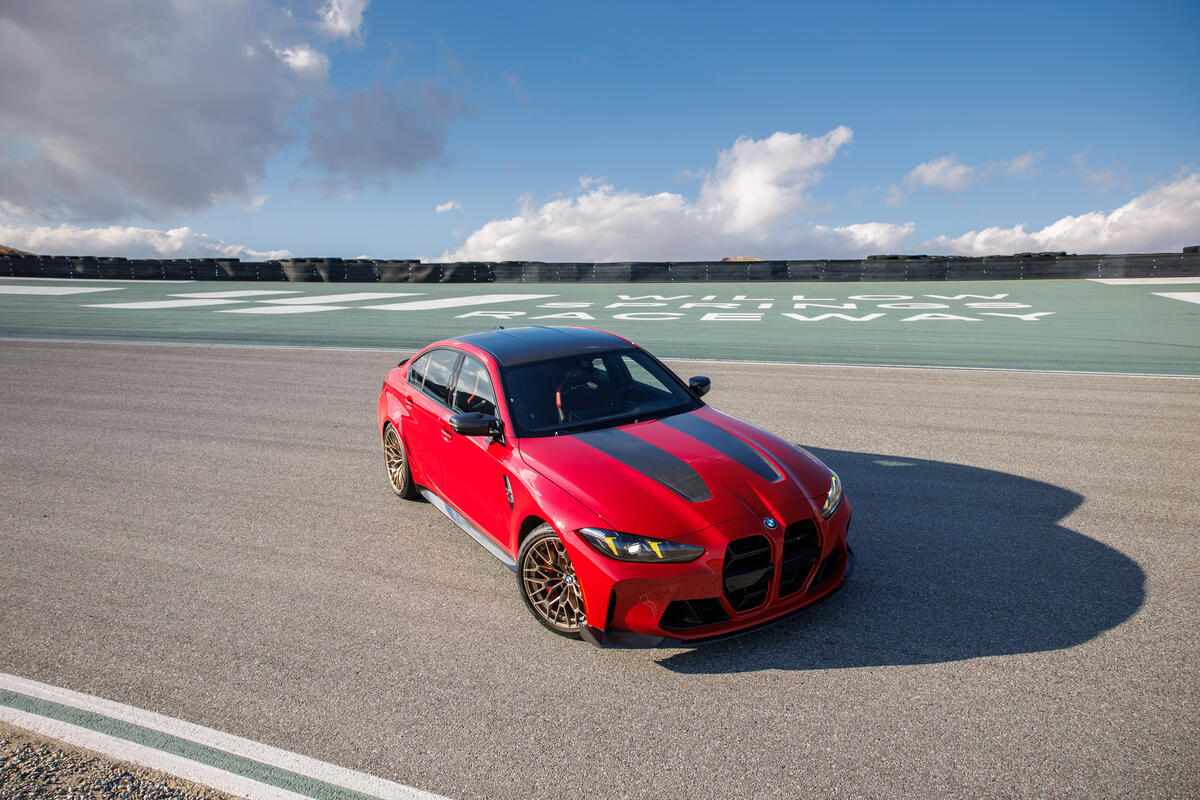
BMW M3
"... those. And I did want to... They had the Hyundai G80, I think it was. And they had a V8 version of tha..."
The BMW M3 is a sporty, higher-performance version of a BMW sedan. It’s made to drive more aggressively and feel more responsive than a regular model. People mention it because it’s known for performance and driving excitement.
The BMW M3 is a high-performance version of the 3 Series, built for drivers who want strong acceleration, sharp handling, and a sport-focused driving feel. It often comes up in car discussions because it represents a “serious” performance package rather than a basic daily sedan. In a podcast, it’s a common reference point when people talk about what makes a car feel fast and engaging.
Hyundai G80
"They had the Hyundai G80, I think it was. And they had a V8 version of that."
The Hyundai G80 is a luxury sedan. They’re saying there was a V8 version, which would make it feel more powerful than the usual smaller engines.
The Hyundai G80 is a large luxury sedan from Hyundai’s lineup, positioned as a comfort-and-features alternative to German luxury cars. This segment mentions a V8 version, which is notable because it’s a higher-performance engine choice compared with the more common V6 options.

Mercedes-Benz Sclass
"features of a BMW or a Mercedes for like half the price. Yeah. Actually, sorry to cut you off, but I'm going to say there's the Kia K900 over there. There was like basically an S-Class competitor that they... Really? What was the price tag on that compared to the price tag on a Mercedes?"
The Mercedes-Benz S-Class is a large luxury car meant to be very comfortable and feature-rich. It’s designed for a smooth, quiet ride and lots of convenience technology. It comes up in conversations when people compare top-tier luxury cars and what you get for the money.
The Mercedes-Benz S-Class is a full-size luxury sedan designed to deliver comfort, quietness, and advanced features. It’s frequently discussed because it’s a benchmark for high-end amenities and technology in a flagship sedan. In the podcast context, it’s also being compared to other “luxury flagship” style competitors for value and features.

Kia K900
"I'm going to say there's the Kia K900 over there. There was like basically an S-Class competitor... What was the price tag on that compared to the price tag on a Mercedes?"
The Kia K900 is Kia’s big luxury car. They’re comparing it to the Mercedes S-Class, basically saying it tries to compete with that kind of luxury for less money.
The Kia K900 is Kia’s full-size luxury sedan, aimed at buyers who want big-car comfort and features. In this segment it’s framed as an “S-Class competitor,” meaning it’s marketed to go after Mercedes-Benz S-Class shoppers—often with a lower price.
badge
"It's kind of like you're paying for the... You're basically... You're part of the club... It's the badge. Yeah. It is the badging."
In car shopping, “the badge” refers to the brand emblem and name on the vehicle, which can strongly influence perceived status and desirability. The hosts argue that some buyers pay extra primarily for that brand identity rather than purely for the underlying engineering or features.
perception of them from early 2000s
"is that everybody kind of has a perception of them from early 2000s, even mid 2010s of this was Hyundai and Kia."
They’re talking about how people’s opinions about Hyundai and Kia can be stuck in the past. Some folks still assume they’re unreliable, while others say their cars have been trouble-free.
This segment discusses how brand reputation can lag behind improvements—specifically how Hyundai and Kia were perceived in the early 2000s and even into the mid-2010s. The hosts contrast that old reputation with newer experiences where some cars are described as extremely durable.
100,000 mile warranty
"say like they're horrible to work on or they're just like they break down. That's why they offer the 100,000 mile warranty. Does both Hyundai and Kia offer the same warranty?"
A 100,000-mile warranty means the car is covered for repairs for a certain number of miles. If something covered breaks before you hit that mileage, the warranty helps pay for the fix.
A 100,000-mile warranty is a manufacturer-backed coverage period measured by mileage rather than time. It typically applies to specific components (often powertrain-related) and is meant to reduce the buyer’s risk if major failures happen within that mileage window.

Hyundai Kona
"Bias aside, I mean, I do, I really like the, you know, I like the Kona in because it was just a weird, you know, I was really close to getting the Kona in actually before I got the Elantra in."
The Hyundai Kona is a small SUV-style car. It’s built on a platform that’s shared with other Hyundai models, so it’s not as “truck-like” as some bigger SUVs.
The Hyundai Kona is a compact crossover SUV built on a car-like platform, which is why it can feel like a “regular car” but with SUV styling and ride height. In the Kona lineup, buyers often choose between different powertrains, but the key point is its crossover packaging and shared underpinnings with other Hyundai models.

Hyundai Elantra
"I was really close to getting the Kona in actually before I got the Elantra in. It's like an SUV kind of one, right?"
The Hyundai Elantra is a compact car (a sedan). The point here is that Hyundai can make different kinds of cars using similar underlying engineering.
The Hyundai Elantra is a compact sedan that’s known for being practical and widely available, and it’s also part of Hyundai’s broader “shared platform” strategy. In this segment, it’s used as the baseline for comparing how Hyundai can offer different body styles (like a crossover) while reusing underlying architecture.
front wheel drive SUV
"It's like an SUV kind of one, right? It's like, I don't know if you can see like a big SUV. It's a front wheel drive SUV, probably built on a regular car chassis, car platform."
Front-wheel-drive means the front wheels do the work of moving the car. Many smaller SUVs use this layout because it’s simpler and usually gives good everyday traction.
A front-wheel-drive (FWD) SUV means the engine’s power is sent to the front wheels, which typically improves packaging and can help with traction in everyday conditions. Many crossover SUVs are FWD-based because it keeps the drivetrain simpler and allows more interior space.
car platform
"It's a front wheel drive SUV, probably built on a regular car chassis, car platform. What car platform to share a platform with? I think they're all on the same chassis, I think, because they all have the same wheelbase essentially."
A car platform is the main underlying structure and engineering that a car is built on. If two cars share a platform, they can be different on the outside but still be related underneath.
A car platform is the shared engineering “base” (major structural and mechanical design choices) that multiple models can use. When brands share a platform, they can build different body styles—like sedans and crossovers—without redesigning everything from scratch.
wheelbase
"because they all have the same wheelbase essentially. Right, the same as yours? Yeah."
Wheelbase is how far apart the front and rear wheels are. Cars with the same wheelbase often feel similar in terms of space and ride.
Wheelbase is the distance between the front and rear axles. It strongly influences interior space, ride comfort, and how the car behaves dynamically, and it’s often similar across models that share a platform.

Hyundai Sonata
"So I think a pretty, you know, similar scenario. Sonata as well is kind of like that. I love the Sonata inlines. They're really cool."
The Hyundai Sonata is a larger sedan than the Elantra. Here it’s brought up as another Hyundai model that likely shares engineering with other cars in the lineup.
The Hyundai Sonata is a mid-size sedan that’s part of Hyundai’s lineup strategy of using shared underpinnings across multiple models. In this segment, it’s mentioned as another example of a model that can be related to other Hyundai vehicles through common architecture.

Genesis G80
"But I do like a lot of the Genesis products. Like I said, I would have loved the Genesis G80. Even the G90 is also like"
The Genesis G80 is a luxury sedan. It’s the kind of car Genesis makes to feel more upscale than Hyundai’s regular models.
The Genesis G80 is a luxury sedan from the Genesis brand, positioned to compete with mainstream luxury offerings. In this segment, it’s highlighted as a car the speaker would have wanted, and it also ties into the discussion about Hyundai’s broader product strategy via Genesis.

Genesis G90
"Even the G90 is also like the, this long kind of stretched out wheelbase version. Those are cool."
The Genesis G90 is Genesis’s top luxury sedan. It’s described here as a longer version, which usually means more space—especially for rear passengers.
The Genesis G90 is Genesis’s flagship luxury sedan, known for its long-wheelbase, full-size comfort and upscale positioning. The speaker mentions it as a “stretched out” wheelbase version, which is a common way luxury brands create a more spacious rear-seat experience.
engine displacement limits
"there's basically confirmation because of a racing series that they're going to enter, where the limitation on like the size of engine is either from 2.1 liter to 2.7 liters."
Racing series often set rules about how big the engine is allowed to be. If the allowed range is, say, 2.1 to 2.7 liters, teams design their engines to fit inside that window.
Engine displacement limits are class rules that cap how large an engine can be in a given racing series. The transcript mentions a range (2.1 to 2.7 liters), which directly affects what engine sizes manufacturers choose to develop for competition.
homologation
"And so it would make sense if it's like a homologation for them to stretch out and go with the two and a half liter because they can get more power out of it."
Homologation is basically the rule that says a race setup has to be based on something you can buy or build for regular cars. Racing rules can force companies to use certain engine sizes, so they adjust the engine to qualify.
Homologation is when a manufacturer builds and sells a road-legal version of a car (or engine) so it’s eligible to compete in a racing series. In practice, the rules often require specific engine sizes or configurations, which is why manufacturers may “stretch” displacement to fit the class limits.
rate pipe them
"If you just like with a Z, if you just rate pipe them, you know, they get very loud. [496.3s] But that's kind of the car I was going to think about getting,"
They mean modifying the exhaust so it’s louder. Usually that involves changing parts in the exhaust system to let gases flow more freely and make more noise.
“Rate pipe” here is almost certainly referring to swapping or removing exhaust components (often the mid-pipes/catalyst section) to make the car louder. It’s a common enthusiast shorthand for exhaust modifications that reduce restrictions and increase sound.

G35
"Genesis Coupes, probably a 3.8 liter. [505.7s] But because it was probably very similar to a G35, G37 Coupes."
They’re referencing the Nissan G35, a sporty V6 car from Nissan’s lineup. In this conversation, it’s used as a comparison for how similar Genesis coupes feel in power and vibe.
The Nissan G35 is a V6-powered coupe/sedan that became a benchmark for “affordable sporty” performance in the 2000s. The speaker is using it as a comparison point for Genesis coupes, implying similar engine size and overall character.

G37 Coupes
"very similar to a G35, G37 Coupes. [509.5s] Yeah."
They’re talking about the Nissan G37 Coupe, another V6 Nissan sports car. The point is that Genesis coupes were being compared to it because they’re in the same general performance category.
The Nissan G37 Coupe is a V6 sports car that followed the G35 and is often discussed as a step up in refinement and performance. Here, it’s mentioned as a comparison for Genesis coupes with similar displacement and sporty intent.

Infiniti M45
"like in the FX45 and then the M45. [539.8s] Oh, right. [540.2s] If they would have brought that and put that in the Z, how cool that would have been."
They’re also referencing the Infiniti M45 as another V8 example. The idea is still the same: using that V8 engine in a Z would make it more exciting.
The Infiniti M45 is a V8-powered sedan, mentioned alongside the FX45 as another source of the “four and a half liter” engine the host wishes could be used in a Nissan Z. It’s part of the same conversation about swapping in a different engine to change performance and sound.
in-house
"Do they build their own motors in-house or do they have to, somebody else build them... I've heard that a lot of their construction process is actually in-house... they manufacture all of that stuff kind of straight out of the gate on their own."
“In-house” means the car company makes the parts itself instead of buying them from another company. That can help them control quality and timing, and sometimes keep costs more predictable.
“In-house” means a company makes a component internally rather than outsourcing it to an external supplier. In automotive terms, it often affects cost, supply control, and how quickly a brand can iterate on parts like engines, seats, and brakes.
bucket seats
"Even one thing that they've said about like some of the components of the in-cars, like the bucket seats and the brakes and things like that..."
Bucket seats are contoured seats designed to hold you in place with deeper side bolsters. They’re commonly used in performance-oriented cars because they help reduce body movement during hard cornering.
brakes
"Even one thing that they've said about like some of the components of the in-cars, like the bucket seats and the brakes and things like that..."
Brakes are what slow and stop the car. For sportier setups, the specific brake parts can make a difference in how strongly and consistently the car stops, especially when driving hard.
Brakes are the vehicle’s stopping system, typically involving pads/rotors and hydraulic or electronic control. In performance discussions, brake choice can affect stopping power, heat handling, and pedal feel.
Brembo
"is they didn't want to go with, say, a Spark OC or like a Brembo seat, because that would mean that they would then have to like charge more"
Brembo is a company famous for making performance brake parts. The idea here is that using a premium brake brand can increase the cost of the car.
Brembo is a well-known performance brake brand that supplies high-end brake components to many sports cars. The host mentions it as an example of a premium supplier that could raise the car’s price if used.
Request an Explanation
Heard something you'd like explained? We'll add it to this episode.
Sign in to request explanations for terms you heard.
Want to learn more?
Browse our glossary for plain-English explanations of automotive terms, jargon, and concepts.
Help improve this episode
See something that's not quite right? Our annotations are AI-generated and can sometimes miss the mark. Click the flag icon on any annotation to suggest a correction.