
Car Repair Advice Live Taking Your Calls from the Experts
About this episode
A live call-in episode that jumps between practical diagnostics and real-world repair decisions. The experts explain why start-stop can shut down when the check engine light is on, then recommend scanning for codes. They cover EVAP failure points, fuel additive cautions, and GDI cleaner requirements. Later, transmission and wheel-speed sensor issues get detailed treatment—plus guidance on headlight failures, including measuring voltage under load and fixing corroded connectors. The show also touches recalls via VIN checks and ends with classic-car alignment advice using spacers.

2019 Jeep Grand Cherokee Laredo
"I've got a 2019 Jeep Grand Cherokee Laredo, and my start stop had seemed to go on the blank... But it was not a good battery, so I changed both the batteries..."
This is a 2019 Jeep Grand Cherokee. It has a feature that can shut the engine off when you stop and restart it when you’re ready to go. The problem here is that the start-stop feature isn’t working anymore.
The 2019 Jeep Grand Cherokee Laredo is a mid-size SUV that uses a start-stop system to reduce idle time and improve fuel economy. In this call, the owner’s start-stop behavior is failing—so the car may not be shutting off at stops and may feel like it’s not getting the expected power.
start stop
"I've got a 2019 Jeep Grand Cherokee Laredo, and my start stop had seemed to go on the blank... So no stop start at all."
Start-stop is a system that turns the engine off when you’re stopped (like at a light) and turns it back on when you’re ready to move. If something isn’t right—like the battery or a warning code—the car may turn this feature off.
Start-stop is an engine management feature that automatically shuts the engine off when the vehicle is stopped and restarts it when you press the accelerator or release the brake. It relies heavily on battery health and sensors, and if the system detects a fault it may disable start-stop entirely.
gas cap
"Any code? ... It's leaving the gas cap off. I mean, that's the one that everybody hopes it always is."
The gas cap has to seal correctly. If it’s off or loose, the car can detect a small emissions problem and turn on the check engine light, which may also disable start-stop.
A gas cap left off or not sealing properly can trigger an evaporative-emissions fault because it allows fuel vapors to escape. That can set a check engine light, and as the host notes, the presence of a code can shut down systems like start-stop.
check engine light
"no stop start, it just doesn't operate, and there's no check engine light, no codes. But in your case, you've got a code. If you fix that code, you're going to fix the stop start problem."
The check engine light comes on when the car’s computer finds a problem. It can be for the engine itself, but sometimes it’s also triggered by other systems that affect how the car runs.
The “check engine light” is the dashboard warning that the engine or emissions control system has detected a fault. Modern cars also use it as a general warning when related systems (like stop-start) trigger diagnostic trouble codes.
stop start
"wish they had, no stop start, it just doesn't operate, and there's no check engine light, no codes. But in your case, you've got a code. If you fix that code, you're going to fix the stop start problem."
Stop-start is a feature that turns the engine off when you’re stopped, then turns it back on when you press to go. It’s meant to save fuel, but it needs the battery to be healthy to work correctly.
“Stop-start” is an engine idle-stop system that shuts the engine off when the car is stopped (like at a light) and restarts it when you’re ready to move. It relies heavily on the battery and the car’s control modules to know when it’s safe to shut down and restart.
codes
"But in your case, you've got a code. If you fix that code, you're going to fix the stop start problem. Now one, the stop start light being on can be caused by bad stop start battery."
“Codes” here means diagnostic trouble codes (DTCs) stored by the car’s computer when it detects an abnormal condition. A scan tool reads these codes so you can identify the specific subsystem causing the problem instead of guessing.
misfire
"But any other code, fuel cap, misfire, anything like that, air conditioning, pressures can do some weird stuff sometimes."
A misfire means the engine doesn’t burn fuel correctly in one cylinder. The car notices it and logs an error code.
A “misfire” is when one or more cylinders fail to ignite properly during combustion. Misfires are detected by the engine control unit and typically generate diagnostic codes that can affect drivability and other systems’ behavior.
fuel cap
"But any other code, fuel cap, misfire, anything like that, air conditioning, pressures can do some weird stuff sometimes."
If the fuel cap isn’t sealed tightly, the car can detect a possible vapor leak. That can turn on warning lights and store error codes.
A “fuel cap” issue can trigger evaporative-emissions diagnostics because an improperly sealed cap can cause fuel vapor leaks. That can lead to stored codes and may coincide with other symptoms, even if the stop-start problem is separate.
scanner
"And I mean, you could just have, you need to plug it into a scanner and find out what those codes are. And once they're fixed, this, this issue with the stop start should go away unless it's originating from the stop start."
A scanner is a tool that plugs into your car and reads the computer’s error messages. It helps you pinpoint the problem instead of replacing parts blindly.
A “scanner” is a diagnostic tool that connects to the car’s onboard computer to read stored DTCs and sometimes live data. It’s the fastest way to confirm whether the stop-start issue is truly tied to a battery/starter-related fault or something else.
battery voltage
"And it says something like starter malfunction or battery voltage that then that would be turning the check engine light on, but scanning it is going to be the first, first thing."
Battery voltage is how much electrical power the car’s battery is providing. If it’s too low (or fluctuating), the car may disable stop-start and log warnings.
“Battery voltage” refers to the electrical system’s measured voltage, which the car monitors to ensure the battery and charging system are operating correctly. Low or unstable voltage can prevent stop-start from functioning and can trigger related diagnostic codes.
evap
"[338.0s] evaporative emission system or a misfire code causing that issue."
EVAP is a system that keeps gasoline vapors from escaping into the air. Instead, it stores those vapors and later sends them to the engine to be burned.
“EVAP” stands for evaporative emission control. It captures fuel vapors from the fuel tank and routes them to be burned in the engine instead of venting them to the atmosphere.
leak detection pump
"[355.6s] You know, a lot of times when the evap systems fail in those, it's what they call a leak [358.8s] detection pump that monitors the pressure in the, in the back."
The leak detection pump is a small EVAP-system component that helps the car check for fuel-vapor leaks. If it can’t build or hold pressure, the car may light a warning and store EVAP-related codes.
A leak detection pump is part of the EVAP system that pressurizes the EVAP lines/tank area so the car can check for small leaks. If the pump or its control strategy fails, the EVAP system can trigger fault codes and cause drivability or emissions-related warnings.
vent valve
"[358.8s] detection pump that monitors the pressure in the, in the back. [362.6s] And it also is the vent valve back there that runs that."
The vent valve is a small EVAP component that controls how vapors move through the system. If it doesn’t open/close correctly, the car can’t regulate EVAP operation and may set a code.
In an EVAP system, the vent valve controls airflow between the EVAP canister and the rest of the system. When it sticks or fails, the EVAP pressure/flow checks can fail, leading to EVAP fault codes.

BMW E30
"..., this is just a more or less a shout out for the E30. I've used, I've used the anywhere from E10 to E2..."
The BMW 3 Series is a compact car made by BMW, usually as a sedan or similar body style. The “E30” part refers to an older generation of that same model line. People talk about it because it’s a well-known older BMW that many enthusiasts still work on and drive.
The BMW 3 Series is a long-running compact executive sedan/compact sports sedan line from BMW, known for balancing everyday usability with driving feel. In the context you shared, the discussion is specifically pointing to the E30 generation, which is often referenced as a classic enthusiast-era 3 Series. It’s a common topic on car podcasts because the E30 is widely supported and has a strong enthusiast following.
E10
"[407.1s] I've used, I've used the anywhere from E10 to E20 for years in my Nissan's. [415.9s] And recently they have it in Mitchell for E30 for three and a quarter."
E10 means the gas has about 10% alcohol (ethanol) mixed in. Some cars handle it fine, but older setups can be more sensitive to higher ethanol blends.
E10 is gasoline blended with about 10% ethanol. Ethanol content affects fuel volatility and how some older or flex-fuel-incompatible systems behave, so it can matter for cold starts, fuel system wear, and tune compatibility.
E20
"[407.1s] I've used, I've used the anywhere from E10 to E20 for years in my Nissan's. [415.9s] And recently they have it in Mitchell for E30 for three and a quarter."
E20 is gas with about 20% alcohol (ethanol). It can affect how the car runs and may be tougher on some fuel-system parts if the car isn’t meant for it.
E20 is gasoline blended with about 20% ethanol. Higher ethanol content can change fuel economy and can be harder on certain fuel system components if the vehicle wasn’t designed for it.
ethanol
"“but the ethanol, people want more ethanol because they're for profit. [637.4s] They want to make as much as they can. [639.0s] Um, bottom line is the ethanol comes from the United States.”"
Ethanol is a type of fuel made from plant material that’s mixed into gasoline. Different blends have different percentages, and that can affect how the fuel burns in your engine. The hosts are discussing why ethanol is being pushed and where it comes from.
Ethanol is an alcohol-based fuel additive/blend component made from biomass (often crops). It can be blended into gasoline to create fuels like E10 (10% ethanol) and E15/E85 (higher ethanol percentages), which changes fuel properties such as energy content and how the fuel behaves in the engine. The hosts discuss ethanol as a policy/industry-driven fuel mix and note that, in their view, much of it comes from the United States.

BMW E88
"...k isn't dirty or that. No premium, no, this is no E88, no E30, whatever, whatever it is for a week, jus..."
The BMW 1 Series is a smaller BMW model than the 3 Series. The podcast is comparing it to other older BMW generations, saying it’s not the same one being discussed. It’s brought up because it’s a different size and generation within BMW’s lineup.
The BMW 1 Series is BMW’s compact car line, positioned smaller than the 3 Series and typically offered as a hatchback or compact sedan depending on generation. In your excerpt, it’s mentioned in relation to other BMW “E” generations, with the point being that this particular 1 Series isn’t the same as the referenced older models. That makes it a relevant topic when discussing how different BMW generations feel and how they’re categorized.
miles per gallon
"would see pickup trucks that come city miles per gallon over 30 all the time. [753.8s] You'd be 30 to 40 miles per gallon. [755.8s] You'd see Toyota Prius is in that 80 mile per gallon range."
Miles per gallon (MPG) tells you how far a car can go on one gallon of gas. Higher MPG usually means you buy less gas for the same trip.
“Miles per gallon” (MPG) is a measure of fuel economy: how many miles you can drive per one gallon of fuel. Higher MPG generally means you spend less on fuel for the same distance, which is why the host compares MPG targets against fuel cost and fuel type.

Toyota Prius
"You'd be 30 to 40 miles per gallon. [755.8s] You'd see Toyota Prius is in that 80 mile per gallon range. [759.5s] They could tune them and do things with it."
The Toyota Prius is a hybrid car that’s famous for getting great gas mileage. The host brings it up to illustrate what “very high MPG” looks like.
The Toyota Prius is a hybrid that’s known for very high fuel economy compared with typical gasoline cars. In this segment, the host uses it as an example of a vehicle that can reach roughly the “80 mile per gallon” range (as stated) when conditions and technology line up.
octane
"And then they've got to figure out for the fuel costs and then you got to just [771.2s] kind of look at it and see where do we need to be to produce a higher octane [775.7s] fuel all the time and does that outweigh the extra miles per gallon."
Octane is a fuel rating related to how resistant gasoline is to “knocking” (premature combustion) in an engine. The host is discussing whether switching to higher-octane fuel all the time would be worth it compared with the benefit of higher fuel economy.
leaded gas
"And with the leaded gas, they're trying to move that over, but they have to do [808.7s] it right because you can't, you can't really miss when you're [811.9s] birds are all getting heavy from the extra lead."
Leaded gas is older gasoline that had lead added to it. Lead is harmful, so the host is pointing out that you can’t just switch fuels carelessly because of the serious effects lead has on living things.
Leaded gas refers to gasoline that contains added lead compounds, which historically helped reduce knocking. The host mentions “moving that over” and then warns that you can’t “miss” because the “birds are all getting heavy from the extra lead,” referencing the environmental/health consequences that led to leaded fuel being phased out.
Allison transmission
"[824.4s] Rich, what can we do for you? [827.3s] I've got a 20, 21 Chevy Duramax, three quarter ton, 10 speed, Allison transmission."
An Allison transmission is a heavy-duty automatic transmission used in trucks. It’s designed to handle more stress than many regular automatics, so repair shops often treat its problems differently.
An Allison transmission is a heavy-duty automatic gearbox made by Allison Transmission, commonly used in trucks and other commercial vehicles. Because it’s built for higher torque loads, it changes the way the vehicle behaves and how certain driveline issues are diagnosed and repaired.
service manager
"And first off, I asked the dealer that question and asked the service manager and as well as the parts manager, and they both gave me the same answer, like ... they just say, well, the transmission we put in there is the same model number as the one we took out."
The service manager runs the dealership’s repair department. They’re usually the one coordinating the repair and talking to you about what’s covered under warranty.
A service manager is the dealership staff member who oversees the service department—scheduling work, managing technicians, and coordinating warranty repairs. In warranty cases, they’re often the person who explains what was done and what parts were used.
parts manager
"And first off, I asked the dealer that question and asked the service manager and as well as the parts manager, and they both gave me the same answer, like ... they just say, well, the transmission we put in there is the same model number as the one we took out."
The parts manager is the person in the dealership who handles ordering and supplying the right replacement parts. They help make sure the correct part number gets used for the repair.
A parts manager controls the dealership’s parts ordering and inventory. For warranty repairs, they help ensure the correct replacement part (often identified by a part number or model number) is sourced and installed.
couldn't repeat the problem
"Now, when it had 40,000 miles on it, the dealer, I took it into the dealer under warranty and they couldn't repeat the problem. So with 40,000, I hadn't flushed the fluid and it never did it again, never"
This means the dealership couldn’t get the problem to happen while the car was there. If they can’t see it, it’s tougher for them to prove what’s wrong and fix it the first time.
“Couldn’t repeat the problem” means the dealer wasn’t able to reproduce the symptoms during diagnosis. That often makes warranty repairs harder because the technician can’t confirm the failure mode or verify the fix under the same conditions.
flushed the fluid
"So with 40,000, I hadn't flushed the fluid and it never did it again, never"
Flushing the fluid means replacing the old transmission fluid with fresh fluid. It can help if the fluid is dirty or degraded, but it’s not a guaranteed fix for every transmission problem.
A transmission fluid flush replaces old transmission fluid with new fluid to remove contaminants and restore proper lubrication and hydraulic operation. Whether a flush helps depends on the transmission’s condition and the specific failure symptoms.
traction control was disabled
"of on the display, said that the traction control was disabled, it was out of fuel, there was just several different items came up on the display."
Traction control helps the car not spin its wheels when the road is slippery. If it says it’s disabled, the car thinks something isn’t right, so it turns the system off to avoid making things worse.
Traction control is a stability system that reduces wheel spin by cutting engine power and/or applying brakes when it detects loss of grip. When the dash says traction control is disabled, it usually means the system has detected a fault and shut itself off for safety, which can happen alongside other warning messages.
new trend
"So when they pulled the codes, the next thing I know, they, they call out and said, Hey, we're going to give you a new trend. Interesting."
“New trend” sounds like it should be “new transmission.” The point is that the shop is replacing the gearbox with an updated one that’s meant to fix a known problem.
“New trend” appears to be a transcription error for “new transmission,” which fits the surrounding discussion about comparing the new transmission to the old one. In this context, the shop is replacing a failed/known-issue transmission with an updated version.
new transmission
"the question is, I guess, do you, do you think this new transmission is any better than the old one, or maybe, maybe I should trade it off while it's still working?"
The transmission is the part that changes gears so the car can drive smoothly at different speeds. If they’re talking about a “new transmission,” it usually means replacing the gearbox with one designed to be more reliable.
A transmission is the drivetrain component that manages gear ratios so the engine can deliver power efficiently across different speeds. When a “new transmission” is discussed as an upgrade, it usually means the manufacturer is replacing the unit with a revised design intended to address a known failure mode.
manufacturers to replace a part with a better up the sole
"Well, it is common for manufacturers to replace a part with a better up the sole, they're on the shelf. And as they build them, if they know there's a known issue, they will upgrade"
This describes a common manufacturer practice: issuing an updated “superseded” part to fix a known issue, often without changing the visible part number. The goal is to improve durability while keeping the ordering/fitment process consistent for dealers and service departments.
part number
"And they do not change the part number. It stays the same, just like oil filters. Tell people with working transmissions that they've changed anything."
A part number is like the part’s ID code used to make sure you get the right replacement. Sometimes the maker improves the part but keeps the same ID so it’s easier to order.
A part number is the manufacturer’s identifier used to order and match the exact component. In service, it matters because an updated design can sometimes be “superseded” while still using the same part number for compatibility and inventory reasons.
oil filters
"It stays the same, just like oil filters. Tell people with working transmissions that they've changed anything. No, you know, like a, like an oil filter, PF 63 oil filter is still going to"
An oil filter cleans the oil as it circulates through the engine. The host is using it as an example that makers can improve parts over time without changing the label you order by.
Oil filters are service components that remove contaminants from engine oil to protect bearings and other internal parts. The host uses oil filters as an analogy for how manufacturers can update internal design details while keeping the same ordering identifier.
transmission locks up
"been a lot in the news about how it locks up the back wheels, and, you know, ... this pickup did get called in on a recall for the transmission ... the software is then supposed to tell you ... before the transmission locks up"
“Locks up” means the transmission stops working normally and gets stuck in a protective state. That can make the car behave strangely or even dangerously, so it’s a big warning sign.
“Locks up” means the transmission stops allowing normal gear/clutch behavior and instead engages in a stuck or protective mode. In this context, the host is describing a known failure behavior where the transmission can lock up and cause unsafe drivability (like sudden loss of smooth control).
recall
"actually it did, it did even get called, and this pickup did get called in on a recall for the transmission, but all they did was they didn't have the software"
A recall is when the car maker has to fix a problem on certain vehicles. It’s usually because the issue could affect safety or cause failures.
A recall is a manufacturer action (often required by regulators) to fix a safety-related defect in a specific set of vehicles. Here, the host says the pickup was recalled for the transmission, but the fix involved software rather than a mechanical redesign.
software
"but all they did was they didn't have the software and the software is then supposed to tell you, you know, several thousand miles before the transmission locks up"
The transmission has computer software that decides how it should act while driving. In this case, the software is supposed to notice trouble early and warn you before it becomes a bigger problem.
In modern vehicles, transmission software is the control logic that monitors sensors and decides how the transmission should shift or engage. The host is saying the software should detect a developing problem and warn the driver (via a code) thousands of miles before a severe failure like lock-up.
relearn
"they also take several hundred miles to relearn after they're installed ... if it does have a problem after it's been driven ... a few thousand miles and it's still doing the same thing"
After a transmission change or update, the car may need some time to “relearn” how to shift smoothly. That can cause temporary hesitation, but if it keeps happening after a while, it needs to be checked.
“Relearn” (often called adaptation) is the process where the transmission control module relearns shift/clutch behavior after a repair or installation. The host notes it can take several hundred miles to relearn, so early hesitation may be normal—unless it persists after the relearn period.
transmission cooler
"When they replaced the transmission, they didn't replace the cooler. And I had kind of questioned about that."
A transmission cooler is like a small radiator for your transmission fluid. It helps keep the fluid from getting too hot. If it’s contaminated, it can send dirty fluid back into the new transmission, so the shop has to decide whether to flush it or replace it.
A transmission cooler is a heat-exchanger that helps keep automatic transmission fluid at a safe temperature. When a transmission is replaced, leaving a contaminated cooler can circulate debris back into the new unit, so many shops decide whether to flush or replace the cooler based on what’s inside.
warranty
"Is there a come a point where if they, they might replace a transmission or any part, and if I'm close to the end, they're going to not give me an extended warranty on that part. Oh, there's some, if the warranty is three or 36,000 miles and you're at the very last day of it, they'll put one in and say, OK, your warranty's over."
A warranty is a guarantee that if something goes wrong within a set time or mileage, the repair may be covered. The host is saying that coverage can end exactly when the clock/miles run out, and after that they might not pay.
A warranty is the shop’s or manufacturer’s promise to cover repairs for a defined time or mileage after installation. The key point here is that warranties often have strict cutoff rules—if you’re at the very end of the coverage period, some shops may deny coverage once it expires, even if the part was installed recently.
GDI system cleaner
"But what's more important is a GDI system cleaner. [2006.7s] And that is a product available from CRC as well, where you're doing a direct [2012.1s] injected gasoline engine service kit you've got in the tank, but you've also"
GDI means the fuel is sprayed directly into the engine, not into the intake. A GDI cleaner is designed to loosen the sticky carbon that builds up on the intake valves and can mess with how air and fuel mix.
GDI (Gasoline Direct Injection) cleaners are made for engines that inject fuel directly into the combustion chamber instead of the intake port. A GDI system cleaner is meant to reduce deposits not just on injector tips, but also on the back side of the intake valves where carbon buildup forms.
CRC
"And that is a product available from CRC as well, where you're doing a direct [2012.1s] injected gasoline engine service kit you've got in the tank, but you've also"
CRC is a brand that sells car cleaning chemicals. Here they’re mentioned as making a cleaner specifically for direct-injection engines (GDI).
CRC is a consumer-facing brand that makes automotive chemical products, including cleaners for gasoline direct injection (GDI) systems. In this segment, the host points to CRC’s GDI cleaner kit as a way to clean both the fuel system and intake-valve deposits.
direct injected gasoline engine service kit
"where you're doing a direct [2012.1s] injected gasoline engine service kit you've got in the tank, but you've also [2017.3s] got through the induction system to clean the back of those valves."
This is a fuel additive kit made for cars that inject gas directly into the engine. It’s meant to clean more than one area—so deposits don’t keep building up on the intake valves.
A direct-injected gasoline engine service kit is an additive/cleaner package intended for gasoline direct injection engines. The idea is that you add it to the fuel tank and also route it through the induction system so it can clean deposits around the intake valves, not just the injector tip.
induction system
"but you've also [2017.3s] got through the induction system to clean the back of those valves. [2021.4s] Cause you want to clean out the injector tips for sure, but you want to get the"
The induction system is how air gets into the engine. In GDI cars, it also matters because carbon can build up on the intake valves, and some cleaners are designed to reach that area.
The induction system is the path air takes from the intake into the engine (including components like the intake manifold and throttle area). In GDI engines, cleaners that travel through the induction system can help remove carbon buildup on the back side of the intake valves.
carbon buildup
"but you want to get the [2026.2s] carbon buildup reduced and cleaned out from the backside of the valves because [2021.4s] that's going to disrupt airflow and cause all sorts of issues with your fuel"
Carbon buildup is gunk that forms on the inside of the engine, especially on the intake valves. In direct-injection cars, it can build up faster and then make it harder for air to flow correctly.
Carbon buildup refers to soot-like deposits that accumulate on intake valve surfaces in many gasoline direct injection engines. Because GDI doesn’t wash the valves with fuel the way port injection does, carbon can build up on the back side of the valves and interfere with airflow.
injector tips
"Cause you want to clean out the injector tips for sure, but you want to get the [2026.2s] carbon buildup reduced and cleaned out from the backside of the valves because"
Injector tips are the parts that spray fuel into the engine. If they get dirty, the fuel spray can be less accurate, and the engine may run worse.
Injector tips are the small nozzles at the end of fuel injectors where fuel is sprayed into the engine. Cleaning injector tips helps restore proper spray pattern and fuel delivery, but on GDI engines you also need to address valve deposits to fully improve airflow and combustion.
fuel trims
"that's going to disrupt airflow and cause all sorts of issues with your fuel [2034.8s] trims and things like that."
Fuel trims are the computer’s way of adjusting fuel delivery to keep the engine running right. If the engine can’t get the right airflow because of deposits, it may compensate by adding or subtracting fuel.
Fuel trims are the engine’s learned adjustments to how much fuel it injects based on sensor feedback. When airflow is disrupted by deposits on the intake valves, the engine may compensate by changing fuel trims, which can lead to drivability issues and diagnostic trouble codes.
radial tires
"I'm just getting ready to replace the radial tires and the mag wheels on it and put the standard steel wheels with the bias belt and tires on it."
Radial tires are a modern tire design where the cords are arranged in a way that helps the tire flex more evenly. They’re usually the standard choice on newer vehicles.
Radial tires use a construction where the tire’s internal cords run radially (from bead to bead) rather than diagonally. This design is common on modern cars because it typically improves ride comfort and tread wear compared with older bias-ply designs.
bias belt
"I'm just getting ready to replace the radial tires and the mag wheels on it and put the standard steel wheels with the bias belt and tires on it."
Bias-ply tires are an older style of tire construction. They can feel different from radial tires, and some classic owners switch to bias-style tires to keep the original look and driving character.
A bias-ply tire (often described in conversation as “bias”) uses cord plies laid at angles, and the tire’s behavior differs from radial tires. “Bias belt” here likely refers to a bias-ply setup intended to match the car’s classic-era tire choice and feel.
mag wheels
"I'm just getting ready to replace the radial tires and the mag wheels on it and put the standard steel wheels with the bias belt and tires on it."
“Mag wheels” usually means lightweight alloy wheels, often magnesium. People like them because they can change how the car feels compared with heavier steel wheels.
“Mag wheels” is a common enthusiast term for aftermarket wheels made from magnesium alloy (or magnesium-look wheels). They’re often lighter than some steel wheels, which can affect ride/handling feel and how the car’s alignment and tire setup behaves.
factory magnesium
"And then when you're an old man, these are factory, the factory magnesium was what ... I think I had one tight magnesium, but the car was not built with that."
Magnesium is a lightweight metal. The host is saying some cars originally came with magnesium parts (likely wheels), and later owners may swap them for different “cool” wheels. Going back to the original magnesium setup is partly about keeping the car as it was built.
“Magnesium” here refers to wheels or components made from magnesium alloy, which can be lighter than many steel or even aluminum options. The host is contrasting factory-original magnesium parts versus later replacements (“cool wheels”). Lighter wheels can reduce unsprung mass, which can improve responsiveness, though the main point in the segment is originality.
originals
"Okay. I said, I'm talking about the ones they were built with originally. So what I'm saying is we go from buying cool wheels to wanting originals."
“Originals” means the parts that came on the car from the factory. People often want to go back to those because they fit correctly and match the car’s intended setup. It’s especially common during restoration or when trying to keep a car authentic.
In this segment, “originals” means returning to the vehicle’s factory-spec parts rather than aftermarket replacements. That can matter for fitment, correct alignment hardware, and maintaining the intended suspension geometry. It’s a common enthusiast mindset when restoring or maintaining older cars.
alignment spacers
"So if you want to align this vehicle, uh, ooh, you know, they stopped, they stopped using the type of alignment spacers you're talking about. ... basically what it is, is a piece of metal, um, that is, looks like a fork and it fits in the bolt, you unbolt the bolt that holds the control arm on and you drop them in between there and the frame..."
Alignment spacers are little metal shims used to fine-tune how the wheels sit. Mechanics use them to get the wheel angles correct so the car tracks straight and wears tires evenly. They come in different thicknesses so you can adjust the suspension a little at a time.
Alignment spacers are small metal pieces used during wheel alignment to adjust suspension geometry. By changing the effective position of a control arm relative to the frame, they help dial in settings like camber and caster. They’re often used when a vehicle no longer has the original factory-style adjustment parts.
control arm
"...it fits in the bolt, you unbolt the bolt that holds the control arm on and you drop them in between there and the frame and they come in, in different thicknesses."
The control arm is a key part of the suspension that holds the wheel in the right position. When you loosen it, you can adjust where it sits. That’s how mechanics can correct the wheel angles during alignment.
A control arm is a suspension link that locates the wheel and controls its movement. In this context, unbolting the control arm allows the mechanic to insert alignment spacers between the arm and the frame. That changes the wheel’s alignment angles without replacing major suspension parts.
alignment guy
"if it doesn't, you need to find an old fashioned alignment guy... he gets a tape measure out, a can of spray paint and he aligns it and that's the way they can do it."
An “alignment guy” refers to a specialist who performs wheel alignments, often using older, manual methods when modern alignment equipment can’t measure or calibrate correctly for a particular vehicle. In the segment, the host describes using a tape measure and spray paint to set the wheels.
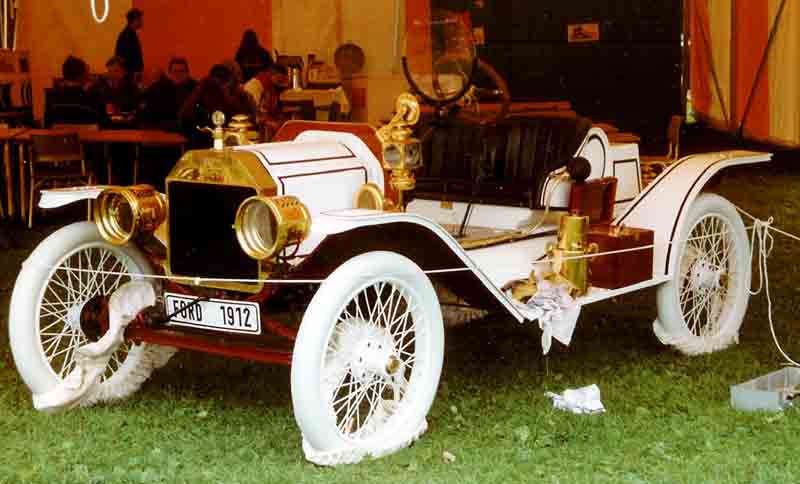
Ford Model T
"...car, your Ford car. I guarantee you, if I pull my Model T into that place and say, change the oil, they'll ..."
The Ford Model T is an old car made by Ford, from the early days of mass-produced automobiles. It’s famous for being one of the first cars many people could afford. The podcast is using it as an example of a car that’s still possible to service, like changing the oil.
The Ford Model T is a very early mass-produced automobile from Ford that helped popularize car ownership in the United States. It’s significant historically and is frequently discussed in the context of how simple, serviceable older cars were compared with modern vehicles. In your excerpt, it’s used as an example of a car that can still be maintained with straightforward tasks like oil changes.

Tesla My Model
"...ur car, your Ford car. I guarantee you, if I pull my Model T into that place and say, change the oil, they'l..."

Ford Cougar
"...415 Oh, that's a definitely a Berkeley classic 71 cougar. Oh yeah."
The Ford Cougar mentioned here is a classic American car from the early 1970s. It’s the kind of car people remember for its style and for being part of the muscle/pony-car era. The podcast is calling it a well-known classic that people still talk about.
The Ford Cougar referenced in your context appears to be the 1971 Mercury Cougar, a classic American muscle/pony car from the early 1970s. It’s being mentioned as a “Berkeley classic,” which suggests it’s a recognizable local or enthusiast favorite from that era. Classic cars like this often come up on podcasts because they’re distinctive, visually memorable, and have active communities around them.
convertibles
"[2404.6s] And the convertible, there were a lot of convertibles made in that year. [2408.5s] They made those up through, uh, you got 73, the big body car. [2415.6s] Convertibles, lots of, lots and lots of convertibles. [2418.0s] Those all leak in the, no, did they hold up over the years?"
A convertible is a car where the roof can fold down. On older ones, the roof seals can wear out, so rain can leak in unless the top and seals are in good shape.
A convertible is a car with a roof that can be folded down, typically using a power or manual mechanism. Because the roof has to seal against water and wind when closed, older convertibles are more prone to leaks if the top material, seals, or drainage paths wear out.
tea tops
"[2440.7s] Now the tea tops though, that was a fad that was used. [2444.7s] Well, it was a staple, but it was also a fad because it went away [2447.7s] because they had problems with them leaking and they get stolen a lot. [2451.3s] I just remember when it was, you could bring your car in and get a, uh,"
“T-tops” are a type of roof where you remove two roof panels, leaving the car more open. Older T-tops can leak if the seals wear out, and the removable panels can also be a theft target.
“T-top” (what the speaker calls “tea tops”) is a roof style with two removable roof panels over the front and rear sections, leaving open sections on the sides. They were popular in the 1970s and 1980s, but they can be prone to leaks and theft if the seals, latches, and locking hardware aren’t maintained.

2016 Acura MDX
"[2488.8s] Uh, so I have a 2016 Acura MDX. [2494.7s] Started out as a break job and it already had one stud broken off"
This is a 2016 Acura MDX SUV. The discussion is about problems on the front wheel—specifically the wheel-speed sensor and related parts in the hub/bearing area.
The Acura MDX is Acura’s three-row SUV, and the 2016 model is known for being a common “call-in” vehicle because it mixes family practicality with modern safety systems. In this segment, the host and caller focus on front-end wheel-speed sensing and bearing/hub service on the 2016 Acura MDX.
front wheel bearing
"[2494.7s] Started out as a break job and it already had one stud broken off [2499.0s] and I broke another stud off, which led to front wheel bearing replacement."
A wheel bearing is the part that helps your wheel rotate smoothly. If it’s worn or damaged, it can cause noise or vibration, and it can also be connected to sensors that the car uses for braking and stability systems.
A wheel bearing lets the wheel spin smoothly while supporting the vehicle’s weight. On many modern cars, the bearing/hub assembly is sealed, and if the bearing or hub is damaged, it can also affect wheel-speed sensing used by ABS and traction control.
wheel speed sensor
"[2505.9s] Uh, I got that done and the wheel speed sensor was not registering. [2512.8s] So I changed out the sensor and it still isn't registering."
A wheel speed sensor tells the car how fast each wheel is turning. If it doesn’t work (or isn’t reading), the car can’t properly control ABS or traction, and it may show warning lights or codes.
A wheel speed sensor measures how fast each wheel is rotating and sends that data to systems like ABS (anti-lock braking) and traction/stability control. If the sensor isn’t reading for one wheel, the car may not be able to modulate braking correctly or may log diagnostic trouble codes.
sealed hub
"[2533.8s] Okay. [2534.6s] And that one has a 16 Acura. [2537.9s] That's got a completely sealed hub on it, doesn't it?"
A sealed hub means the wheel’s hub/bearing area is packaged as a sealed unit. If the sensor is part of that assembly (or attached to it), you may need to check whether the whole hub assembly is the real issue—not just the sensor.
A sealed hub refers to a wheel hub/bearing assembly that’s built as a sealed unit, limiting how serviceable it is without replacing the whole assembly. If a wheel-speed sensor is integrated into or mounted to that sealed hub, replacing only the sensor may not fix the issue if the hub assembly, wiring, or mounting interface is the real problem.
tone wheel
"Then it's, it's probably in the hub then you probably got some trash in that hub or you've got a broken tooth or a cracked tone wheel inside of the hub. It's not picking it up."
A tone wheel is a toothed ring that spins with the wheel. The sensor reads those teeth to figure out wheel speed—if the teeth are broken or cracked, the sensor may not get a usable signal.
A tone wheel (also called a reluctor ring) is the toothed metal ring near the wheel-speed sensor. As it spins, the teeth create a changing signal that the sensor reads to determine wheel speed; damage or missing teeth can prevent the signal from being detected.
ABS system
"But if you put a sensor in it and your sensors are, are reading well and you're not getting an open circuit code from the ABS system, the module, um, saying that you've got to disconnect."
ABS is a safety system that helps your brakes not lock up. When you brake hard, it can automatically adjust braking so the wheels keep rolling and you can still steer.
ABS (anti-lock braking system) is the car’s braking-control system that prevents wheel lockup during hard braking. It uses wheel-speed sensing to detect slipping and rapidly modulates brake pressure so you can keep steering control.
open circuit code
"But if you put a sensor in it and your sensors are, are reading well and you're not getting an open circuit code from the ABS system, the module, um, saying that you've got to disconnect."
An open circuit code is basically the car saying, “I can’t get a complete electrical connection.” That can happen if a wire or connector is damaged or a sensor isn’t communicating.
An open circuit code means the car’s electronics detect a break in the electrical path—like a failed wire, connector, or sensor circuit. In practice, it often points to wiring issues or a sensor that isn’t electrically connected properly.
magnetic pickup
"Right. I can't find any of that. Are those the, uh, magnetic pickup?"
A magnetic pickup is a sensor that uses magnetism to “read” the spinning teeth on the tone wheel. If the teeth are damaged or the sensor can’t read them, the wheel-speed signal can be wrong or missing.
A magnetic pickup is a type of wheel-speed sensor that generates a signal based on magnetic changes as the tone wheel teeth pass by. It relies on the sensor’s magnetic sensing and the tone wheel’s condition to produce a consistent reading.
ceramic magnet
"They got a little ceramic magnet in them."
A ceramic magnet is a strong magnet used inside some car sensors. The sensor uses magnetism to create a signal the car can read, so if the magnet/sensor isn’t working you may get no reading.
A ceramic magnet is a permanent magnet used in some automotive sensors to generate or interact with a magnetic field. In this segment, the speaker implies the magnet is part of the sensor/hub assembly and that you can test whether the system is reading anything.
Vin
"and you give me your license number and I put it in, boom, the Vin comes up and then the Vin says active recall"
VIN is your car’s unique ID number. Shops use it to look up whether your exact car has any recall notices that still need fixing.
VIN stands for Vehicle Identification Number. It’s a unique 17-character code used to identify a specific car, so shops and manufacturers can check whether that exact vehicle has open recalls.
Daytime running lights
"One of these GM has one for headlights and Ford does too. Daytime running lights that never shut off at night."
Daytime running lights are lights that turn on in the daytime so other drivers can see you. If they stay on at night, they can change how bright and how focused the light is compared with your regular headlights.
Daytime running lights (DRLs) are lights designed to make your car more visible during daylight hours. Many systems are engineered to reduce glare and to improve visibility in a specific way, so they may not behave the same as normal headlights at night.

2018 Subaru Forester
"Let's talk to Bob. [2978.7s] Bob, you're on the end of the hood show. [2979.9s] What can we do for you? [2982.1s] Yeah, I've got a headlight issue in a 2018 Subaru Forester."
A Subaru Forester is a compact SUV that many people use for everyday driving and bad-weather conditions. Here, the caller says their 2018 Forester has a headlight problem, which is important because the exact headlight setup can differ by year and trim.
The Subaru Forester is a popular compact SUV known for standard all-wheel-drive in many trims and a practical, family-friendly layout. In this call, the host/guest is dealing with a headlight issue on a 2018 model year Forester, which matters because lighting systems and bulb/LED setups can vary by model year and trim.
voltage issue
"It sounds like he's got a voltage issue, Chris, because if he's got an LED that flashes, it's usually a voltage issue."
A “voltage issue” means the car isn’t sending the right amount of electricity to the light. If the voltage is wrong, bulbs can flicker or burn out quickly. The right way to check is to test the voltage while the light is actually turned on.
A “voltage issue” means the electrical system isn’t delivering the correct voltage to the lighting circuit. The host connects this to symptoms like an LED that flashes and to halogen bulbs burning out sooner, which can happen when voltage is too high or unstable. The fix is to diagnose by measuring voltage under load, not just when unplugged.
hyalogen
"And if he's got a factory one that a hyalogen that's burnt out, they, they'll burn out with voltage issues."
Halogen is a common older type of headlight bulb. If the car is sending too much or unstable electricity, halogen bulbs can burn out quickly. So it’s important to check the electrical supply, not just replace the bulb.
“Hyalogen” here refers to halogen bulbs, the older style of automotive headlight that uses a filament and a halogen gas to produce light. The host notes that halogen bulbs can burn out faster when the car’s voltage is off, so the electrical system may be the root cause. That’s why they recommend measuring voltage rather than only replacing bulbs.
measure voltage
"So I would, I would measure voltage. Now you have to measure the voltage with the bulb plugged in and operating."
“Measure voltage” means using a multimeter to check how much electricity the car is sending. The key point is to test while the light is actually on, because the voltage can change under real load. That helps you find whether the issue is the wiring/switching or the bulb area.
Measuring voltage is the diagnostic step to confirm whether the charging/electrical system is delivering correct voltage to the lighting circuit. The host emphasizes testing with the bulb plugged in and operating, because voltage can look “fine” when unplugged but drop or fluctuate under load. This load-based measurement helps pinpoint whether the problem is upstream (supply) or localized (socket/wiring).
load
"Not if you unplug it, you're going to have great voltage. But when it's under a load, you're going to have to measure it with the load on it and operating."
Here, “load” means the light is turned on and drawing power. If you measure voltage with the light unplugged, you might not see the real problem. Measuring while it’s on shows what the car does under normal use.
In this context, “load” means the electrical demand of the circuit when the bulb is turned on. Voltage readings can be misleading if you measure with the circuit unloaded (unplugged), because the system may only show the problem when current is actually flowing. The host’s point is to measure voltage under load to reproduce the fault condition.
pigtail connectors
"And it could be in the socket. There's a lot of pigtail connectors sold to repair those ends."
Pigtail connectors are small plug-in wiring pieces used to fix damaged wiring near a light or connector. If the wires at the end are corroded or broken, you can replace just that section. It’s often easier than replacing the whole wiring harness.
Pigtail connectors are short wiring harness leads with a connector on one end and bare wire on the other, used to repair damaged wiring ends. The host mentions them as a common solution when corrosion or wiring damage is at the connector/socket area. This is a practical approach because it replaces the compromised section without rewiring the entire harness.
fuse box
"Could be in the fuse box. Could be in the relay. It could be many things."
The fuse box is where the car keeps safety switches (fuses) for different electrical systems. If the fuse for a light blows, that light won’t turn on until the fuse is replaced.
A fuse box is the car’s centralized location for fuses that protect electrical circuits from overloads. If a headlight or other lamp circuit has a blown fuse, the light won’t work even if the bulb is fine.
relay
"Could be in the fuse box. Could be in the relay. It could be many things."
A relay is like an electrically controlled switch. It helps send power to things like headlights, and if it fails, the light may not work right.
A relay is an electrically controlled switch that routes power to a load, like a headlight circuit. When a relay fails, the circuit may not get power reliably, causing lights to flicker or stop working.
bulb
"But like on your car, Chris, you had to replace that pigtail socket and the bulb and then all of a sudden magically it was fixed."
In this context, “bulb” refers to the replaceable light source in a headlight or other lamp assembly. If the bulb is burned out or not making proper contact, replacing it (and the socket/connector) can restore operation.
corrosion
"You know, and the other thing is you get corrosion there. That's why we use the CRC dielectric grease."
Corrosion is rust-like buildup on metal contacts. It can stop electricity from flowing properly, so a light may fail even if the bulb itself is new.
Corrosion at electrical connectors is a common cause of lighting problems because it increases resistance and interrupts the metal-to-metal contact. Even if the bulb is good, corrosion can prevent enough current from reaching the bulb.
headlight
"So especially the one side I was all fine with buying them in bulk and they sold them in bulk, by the way. If you're headlight, if there's somebody that sells them in a six pack,"
A headlight is the front light you use for driving at night. People often buy the same bulb type in packs so they can replace both sides or keep a spare.
A headlight is the front lighting system used for night driving and visibility. The segment discusses buying headlight bulbs in multi-packs, which is common because many vehicles use the same bulb type on both sides.
Request an Explanation
Heard something you'd like explained? We'll add it to this episode.
Sign in to request explanations for terms you heard.
Want to learn more?
Browse our glossary for plain-English explanations of automotive terms, jargon, and concepts.
Help improve this episode
See something that's not quite right? Our annotations are AI-generated and can sometimes miss the mark. Click the flag icon on any annotation to suggest a correction.