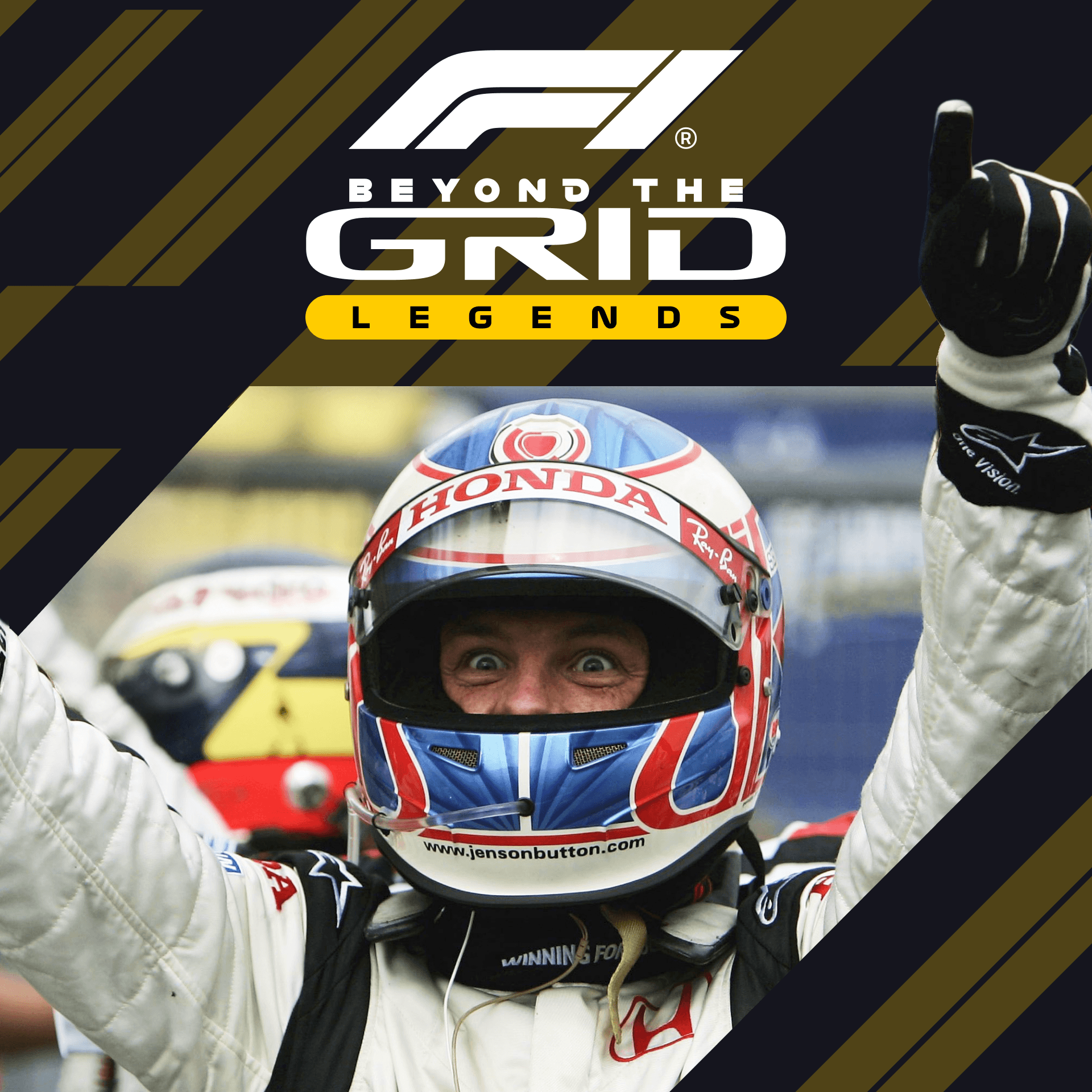
LEGENDS: Jenson Button’s first F1 win
About this episode
Jenson Button’s first F1 win is traced back to Hungary 2006, where an engine failure triggered a 10-place group penalty and forced him to start near the back. He describes navigating yellow-flag chaos, then capitalizing as “A lot of action started wet, it dried out.” Tire switches, pit-stop timing, and the Hungaroring’s tricky overtaking conditions helped him lead Fernando Alonso and finally take the Hungarian Grand Prix. The conversation also touches on Honda’s call after the win and the mindset shift that followed.
A moment long overdue after multiple podiums, Jenson admits he did get to a point where he thought a win might never happen.
So how did he feel when he finally did cross the finish line and take the chequered flag first?
Speaking to Tom Clarkson, Jenson talks through the race in great detail, before describing the emotions of that huge milestone, how he celebrated and why it changed him as a driver.
Plus, the 2009 World Champion also reflects on when he was at his best in Formula 1, which driver on the current grid he relates to the most and why drivers are more insecure than we might think.
This episode is sponsored by:
Saily - get an exclusive 15% discount on your first Saily data plans! Use code grid at
checkout. Download Saily app or go to to https://saily.com/grid
Liquid I.V. - go to liquidiv.com and get 20% off your first purchase with code GRID at checkout.
engine failure
"it went from qualifying for getting a 10-place group penalty because we had an engine failure, starting near the back."
Engine failure means the engine isn’t working properly. In Formula 1, that can lead to penalties and a tough starting position, because the car can’t perform at full strength.
An engine failure means the car’s engine (or engine-related systems) stops performing as required, often forcing the driver to retire or take a major performance hit. In F1, it can trigger grid penalties and dramatically change race strategy, as Button explains happened to him in Hungary 2006.
10-place group penalty
"it went from qualifying for getting a 10-place group penalty because we had an engine failure, starting near the back."
A 10-place penalty means you start the race ten spots farther back than you otherwise would. It’s a punishment for something that happened earlier, and it makes the race harder because you’re stuck in traffic.
A 10-place group penalty is a sanction that moves a driver back by ten positions on the starting grid. Button links it to his engine failure, explaining how the penalty forced him to start near the back and work his way forward.
qualifying
"it went from qualifying for getting a 10-place group penalty because we had an engine failure, starting near the back. ... because they both got penalties in qualifying for overtaking under a yellow flag."
Qualifying is the session where drivers set their starting positions for the race. If something goes wrong in qualifying, you can end up starting farther back and have to make up positions during the race.
Qualifying in Formula 1 determines the starting grid for the race. Button describes qualifying problems that led to penalties, which then forced him to start near the back and fight through the field.
yellow flag
"because they both got penalties in qualifying for overtaking under a yellow flag."
A yellow flag is a warning that something is wrong or dangerous on the track. Drivers have to slow down and avoid overtaking, and breaking that rule can lead to penalties.
A yellow flag in F1 warns drivers that there’s danger on track (like an incident or debris), and overtaking is restricted. Button says Schumacher and Fernando received qualifying penalties for overtaking under a yellow flag, which is why the field was shuffled.
wet-to-dry conditions
"A lot of action started wet, it dried out."
Wet-to-dry means the track changes from rainy and slippery to drier and grippier. That can completely change how fast you can go and when you should make strategy decisions.
Wet-to-dry conditions describe a race that starts in rain and then transitions to a dry track. That change affects grip, tire choice, and timing of pit stops, creating opportunities for drivers to gain positions as the race evolves.
turn one
"I made a move on Michael into turn one, which kind of was a win for me anyway, before I actually got the victory."
Turn one is the first corner on the track. It’s a common spot for big moves because lots of cars are close together, especially early in the race.
Turn one is the first corner of a Grand Prix circuit, and it’s often the most chaotic place to overtake because many cars are bunched up at the start. Button’s move on Schumacher into turn one is highlighted as a key moment that set up his eventual win.
pole position
"Pole position in Imola, in front of Michael, [340.6s] in the Ferrari, which is pretty special."
Pole position means your car starts the race from the very front. It’s earned in qualifying by being the fastest, and it usually gives you a better chance to control the race.
Pole position is the starting spot at the very front of the grid, awarded to the fastest car in qualifying. In F1, starting first can strongly improve race strategy because you’re less likely to get stuck in traffic early on.
team behind
"Renault appeared from nowhere, competitive with Fernando Alonso, [364.8s] and those two were fighting, and we were like the team behind."
“Team behind” just means your team isn’t leading the race pace. You’re trying to catch up to the faster teams that are battling for the top spots.
“Team behind” describes being outmatched by the leading teams in pace and race competitiveness. In this context, Button says Renault and Ferrari were fighting at the front while his team was stuck chasing from behind.
constructors
"We were the team in third in the [369.5s] constructors, and it was getting a little bit frustrating."
The constructors standings are how teams are ranked based on points from both of their cars. Being third in the constructors means your team was doing better than most other teams overall.
In F1, the Constructors’ Championship ranks teams based on the points scored by their two cars. Button mentions being “third in the constructors,” meaning his team was the third-best overall team in the standings at that time.
engineering
"in terms of who's the driver that you feel was the best at engineering, and by far it was Rubens. [406.7s] At working with a team, developing a car, understanding what a car is doing out on track..."
In racing, engineering is about using technical work and information to make the car faster and easier to drive. Button is saying Rubens was unusually good at understanding the car and telling the team what to change.
In F1, “engineering” refers to translating data and driver feedback into car setup and performance changes. Button praises Rubens Barrichello’s skill at understanding what the car is doing on track and communicating that clearly to help develop the car.
teammate
"And I understand why Michael wanted him as a teammate for so many years. [428.6s] And I was lucky enough to have that when we started racing together..."
Your teammate is the other driver on your same F1 team. They work with the same engineers and can help the team improve the car through feedback.
A teammate in F1 is the second driver on the same team, sharing the same car development direction and working with the same engineers. Button notes how Barrichello’s presence as a teammate helped him see a different skill set and how drivers can influence car development.
Hungaro ring
"Okay. So that's the background. Let's talk about the track now, the Hungaro ring. You actually won there twice in your career."
They’re talking about the Hungaroring track. Button explains why it’s hard to race there and how rain can make it more exciting for passing.
This segment shifts to the Hungaroring, where Button explains what makes the circuit tricky and why it rewards certain driving styles. He discusses overtaking difficulty in dry conditions and how wet/mixed grip changes create passing opportunities.
mixed conditions
"In mixed conditions, it was awesome, because you could put it around the outside at turn two."
Mixed conditions in racing means parts of the track have different grip levels—often dry patches alongside wet sections. That creates more overtaking opportunities because drivers can exploit where their tires have the best traction.
Bridgestones
"We were also on Michelin tyres at the time, and the Ferraris were on Bridgestones, which definitely helped us in those wet conditions."
Bridgestones are another tire brand. Button is saying Ferrari’s tires were different from his, and that difference mattered when the track was wet.
Bridgestones refers to the tire brand Ferrari was using at the time. In F1, different tire manufacturers can behave differently in wet conditions, affecting traction and how confidently drivers can push.
Michelin tyres
"We were also on Michelin tyres at the time, and the Ferraris were on Bridgestones, which definitely helped us in those wet conditions."
Michelin tyres are the tires a team was running. In wet races, the tire brand can change how much grip you have, so it can affect who’s faster.
Michelin tyres are the tire brand used by some F1 teams; tire choice can strongly affect grip and consistency, especially in wet or mixed conditions. Button notes that his team had Michelin tires while Ferrari had Bridgestones, and he links that difference to performance in the rain.
oversteer
"was never my strong point to have a car that had too much of a pointy front end, because I didn't like oversteer that much."
Oversteer is when the back of the car slides/turns out more than you want. Button is saying he preferred a car that didn’t feel too “back-end happy.”
Oversteer is when the car’s rear end rotates more than the driver expects, making the car want to turn more than commanded. Button says he didn’t like oversteer much, which implies the RA106’s balance in Hungary suited him better when the front stayed predictable.
steering lock
"But it was a car that as you added steering lock, it was like the dream, you got more front grip."
Steering lock means how much you turn the wheel. Button is describing how the car felt better the more he turned it, instead of losing grip.
Steering lock is how far you turn the steering wheel (and therefore the front wheels) from center. In an F1 context, how grip changes as you add steering lock tells you whether the car’s front end will keep biting or start to wash out.
front grip
"But it was a car that as you added steering lock, it was like the dream, you got more front grip."
Front grip is how well the front tires stick to the track. He’s saying the car kept giving him more grip as he turned in, instead of losing it.
Front grip is the traction and control available at the front tires, which largely determines how well the car turns in and holds its line. Button contrasts a car that gains front grip with one that “washes out,” meaning the front stops gripping as steering angle increases.
washes out
"Whereas a lot of racing cars, you get to a point and it washes out."
To “wash out” means the front tires lose grip and the car won’t turn properly anymore. He’s saying his car didn’t do that as easily.
“Washes out” describes a loss of front-end traction where the car stops responding to steering input and the tires slide instead. Button uses it to explain that some cars reach a steering angle where the front grip disappears, while his car didn’t behave that way.
understeer
"So you'd always just go in there and throw in on loads of steering lock and understeer. So that's where we lost time."
Understeer is when the car doesn’t turn as much as you want. Instead of following the corner, it tends to push outward, which usually slows you down.
Understeer is when the car turns less than you expect—its front end doesn’t grip enough, so it pushes toward the outside of the corner. Drivers often feel it as a lack of turn-in, and it can cost time by forcing wider corner exits.
V10
"But that V10, when I watch videos back, just blows my mind. There's the scream of it. How does an engine produce that noise?"
A V10 is an engine with 10 cylinders arranged in two rows that form a V shape. In that F1 era, it revved extremely high, and the sound was a big part of what made the cars feel special.
A V10 is an engine with 10 cylinders arranged in a “V” shape (two banks of five). In F1, V10s were known for very high-revving character and a distinctive intake/exhaust note, which is why Button says the sound “blows my mind.”
grid penalty
"smoke billowing out of the back of the car. And that was it. I was like, oh, 10 grid place penalty done."
A grid penalty means you start the race further back than you earned in qualifying. It’s a punishment for something the team did (often related to the car/engine), and it changes how you have to race.
A grid penalty is a sanction that moves a driver back from their qualifying position on the starting grid. In F1, penalties are commonly tied to technical infringements or power unit/engine-related changes, and they can dramatically affect race strategy.
inters
"Talk about the decision about what tyres to start on, because you started on inters from P14."
“Inters” are special tires for when the track is wet but not fully flooded. They’re meant for damp or drying conditions, so you get better grip than on dry tires.
“Inters” are intermediate wet-weather tires designed for damp or drying conditions—wet enough to need grooves for water evacuation, but not wet enough for full wet tires. They’re a common starting choice when the track is partially wet and grip is evolving.
wet tyre
"I don't remember why Rubens was on wets. I mean, most of the time in F1, as we've experienced, you don't ever want to be on a wet tyre. The only reason why you'd be on a wet tyre is because it's too wet to drive on the track..."
A wet tyre has tread made to push water out of the way so the car can grip on a damp track. In F1, teams usually only switch to them when the rain is heavy enough that other tyre types aren’t safe.
In Formula 1, a wet tyre is designed with a tread pattern that channels water away to maintain grip on standing water. Button explains that you generally only use wet tyres when conditions are too dangerous for slicks or intermediate tyres, and that wet tyres degrade quickly.
safety car
"The only reason why you'd be on a wet tyre is because it's too wet to drive on the track, you know, so you'd be behind the safety car. As soon as the safety car comes in, you want to be on an inter..."
The safety car is a pace car that comes out to slow everyone down when the track is dangerous. It also gives teams a window to change tyres safely.
The safety car is deployed in F1 to control the pace of the race when conditions are hazardous (like heavy rain or an incident). Button ties it to tyre strategy: once the safety car comes in, teams can make the switch to the appropriate tyre type for the changing track.
inter-tire
"As soon as the safety car comes in, you want to be on an inter because they just, they get eaten up so quickly, a wet tyre... Whereas the inter-tire just, it just worked in those conditions."
An intermediate tyre is for “in-between” rain—wet enough to need tread, but not so wet that you need the full wet-tyre setup. It’s often the go-to choice when the track is improving.
An inter-tire (intermediate tyre) is a compromise tyre for damp conditions—typically when the track isn’t wet enough for full wet tyres. Button notes that inters work well after the safety car because they last longer and the tread is better suited to “not rivers” levels of water.
tyre wall
"Quick word on the tyre wall. You already mentioned that it would... did you enjoy the tyre wall era of Formula One? I did... it's such an exciting part of racing because it's tyre manufacturers going at it as well."
“Tyre wall” is a fan-friendly way to describe how much tyres mattered in that era—different tyre options and suppliers could strongly change how fast cars were. It was exciting because tyre makers were constantly trying to outdo each other.
The “tyre wall” era refers to a time in F1 when tyre suppliers and compounds were more varied and teams were more dependent on tyre performance changes across a race weekend. Button describes it as an exciting period because tyre manufacturers competed aggressively, and lap times could be dramatically affected by tyre choice.
one tyre for the whole race
"And then 2005 happened and we... sorry, the year before 2005, well, we use one tyre for the whole race. And we, we did it, you know, it was a problem if you locked up."
He’s talking about a rules change where you couldn’t keep switching tyres during the race—you had to stick with one type. That made braking and grip management more critical.
Button contrasts earlier tyre rules with a later change where teams used one tyre type for the entire race. He notes a key downside: it could be a problem if you locked up, but he also says the grooved tyres worked well.
locked up
"we use one tyre for the whole race. And we, we did it, you know, it was a problem if you locked up."
When brakes lock a wheel, the tyre stops rolling and starts sliding. That usually makes braking less effective and can hurt control.
“Locked up” describes when a wheel stops rotating during braking (a skid), reducing traction and increasing stopping distance. Button mentions it as a problem in the era when using one tyre for the whole race, implying tyre grip and braking control were especially important.
grooved
"And we, we did it, you know, it was a problem if you locked up. And they were grooved. grooved and they worked."
“Grooved” refers to tyre tread design—channels cut into the rubber to manage water and improve traction. Button says the tyres were grooved and that they “worked,” implying the tread pattern helped performance and safety in that period’s wet/damp conditions.
refuelling era
"What about refuelling? It was a refuelling era as well, wasn't it? I loved that part of it, you know, because you could have different strategies. You could run"
In the refuelling era, teams could add fuel during the race. That meant they could plan different strategies instead of just starting with everything you’d need.
The “refuelling era” refers to periods in F1 when cars could take on fuel during the race, enabling different fuel loads and multi-step strategies. Button says it allowed different strategies, which is a major tactical difference from today’s no-refuelling races.
starting the race on half tanks
"So you could even start the race on half tanks if you wanted to, to have a lightning first stint."
“Half tanks” means you start the race with less fuel than you could. Less fuel usually makes the car lighter and can help it feel quicker at the beginning. But you’ll need to stop to refuel sooner, so it affects how many pit stops you plan.
Starting “on half tanks” means carrying less fuel at the race start than a full tank. In F1, that reduces initial weight, which can improve early lap pace and tire performance. The tradeoff is that you must refuel more often, which changes the pit-stop strategy.
pit-stop strategy (three-stop vs two-stop)
"to have a lightning first stint. And you'd never be at full tanks because you could do a three-stop race, two-stop race, and you're never at full tanks."
A pit-stop strategy is the plan for how often you stop during the race. Stopping more times can let you run with less fuel (so the car may feel faster), but you lose time each time you pit. Stopping fewer times means fewer pit stops, but you carry more fuel for longer.
F1 pit-stop strategy is how teams decide when to refuel and how many times to stop during a race. A “three-stop” or “two-stop” plan changes the balance between running lighter (less fuel) and spending more time in the pits. The best strategy depends on the car’s pace and how efficiently it uses fuel.
fuel moving
"So if your car didn't work as a heavy car, with the fuel moving, you'd just run a lower fuel level and just do more stops."
As the car drives, the fuel inside the tank can shift around. That can slightly change how the car feels and handles. If a team’s car isn’t great with that effect, they may choose a different fuel level and pit-stop plan.
“Fuel moving” refers to how the fuel sloshes and shifts inside the tank as the car accelerates, brakes, and corners. That movement can affect the car’s balance and handling, especially when running with different fuel levels. Teams account for it when choosing how much fuel to carry and how aggressive the stints should be.
fuel on board
"Also in qualifying, then, we had fuel on board, you remember? So we, it was declared after qualifying how much fuel we had on board for the race."
“Fuel on board” just means how much fuel the car has with it when the race starts. More fuel usually means the car is heavier, but it can go longer between pit stops. Less fuel can make the car quicker early on, but you’ll need to stop more often.
In Formula 1, “fuel on board” is the amount of fuel the car carries at the start of the race. Teams use it to plan strategy—how many pit stops they can do and how long they can run before refueling. Because fuel affects weight, it also changes how the car behaves on track.
stint
"Right, back to the race. We get underway. You're immediately start flying, actually. That first stint was great. I think you overtook Massa Fizzichella Schumacher in the space of two laps."
A stint is how long a driver stays on one set of tires before coming into the pits to swap tires. In F1, that timing can strongly affect lap times and race outcome.
In Formula 1, a stint is a continuous period of running on a specific set of tires before the car pits to change them. Strategy often revolves around how long each stint can be, and how tire grip changes as the stint wears.
dry tires
"Definitely. I would say towards the end of that stint. I think we went to dry tires on the first stop. It was around that time because the pace was really good on the wet on the inters."
Dry tires are the kind of F1 tires you use when the track isn’t wet. If you switch to them while the road is still wet, the car can lose traction fast.
“Dry tires” in F1 refers to slick tires designed for dry or drying track conditions, with no tread pattern for water evacuation. Switching to dry tires at the right moment is crucial because using them too early on a wet surface can quickly destroy grip.
offset
"I didn't realize the offset that we had with Fernando with pit stops. I thought it was a walk in the park. Then I was like, oh, no, actually, Fernando's in front."
Offset is basically the gap between two cars caused by when they pit. If one car pits earlier or later, it can end up ahead even if the other car is quicker.
In F1 strategy, “offset” refers to the time/position gap created by different pit-stop timings between two cars. Even if one driver is faster on track, an offset can mean the other driver is still ahead when the stops cycle through.
wheel nut
"Then I was like, oh, no, actually, Fernando's in front. Then he had his wheel nut fall off in"
A wheel nut is what holds the wheel onto the car. If it fails, the wheel can come loose, which is extremely dangerous and usually ends the race.
A wheel nut is the fastener that secures the wheel to the hub. If a wheel nut comes loose or fails, the wheel can detach or become unstable, which is a serious safety and race-ending failure in F1.
wet patches
"With the way the track was, drying track, it's always difficult to put it on the wet patches to overtake."
"Wet patches" are spots on the track that are still slippery even if other parts are drying. Those spots can make the car lose traction unexpectedly.
"Wet patches" are areas of the track that still have standing water or a thin film of moisture while other sections are drying. They reduce tire grip and can cause sudden traction loss, making overtakes risky.
drying track
"Passing is another thing always and then a fun. With the way the track was, drying track, it's always difficult to put it on the wet patches to overtake."
A "drying track" means the road surface is changing—like when rain has just stopped. Because the grip keeps changing, it’s harder to drive consistently.
A "drying track" is when the circuit is transitioning from wet to dry (or vice versa), usually because rain has stopped or is easing. Grip levels change lap to lap, so tire choice and driving lines become harder to predict.
dirty air (aero wake)
"I didn't even know that I was racing Fernando at that point. I thought I was in the lead anyway. Let's hope the floodgates now open for Jensen Button as they did for Nigel Mansel and for Damon Hill before him because here in his 113th Grand Prix start,"
In F1, one car can make the air behind it messy. The car behind then has less grip, so it’s harder to catch and pass.
In F1, "dirty air" (the aerodynamic wake) is the disturbed airflow a car creates behind it, which reduces the following car’s downforce and grip. That makes it harder to close the gap and especially harder to overtake, because the trailing car can’t generate as much aerodynamic grip.
Super Aguri
"Then I caught the Honda Junior team, which was super aguri. I remember that."
Super Aguri was an F1 team. Button brings it up because it was the team he was dealing with during that race moment.
Super Aguri was an F1 team that competed under the Aguri brand, often fielding cars with Honda-related technical support during parts of its history. Button’s mention places it in the context of his early-career racing and on-track battles.
Honda Junior team
"Then I caught the Honda Junior team, which was super aguri. I remember that."
Button is talking about a Honda-linked junior team—basically a training pathway for drivers. It’s where young racers get experience and chances to move up.
Jenson Button mentions the “Honda Junior team,” which was a junior development setup associated with Honda. In motorsport, junior teams are where drivers build experience and get opportunities before (or alongside) reaching top-level F1 drives.
laps down
"On the last lap, I called up to them. I was like, this would be nice. We can cross the line together when they're a lap down or two laps down."
“Laps down” means you’ve fallen behind by a whole lap compared to the leaders. It changes how you race because you’re not fighting for the same spot on the track anymore.
“Laps down” means a driver has been overtaken by the race leader by at least one full lap, so they’re behind in total distance. In F1, being laps down affects strategy and how drivers manage pace, because they’re no longer competing for the same immediate track position.
concentration goes
"At that moment, you start backing off, your concentration goes. You don't want to be messing with that."
When you slow down or ease off, it’s easy to lose focus. In racing, you have to stay sharp even if you’re not pushing as hard as possible.
In racing, “backing off” (reducing effort/pace) can make it harder to stay fully mentally locked in, especially near the end of a stint or race. Drivers often emphasize that even if you’re not at 100%, you still need to keep focus because small lapses can lead to mistakes.
podium
"JB, it was an incredible podium of firsts actually. Your first win, it was the team's first win. It was Dilla Rose's first podium."
A “podium” means you finished in the top three in the race. In F1, that’s usually the finish that gets you a trophy and lots of attention.
In Formula 1, a “podium” is finishing a race in the top three positions (1st, 2nd, or 3rd). It’s a big deal because it comes with trophies, major points, and strong visibility for both the driver and the team.
BMW Sauber
"Heidfeld had given BMW Sauber their first podium as well."
BMW Sauber refers to the F1 team partnership where BMW backed Sauber’s F1 program. Button notes that Nick Heidfeld had given BMW Sauber their first podium, highlighting the team’s milestone result.
McLaren
"being up there, giving this opportunity to go and race from McLaren after Pampavlo was moved aside."
McLaren is one of the most famous F1 teams. Button is saying that being able to race for McLaren was a huge opportunity for him.
McLaren is a historic Formula 1 constructor known for championship-winning cars and a strong driver development culture. Button references moving to race from McLaren, emphasizing the significance of getting a chance at the top level.
Hangaroring
"I think for the first win to be hangaroring with that beautiful trophy, I think that means a little bit more."
Hangaroring is a race track in Hungary that hosts F1 events. Button is saying the win felt extra meaningful there, especially with the trophy.
Hangaroring is a motorsport circuit in Budapest, Hungary, best known for hosting the Hungarian Grand Prix. Button’s comment ties the first win to the track’s trophy moment, suggesting the venue’s emotional and symbolic weight.
private plane
"Yeah, I had a couple of beers at the track, jumped on a private plane, which took us to a bigger airport, which then I flew to China and did an event."
A private plane is a chartered flight, not a normal commercial route. Button is describing how he had to travel quickly after the race for other commitments.
A “private plane” is a chartered aircraft used for fast, direct travel—common for top-level motorsport personnel who need to move between events and sponsor obligations quickly. Button’s description shows how F1 schedules can require immediate travel after race weekends.
Monkey off your back
"Monkey off your back. Yeah, I think that's the feeling that you have. It's less tense. I'm not going to win the world championship. So let's go out and do as well as we can."
It means once you finally achieve something you’ve been worried about, the stress goes away. Button says his first win made him calmer and more willing to push.
This is a racing-mindset phrase meaning the pressure of a long-standing goal is lifted after achieving it. Button connects it to how his first win reduced tension and allowed him to take more risks afterward.
brawn season
"One, because I was so relaxed. People talk about the brawn season being my best year and then I find it wasn't, I don't think."
“Brawn season” is a nickname for the 2009 F1 season. It refers to the team Brawn GP having an unusually dominant year.
“Brawn season” refers to the 2009 Formula 1 season, when the Brawn GP team won the Drivers’ and Constructors’ Championships. It’s often used as shorthand for that year’s standout performance and the team’s momentum.
Request an Explanation
Heard something you'd like explained? We'll add it to this episode.
Sign in to request explanations for terms you heard.
Want to learn more?
Browse our glossary for plain-English explanations of automotive terms, jargon, and concepts.
Help improve this episode
See something that's not quite right? Our annotations are AI-generated and can sometimes miss the mark. Click the flag icon on any annotation to suggest a correction.