Portaluppi on F&I Pay Plans, Fusco on Pricing Transparency, Crain on Video MPI | Daily Dealer Live
Car Dealership Guy Podcast
Portaluppi on F&I Pay Plans, Fusco on Pricing Transparency, Crain on Video MPI | Daily Dealer LiveCar Dealership Guy Podcast · May 20, 2026
Annotations will appear as you listen
0:00
59:52
Concept
gas to liquids (GTL)
Gas to liquids (GTL) is a process that converts natural gas into liquid fuels or feedstocks. In the segment, Qatar’s Pearl GTL plant is cited as being damaged, which matters because those liquid products/feedstocks can feed into motor-oil production supply chains.
Toyota is mentioned because it told its dealers how to handle a shortage of motor oil. The guidance includes using a different oil grade temporarily for some cars.
Viscosity is basically how thick the oil is. Thicker or thinner oil changes how well it lubricates the engine, especially when the engine is cold.
Term
OW-16
OW-16 is a different oil grade label. It’s being used as a temporary substitute when the usual oil grade can’t be supplied.
Term
OW-8
OW-8 is an oil label that tells you how the oil behaves when it’s cold. The hosts are saying some cars are being switched to a different oil grade temporarily because of shortages.
Allocations mean how much of a specific product a dealer is allowed to receive. When supply is tight, the manufacturer limits how much each dealer can order.
The Nissan Pathfinder is a larger SUV that can carry more people, usually with three rows of seats. It’s the kind of vehicle dealerships watch because it sells well when families are shopping for bigger SUVs. The podcast mentions it as part of a group of Nissan models that saw sales increases.
The Nissan Armada is a big SUV with three rows of seats, made for carrying more people. It’s also built for heavier-duty needs like towing and hauling compared with smaller SUVs. The podcast mentions it because its sales increased significantly.
The Nissan Frontier is a pickup truck, meaning it has a cargo bed for hauling things. It’s designed for people who want truck capability without going to the biggest truck sizes. The podcast brings it up because it also saw sales growth compared with other Nissan models.
The Nissan Rogue is a smaller SUV meant for regular daily driving. It’s popular because it’s practical and fits well for many drivers. In the podcast, it’s mentioned as one of the Nissan models that increased in sales.
The Jeep Grand Cherokee is an SUV made for people who want a comfortable ride with options for tougher roads. It’s a well-known Jeep model, so it shows up when companies talk about improving or refocusing their brand. The podcast mentions it in the context of a larger plan for Jeep as a core brand.
FTC compliance means following the rules the U.S. government uses to prevent misleading advertising. For car shopping, it’s about making sure the price you see matches what you’ll actually pay after fees and add-ons.
Advertised pricing requirements are the rules about what a dealer has to show when they advertise a car price. The goal is that shoppers can see the real total cost, not just a low number that changes at checkout.
S&P Global Mobility is a company that provides automotive data and software tools. Here, they’re launching a tool to help car dealers keep their advertised pricing rules straight.
TrueCar is a website/app that helps people find car deals and pricing. Here, they’re changing their display so buyers can see the full price, including dealer fees and add-ons.
Dealer fees and add-ons are extra charges added on top of the car’s base price. They’re important because they change the total cost you should expect to pay.
A private personalized price is a deal offered to a specific buyer, not everyone who sees the ad. The idea is you can offer a better price to the right shopper without lowering the price everyone else sees.
Term
verified affinity customers
Verified affinity customers are specific types of shoppers who qualify for special pricing. In this case, the platform verifies they meet the criteria before showing them a lower offer.
“Full synthetic” is a higher-grade type of engine oil. An “oil change deal” is a discounted package to change the oil (and usually the filter) for a set price.
Concept
service departments getting busy
As weather gets warmer, more people drive and book maintenance. That usually means the dealership’s service area gets more appointments and work.
“ROs” typically means repair orders—paperwork/work orders that document a customer’s requested service, parts used, and labor performed. “250 ROs per day” is a measure of service department volume and operational pace.
A Harley dealership is a shop for Harley-Davidson motorcycles. They’re saying their group has experience running that kind of dealership too, not just car stores.
Fixed ops is the dealership’s service and parts business—like repairs, maintenance, and selling parts. It can be harder to change quickly because it relies on the shop’s day-to-day operations.
Expense control is the operational effort to reduce or manage dealership costs—labor, overhead, and other operating expenses. In the context of dealership groups, it’s often part of the value they try to add when taking over or partnering with stores.
Economy of scale means bigger groups can often run more efficiently. Costs per store can drop because they share resources and buy things in larger quantities.
F&I pay plans are how a car dealership pays the people who handle financing and add-on products. Changing the pay plan can change how those employees work and how much money the dealership makes from those deals.
F&I is the part of the dealership process where they set up your loan and offer extra products like insurance-related add-ons. Dealers often focus on it because it can be a big source of profit.
Term
Fusco on Pricing Transparency
Pricing transparency is about being clear with customers about what things cost and why. The goal is fewer surprises and less confusion when buying.
VSC penetration is a percentage metric: out of the cars sold, how many customers also buy a vehicle service plan. Higher penetration usually means more revenue from those plans.
Exclusions are “rules that don’t count” for earning money. They’re saying the old plan had situations where deals were left out, and the new plan counts more of them.
It’s a benefit where your “out-of-pocket” deductible gets smaller the longer you stay with the same provider. So if you ever need a covered repair, you pay less.
In dealership language, a “trade” is the customer’s current vehicle used as part of the purchase deal for a new or used car. The speaker ties F&I and customer retention to the ability to earn more trades and repeat purchases.
Ford is an automaker brand the speaker lists among the dealership group’s franchises. It’s part of the broader discussion about which OEM brands are performing well versus struggling.
OEM means the carmaker itself—the company that makes the vehicles. Dealerships often talk about OEMs because they control a lot of the programs and incentives that affect sales.
The Jeep Cherokee is an SUV made for everyday driving, with options that can handle rougher roads. Dealerships talk about it when they’re waiting for the newest version or more units to be available. That’s why it’s mentioned in the context of “waiting for the Cherokee to come out.”
In this context, “production” means how many cars and deals the dealership is able to generate. They’re saying they want steadier, controlled output rather than pushing too many incentives.
“Over incentivize” means offering bigger discounts or deals than necessary to sell cars. The worry is that it can hurt overall pricing and make the market feel flooded with cheap cars.
BMW is being referenced as a luxury brand that’s “crushing it” in the market. The host is using brand performance language to compare how different luxury makers are doing.
Zurich is the company sponsoring this part of the podcast. They’re talking about tools and services that help dealerships improve their finance-and-insurance work and manage risk.
Informative is the company Doug Fusco works for. They help dealers with compliance—making sure the dealership follows the rules—and they use software to help enforce that.
Dealer safeguard solutions is referenced as the earlier company Doug Fusco founded. The segment says it was later rolled into Informative via an acquisition.
F&I stands for finance and insurance. It’s the part of the dealership where they sell things like optional coverage and add-ons along with the car purchase.
Term
FCC safeguards rules
FCC safeguards rules are government requirements from the FCC. The speaker is saying the “dealer safeguards” approach was built around those rules.
A credit app is the information you submit to get approved for financing. The speaker is saying that when it’s done quickly—like over the phone—people may be tempted to do the wrong thing.
Fraud means someone is intentionally lying or faking information to get a benefit. In this segment, they’re saying it’s more likely to happen when the dealership is rushed and people feel pressure.
“Red flags” are warning signs that something doesn’t look right. In this story, they’re clues that the situation might involve theft or fake documents.
Machine learning is smart computer software that can spot patterns. In this case, it’s used to check whether a driver’s license looks real or fake by analyzing visual details.
FCRA is a U.S. law that governs how credit reports and credit information are used. If a business mishandles credit information, it can lead to legal trouble.
A compliance audit is an organized check to make sure a business is following the rules. In this context, it’s something the dealership does regularly to avoid legal problems.
Berkshire Hathaway is a big company that owns lots of different businesses. Here it’s mentioned because it influences how the dealership group runs compliance.
Company
Vantal
Vantal is mentioned as an earlier ownership group for Crest Cadillac. The speaker uses it to explain how the dealership’s parent structure changed.
A key machine is a tool dealerships use to make car keys. Modern keys can be expensive and need to be programmed correctly, so dealerships invest in the equipment.
A “deal jacket” is the folder of paperwork for a specific car sale. “Digital” means it’s stored and managed on a computer instead of paper, which can make the process faster and easier to track.
VIN verification means checking the car’s unique identification number (VIN) to make sure it matches the paperwork. It’s a basic fraud-prevention step in the buying process.
A buyer’s guide is paperwork that explains important details about the car and the coverage/warranty terms. It’s included in the deal documents the dealership prepares for the customer.
Term
make ready
“Make ready” means getting the car ready for the buyer—making sure it’s inspected and prepared before delivery. The host is just listing it as part of the overall digital process.
Credit abuse means repeatedly checking someone’s credit without a good reason. The idea is to limit unnecessary credit pulls so the customer isn’t hurt and the dealership stays compliant.
Credit reports are the lender’s record of how someone has handled credit. Dealerships use them to decide loan terms, and the segment explains limiting how many times they pull them.
A credit bureau is a company that keeps credit records for consumers. Dealerships can request reports from one bureau first, and only request others if certain conditions are met.
This phrase means checking credit from multiple credit agencies quickly, like trying several at once. The point here is that dealerships are moving away from that approach and using tighter rules instead.
A “straw deal” is when someone uses another person’s identity or credit to get a car deal approved. It’s a fraud risk, and the hosts say dealers need better monitoring to catch it.
“Grandma deals” is a nickname for a fraud scheme where a relative is used to make the transaction seem acceptable. The hosts say it’s growing and dealers need better detection.
“Baked pay stubs” means fake or altered paycheck documents used to make someone look like they earn enough money. The point is that dealers need systems to spot these tricks.
“Verified steps” means the dealership collects the documents it needs and checks that they’re real before moving forward. It helps prevent fraud and makes the process faster and more reliable.
A “subprime customer” is a buyer with lower credit scores or a less solid credit history. Because of that risk, dealerships may require more document checks before approving financing.
An “encrypted platform” is a secure system that protects sensitive information. It helps ensure customer documents can’t be easily read or stolen while being shared.
Term
POI
“POI” here means proof of identity—documents that confirm who the customer is. The dealership needs it before they can finish the financing paperwork.
Term
CIT
“CIT” sounds like an internal dealership timing metric—basically how long it takes to get the deal processed and funded. Faster document turnaround helps reduce that time.
Concept
sell cars virtually
“Sell cars virtually” refers to completing parts of the sales process remotely rather than requiring customers to visit the showroom. The speaker connects it to maintaining compliance standards and using digital “on-ramps” and “off-ramps” to move customers through the workflow.
This means customer data ending up on someone’s personal phone or tablet. The concern is that it’s less secure and can create legal and compliance risk for the dealership.
LIVE
Hey, everybody, welcome back to another episode of the Daily Dealer
Live. I'm your host, Sam Darkin. Thanks for choosing to be here with us this
Wednesday, May 20th. Thanks for your patience on this delayed start today.
A lot going on out there on automotive. First up today, Leo Portolubi, CEO of P4
Automotive, nine rooftops across Indiana. His group doubled in size and he's here
to talk about what scaling that fast actually breaks inside a business and how
simplifying everything, well, that's been the fix. Then Doug Fusco from
P4 Automotive is making the case that most dealers who think they've checked the
compliance box, well, they're actually sitting on more exposure than they know.
One missing deal jacket, it costs a Dallas dealer $191,000. We'll get into where the
real risk lives and what to do about it now. And then closing out today, Christian
Crane is back. He's VP of Ops at Crane Automotive. He's got 22 stores, 45,000
vehicles this year. Last time he was here, he told us about Crane Vision.
We talked video MPI commissions and Crane by his cars. A lot has changed. A lot hasn't
as they continue to execute. Elite Lee, we're checking into it all. But first,
let's get into today's automotive headlines.
Breaking news today. CDG is writing a story this morning related to two OEM captives
who refusing to fund broker deals and threatening to unwind those deals.
If they find out those deals are captives. We're wanting to confirm the source. We're
wanting to confirm all the information and details around it before we officially break
the story. But watch for that across all CDG social media because there will be more of
that coming. And as a reminder, I'm a little bit off my track today. We're streaming today live
across all CDG social media platforms. Post those comments into today's show. We'll bring
them into the conversation. We love having you, our listening audience participate and come into
the chat as we go. Ken comes in. Let's get this going. So excited. This one's in my wheelhouse.
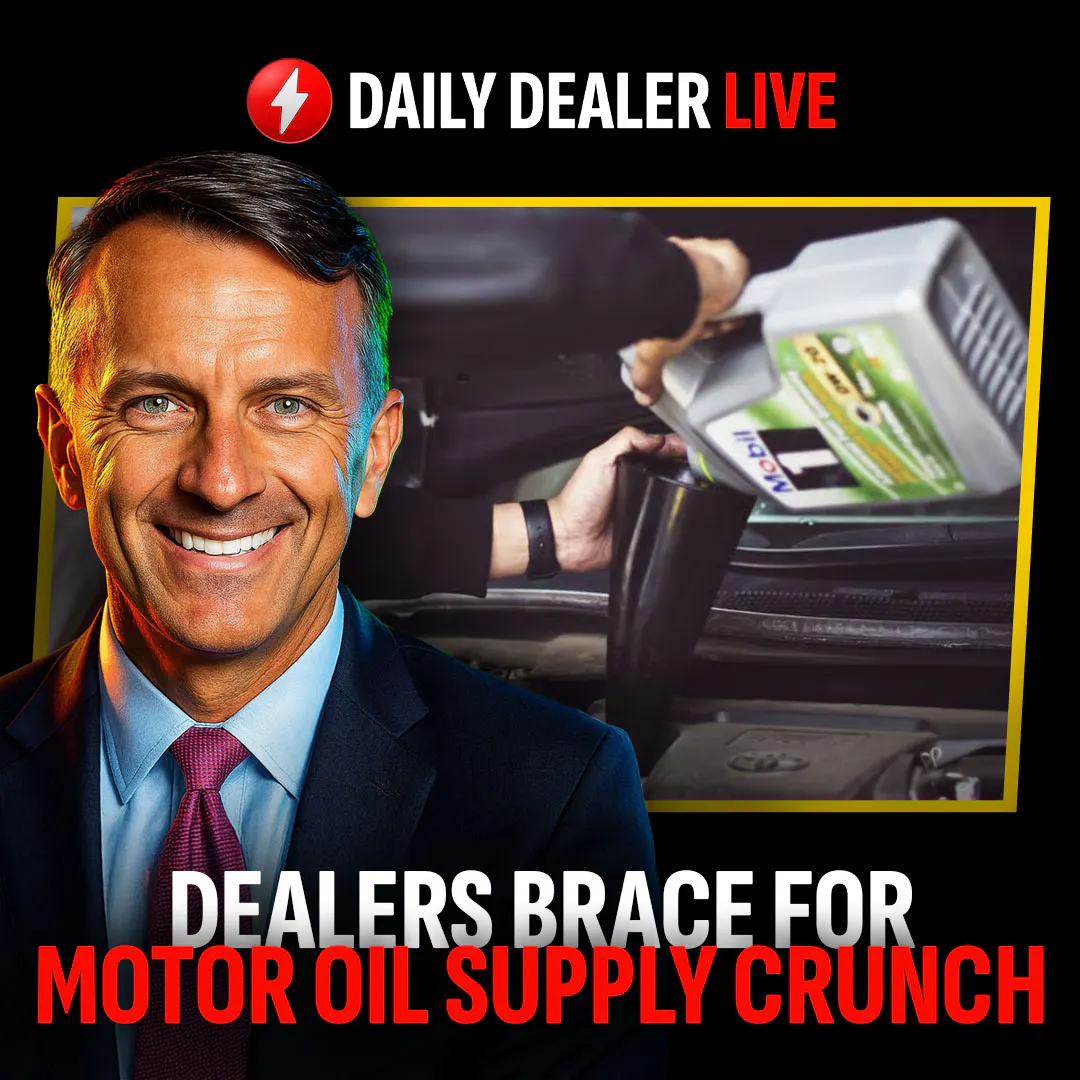
Let's do it. So first up today in the news, a motor oil shortage is beginning to take shape
and Toyota Nissan dealers are already receiving guidance on how to navigate it. Nearly 44% of
the group, three base oil used in motor oil production comes from three Persian Gulf producers
affected by the straight of Hormuz closure and Qatar's Pearl GTL. That's the world's largest
gas to liquids plant has been seriously damaged and taken offline indefinitely. Wholesale motor
oil has seen three rounds of price increases over the past two and a half months with some
producers raising bulk distributor prices by five bucks or more a gallon compared to 70 to 80 cents
in a typical year. Toyota dealers received an internal bulletin dated April 30th instructing
service managers to substitute certain oil viscosities for one service interval with 20%
of vehicles requiring OW8 temporarily receiving OW16. Nissan's May 1st bulletin cap genuine
oil allocations at 55% of year ago purchased volumes for dealers. The priority right now is
proactive communication with customers and close coordination with suppliers before the situation
gets even tighter than it is today. Now for some good news and this out of Nissan, that automaker
closed fiscal year 2025 with 12 consecutive months of dealer retail sales growth. That's a 19.6%
year-over-year jump in retail market share and more than 43,000 additional retail units sold
compared to the year prior. Nissan was one of only three automakers to grow retail volume
in 2025. The gains were led by trucks and SUVs. Armada was up 72%, Pathfinder up 44%,
Rogue 17% and Frontier was up 15%. This is all part of the re-Nissan deliberate shift
toward dealer retail and shutting fleet sales. US localization climbed from 44% to a peak of 65
during the fiscal year, cutting tariff exposure significantly. Next up today,
Stellanus is set to unveil its new strategic plan Thursday at the company's Capital Markets Day
and based on what Reuters is reporting ahead of it, the US is central to the turnaround story.
CEO Antonio Fallosia is expected to outline a focus on four core brands, Jeep, Ram, Peugeot and Fiat
out of the 14 brand global portfolio along with expanded joint ventures with Chinese automakers
to reduce costs and utilize idle capacity. In 2025, Jeep accounted for 47% of US sales
and Ram 34%, so the brand concentration, well, it makes sense. That makes the key question
Thursday is whether that this translates into a clearer product road max brought stronger
inventory flow and a more competitive retail strategy or whether it stays at the strategic
level without near-term operational impact. And finally, up today on the FTC compliance front,
two industry tools launched this week to help dealers get ahead of advertised pricing requirements,
S&P Global Mobility announced Feesync. It's a free platform that gives dealers one place to
update their fee schedule across all vendor and agency partners, eliminating the need
to chase updates across a dozen different systems every time something changes. TrueCar, meanwhile,
they updated their platform to display all-in pricing inclusive of dealer fees and add-ons
with a breakdown visible to shoppers via a dedicated link and plans to eventually pull
fee data automatically through inventory leads. TrueCar's CEO, who's been on the show twice,
also outlined an offer of one feature. He says it's a private personalized price for verified
affinity customers. That allows dealers to offer a lower price to a specific qualified shopper
without having to lower the advertised price for everyone. As FTC scrutiny continues and
state regulators pick up the pace, tools that make compliance simple and scalable,
they are going to matter more than they ever have. Both of these are worth a closer look.
We've props to both of those lead generators, lead providers for leading the industry in
that transparency piece. And that, folks, is a wrap on today's auto industry headlines.
So yeah, you know what? Props to TrueCar, props to S&P Mobility for hearing what the FTC's saying.
You know, it's interesting, in my own world, we've been tracking all these different lead
providers and all the different technology providers. You know, automotive is committed,
I believe, today to this Bernie Marino cleanup on aisle 8. 5% are going to go away. The challenge is
with all of the disparate technologies, all the different technologies that feed these prices
out of the platforms and tools, we've got to make sure that they're sending the same message out.
And props to S&P Mobility, TrueCar, in my own world, I've seen Cox leading the way,
cars.com, car gurus and others, at working so hard to make sure that the data that they are
sending out or receiving is in line. So props to them. A lot of comments coming online.
DNC says, sounds like $50 full synthetic oil change deals might be challenging going forward.
I agree, 100%. Igor Kay says, 2 p.m., it's a way better time. Gives me time out of the
auctions on Wednesday and Friday. We're not looking to change. It was an accidental,
incidental pushback. So Igor Kay says, hello, Sam. Marv 48, hello from Arizona summer,
where temperatures are going up. So that means service departments are starting to get busy,
250 ROs per day. Let's go, says Marv 48. Let's dive into our first guest conversation.
Up first with us, owner, CEO at P4 Automotive, Leo Porto Lupi. Welcome to the show.
Hey, Sam. It's great to have you here. So hey, for our audience that doesn't know you,
tell us who you are and what you do out there, Leo.
Well, first I'll give you props. You pronounced my last name pretty, pretty accurately.
Oh, I struggle on the name for it. No, no, no. Listen, I was ahead of the most. So I appreciate
that. So yeah, like you said, I'm CEO and owner of P4 Automotive. We're based out of
Indiana, around the Indianapolis area. We have nine dealerships all around Indianapolis and
Circle. And yeah, I'm happy to be here. I've been listening for a long time. And the only
opportunity, the only thing I, the only gripe I have is that every time I listen to something,
I sign up for something. Oh, well, but it's usually a good product. So, you know what's,
so it's interesting. We, it's interesting because so many of the best ideas are shared here. And
then when you hear a best idea and it actually works, you know, obviously you don't want to
just sign up for anything, but it's a great opportunity to, to test ideas and theories
and strategies. Are you part of CDG circles? No, but I'm a future. Okay. Okay. Very good. Very
good. All right. So how's business in your group this May of 2026? I would say interesting.
It's been an interesting time. We had a better than average April. So we're happy about that.
And then May started off slower than average. So you have a lot of pent up activity going
right now. So we're hoping to be a, you know, fourth quarter when you're gaming the fourth
quarter. So everybody's pretty motivated right now. Leo, what do you, you cite some of the
challenges with a May start for those that are having a little bit of a challenge beginning
in May? Where do you think that's coming from? Do you think some of the negative headlines,
the straight of hormones, you see this news about oil change prices and OEMs changing their,
their strategy? What do you think, Leo? Yeah, I mean, I think, I mean, we're in the car business.
So we, when we have a bad month, we always find a reason why we did, right? Yeah. So,
you know, consumer confidence is probably something we know personally, like many others,
we could be doing a lot better if we could do a better job with acquisition. Like we know we
have more used cars and the right use cars that, that would drive more new car business that would
drive everything else. So we're constantly having that conversation. So we like to
control the controllable. So look at what, what we're responsible for. And that's the area that
has the biggest opportunity on the sales side. So it's interesting, you, in a very short period
of time, Leo, you have doubled in size. What, what were, what was the biggest challenge with
growth that fast? And then you actually did some restructuring as a result of that. Talk to us
about how you grew that fast, what broke and what you did to respond to it, Leo.
So I think my biggest pain point personally is when we grow, it kind of disturbs everything.
Like it's amazing how we buy a store in Indianapolis and it disturbs things in Columbus, Indiana,
which is a whole different market. And it just does. And some of the processes that
worked when we had two or three stores, now they don't work with time stores. So it's always like,
I feel like a 12 year startup. That's what I feel like. I'm always reinventing,
I'm always reinventing the group, but I'm blessed that I have such amazing people. So we have a
core group inside of P4 corporate or whatever you want to call it, support staff. And they're
amazing. And every time we challenge it and shake it up, the rise of the challenge and we
figure it out. So it's been fun. So as you add stores, there's probably a certain store type
you're looking for. Is there a geography store size? Is it a particular OEM? What are you looking
for as you continue to grow the group, Leo? Yeah, I think that's changed. So, you know, because I
started, you know, in humble beginnings that the stores I was able to buy or we're looking for was
very distressed. We can turn around something that I can afford to buy. That's changed a little bit
now. Now we don't have the bandwidth maybe for those type of stores. Not that we're not interested,
but it would have to make sense. Now we're looking for, there's two criterias. Can we add value?
Can we improve something? It doesn't necessarily, it might be expense control or something else.
Can we add value? And can our P4 team support that store? So if I buy a store 10 hours away,
that doesn't fall in our plan right now. So anything within the Indianapolis
area that our P4 team can support, we're very interested in. Brand, there's good and bad to
every brand, I think. There's a way to make it work. We have a Harley dealership. So that's something new.
You bought a Harley dealership or you'll do this for the group? We bought one a year ago.
Okay. So when you say you add value, I'll come back to the Harley in a minute. Where do you feel
like you as a group can add the best value? What's something that you've really specialized in and
honed in on? My background is fixed ops. I was a technician when I started. I was a service advisor
and service manager. That tends to pull at us a lot. We know that's the harder shift to turn,
I mean sales. You hire a few good sales managers and some sales people and that changes quickly.
Fixed is something that takes a little longer. So that always pulls at me.
But there's been some stores that they were doing a good job in a lot of areas,
but maybe expense control is an area that we can help with. So we bring that to the table because
we can share resources and we can do things. As you grow, you get economy of scale and
naturally economy of scale helps anything grow. So you recently went through and revamped your
F and I pay plans. You did it at the structural level. Talk to us about what you did in F and I
and why do that in May of 2026 at a time when F and I seems to be a pretty crucial profit center
to most dealer groups. Yeah. And pay plans always, you know, of course you talk to the team and if
there's a pay plan change, they automatically think it's a reduction. That wasn't our intent.
Our intent was a refocus. So we wanted to focus heavily on retention, getting back to fixed ops,
service contracts, drives a lot of that, right? So we wanted to focus more on
contract sales and what's best for the customer, what's going to hold, you know, keep them coming
back. So we focused on that area. We focused on simplifying. We're simplifying everything,
all pay plans. We looked up one day and our pay plans were super complicated and
we got to stop the insanity. Sorry, open to sharing, maybe a couple components of the new F and I
pay plan from structurally, like from a concept standpoint, what are the new behaviors that this
rewards and obviously gives folks a chance to earn more revenue, but also helps the performance
overall, I would assume. So our pay plans in the past were really structured around maybe an F and
I manager that's never been an F and I manager before. So most of our F and I managers started
with the selling cars and most of our sales people have never sold cars anywhere else. So
we had to make it where PBR and total product penetration was the focus. And as we've grown,
maybe brought some people onto our group that have been F and I manager somewhere else,
we thought shifting it to contract penetration, service contract penetration was a key
component that we needed to get to. So what's your target on on VSC pen as a result of the new
pay plan? Where do you feel like you should be based line? And what's the baseline? 50%
very good. And we're running a little over that. So we're happy with that. The other thing we did
is we used to have a lot of exclusions. So cars with high miles were excluded and again,
complexity in the pay plan. We did away with all that and said, listen, everything counts.
We're in it with you, but you know, this pay plan is going to be very
lucrative for you, but we have to all perform. And so now we're in alignment, all the stores are
in alignment. I'll tell you, in 2026, I think the reliance and the focus on VSC is super important.
Your fixed ops background has got to inform that a little bit. Why the focus on
VSC and and how does your experience in fixed ops kind of educate that need for better VSC
penetration in 2026? Yeah, I think I mean, you know, I remember the days I was a service advisor
and I would rather, you know, have a customer come in with a service contract. It was an easier
sell and it was a better experience. One thing we push is disappearing deductibles. You know,
if they're coming in to us, they shouldn't pay a deductible. They should come in and there should
be some kind of reward for continue to do business with us. And we're uniquely placed where we have
nine stores around the area so they can visit any of the stores. Yeah. And one thing that we're
focusing on now, which we could do a better job is if somebody buys a Chrysler Stellanus product
from our Chevy store that we want to drive them back to the Stellanus dealership. So we're working
on that cross function where because we know we can service them better at the original OEM.
Yeah. So we buy that used car. We can try to move them back to one of our stores that can serve
us better. Awesome. All right. Next up area, great focus on FNI, VSC pen. I agree with that. Our group,
we 100% agree with that. We retain that customer to the brand. We retain them to the group and get
the opportunity to sell them more cars and to get trade ends. Where are you getting used cars in May
of 2026? That seems to be one of the biggest challenges facing automotive cities. So use car
acquisition. What's your strategy? Well, what's our strategy and what we're doing is probably
two different things. We're definitely, we bought two stores, one big store in Indianapolis,
and we are struggling with this. We bought that six months ago, seven months ago,
and we're buying way too many in the auction, but it's the only way to get what we need to get to.
So we really need to focus on doing a better job with the buy center. This is one of the things
that got disturbed. We had a good run of a buy center. We bought more stores and it kind of fizzled
out. We're not doing the job we need to do or what we used to do. So between that and heavily
focusing on new cars, I mean, new cars is a acquisition, customer acquisition. So treating it
that way to say, hey, we're going to acquire a customer, we're going to acquire a trade, and
that's all that is. That's So you got a lot of fans online. Damon Lester coming into
the chat says, what's up, Leo? Great human being, running an amazing company. And then Eager K comes
in on the FNI Conversation, use cars. I would hire rookies with no previous car selling experience
faster than a vet who is set on his ways and not willing to learn and innovate and adopt to the
new world. You've got a lot of franchises as part of your group there at P4. So you've got Chevy,
Ford, Chrysler, CDJR, Hyundai, Nissan, GMC, it may have 25. Who is winning for you as an OEM and who
is challenged? Who could learn? Well, yeah, I mean, it's no secret. Scalanus and Nissan are the areas
that everybody's focusing on when you talk about challenge brands. I think they're
saying the right things. I'm optimistic about it. I would buy more Nissan or Scalanus stores.
I think it might be actually a good time. Scalanus is moving a little slower than
maybe Nissan on the comeback. Yeah, you heard the story at the top read. Nissan is up here to
date unit sales across the board. It's one of the few OEMs that's seeing that increase. Any thoughts,
feedback on what they're doing right to get that in May of 26? So I love the product. I've always
loved the product. I think they've got, they got too complicated and now they're simplifying things.
They got too complicated with the programs they provide us. They got too complicated and how a
customer needs to do business with them and now they're simplifying. They're removing roadblocks
and I think that's making a big difference. The product's already there as opposed to Scalanus
where we're kind of waiting for product. We're kind of waiting for the Cherokee to come out.
We're waiting for some things, but I feel like it's coming and I'm positive about it.
And who of your OEMs, last question up today, Leo, and thanks for spending your time being so
giving of it. What OEM that you have right now is just crushing it and that the others could learn
from and make. GM is my, we have four GM stores and GM is the one that gave me my start. They took
a chance on me. So always have a special place in my heart for, for General Motors. I'm on dealer
counselors and so I don't want to say they might, it's like your kids, right? You don't want to say
your favorite. They're my first, right? They've done a lot of good things and they've been very
disciplined. They've been very, just even during COVID coming out with inexpensive vehicles,
they didn't have to do that during COVID and they did. Yeah. We had the, the head of GM on the show
at NADA and he talked about how, look, you know, we're, we're, we're trying to implement discipline
and production so we don't have to over incentivize so the market doesn't get flooded. There's just a
good solid demand and it does seem like it's working well now. It impacts pen overall and
all dealers would love to get more vehicles, us included, but it is an interesting balance today,
Leo. And really, really interesting is Buick GMC, when you look at like multiples,
it's going to, it's increasing for the first time, I think in a long time. Actually GMC scores
are starting to increase, which even when I never thought of that, you know, five to six years ago
and, and we're, we're doing really well with our Buick GMC scores. Yeah. All right, Leo Portolupi,
we'd love to have you back here soon to talk about your continued work on all the things that you're
doing. I think the FNI piece with the VSC pen goal, 50% want to, want to get a catch up on that. And
then at some point, you know, as you get those by centers back up and running and, and really
start working on that used vehicle acquisition, love to, love to get an update back. But Leo
Portolupi, owner and CEO of P4 Automotive, did I get it right, by the way? Awesome. Thanks,
thanks for being on the show and thanks for joining today. Thank you. So
good comments from our audience. Eager K comes back in says BMW is crushing it on the luxury side. I
agree with that. Toad and Lexus are also doing extremely well. Mitchell, let's talk Zurich.
Today's episode is brought to you by Zurich. Dealers want to win now and build for what's next.
Dealer pairs proven FNI processes with insights driven training, income generating programs,
profit participation, and risk management solutions. So you can drive stronger performance
today while protecting long term value. Learn more at ZurichNA.com forward slash CDG or
click the link in the show notes below. Props to Zurich for supporting today's content,
including that great conversation we just had with Leo Portolupi. And, you know, I like his
candid take on some of the challenges we face in automotive today. You know, there's a lot of
people out there that want to buy center. There's a lot of people out there that start the work in
that direction. And it's not knowing what to do. It's not knowing the steps to get that set up and
up and running. It's about executing on it. And that can be a challenge in 2026, as much as it
was a couple years ago. And I love a refocus on executing on that. We'd love to have Leo back
and chart that progress over time. Next up today, let's turn to Doug Fusco, managing partner,
dealer compliance at Informative. Doug, welcome to the show.
Hey, thank you and excited to be here. Yeah, excited to have you. So, for our audience that
doesn't know you, share with us. Who are you and what do you do out there? And how's Biz, May of
2026? As you said, managing partner of Informative originally founder of dealer safeguard solutions,
which got rolled into Informative through an acquisition compliance enforcement platform for
the front end of Automotive. Business for us has been great with continued focus and
increase on compliance. It's been a very, very positive experience for us, and we've done very
well. That's great. So, actually, Safeguard, that's an FNI product. Were they related?
No, dealer safeguards was really just based on the FCC safeguards rules.
Got it. So, let's talk about that, Doug. In May of 26, there's a lot of
dealers out there that feel like they've checked the compliance box. They've done the training.
They've got the policy. Where does the training, the policy, where does the confidence usually
break down, especially with given the letter that went out to 97 dealers and some of the oversight
sitting out there, Doug? Yeah, let's start by being honest with each other. I don't think anybody on
this call wakes up and says, I'm really excited to talk about compliance today. It almost fits into
that four letter word category, right? If I ask five meetings, what's compliance mean to you? I
probably get six different answers back. Currently, it's probably pricing and transparency. In June
of 23, it was probably the technology stuff that got dropped on us with penetration testing and
all those things. Could be policies, could be red flags, could be many things. At the end of the day,
you said the word of minute. It comes down to execution. We train, we've stomped our feet,
we've documented our policies and procedures, and then it comes down to execution. There's a direct
correlation between how busy we are and how consistent we become. When you look at our industry,
turnovers of fact of life, I think it's fair to say training is temporary. Policy evaporation is
real. We train people. We all have different retention. We all have different memory. We'll
have different areas of focus. We're not robots, right? We're humans. And things happen,
unintentional or intentional. If they happen too often and too frequently, that's where the problems
become. And the lack of technology to standardize those processes has led to these challenges of
the last 10 plus years. Yeah, you've talked a lot about the importance of being reactive to
challenges. You've talked about dealers being reactive when we talk about challenges,
not being proactive. We've talked a lot nebulously about challenges and threats that are out there
related to compliance. What does proactive work in the compliance realm look like in a normal day
and a dealership? Yeah, we put ourselves in positions where we can only be reactive. If you
think about the environment, we have lots of traffic, lots of moving pieces, lots of money on
the table, lots of temptation, lots of pressure to get deals closed, lots of paperwork, and that's
all bound by lots of rules, right? So yeah, when we get busy, bad things happen on purpose and
on a purpose, right? So I'm off the far end a lot with a customer. I've got their driver's license,
so I run back in and do the right thing, and do I take a picture of on my cell phone,
direct violation or perhaps the statement, and they change to a credit app. There are two
cases out there, recent cases where manipulation of income and other things have been brought
to the front by the FTC. One was north of a $7 million judgment. The other was a $20 million
settlement. Credit apps taken over the phone, take the temptation. I'm not coming in until I get
qualified. Here's my information. I'll text you my license. Please run my credit. Same thing
happens to the desk where I get busy and we've got a line of sales people waiting for an opportunity
and need a pencil that deal. Do I turn every stone? Do I take the quick out to get on to the next one
because we have lots of traffic and in some cases, I'll eat money on the table. And one of the biggest
ones is fraud. When we're busy, that's when the bad guys come in. They don't come in on a Monday
morning. They're coming in nights, weekends, half an hour before you close, and that's the way of
our most risk, and that's when we're running the fastest. All those things, if they're not handled
up front and handled in a consistent way, force us to be in a position where all we can do is
react. It's already done. We can't do anything about it at that point. So give me an example
on the driver's license one. We need a driver's license for a deal jacket for Stips. Customer
says, hey, I'll just text it to you. So we accept the text by a cell phone. What's the big deal with
that? And obviously, I'm playing devil's advocate. I know the problem. But I need to get this license
for Stips to go in the deal jacket. They're going to text it to me. I'm going to then text it into
a security email address. What could possibly be the harm? It helps get the deal funded.
Well, the privacy statement clearly calls out that it's got to be on a company on device,
can't be shared with an authorized part as a cell phone, a Gmail account. Those are all unauthorized
unless the cell phone is owned by the dealership. So by texting that paste of that water bill,
that driver's license, whatever it may be to a salesperson, first of all, is a violation of
privacy statement. And let's hope that if they leave tomorrow, they don't take that to the dealer
down the road and call that customer, which then creates an even bigger problem. Yeah. So let's
go to Frisco Chrysler. So you had an interesting situation pop up there. Detectives were on the
chase of a bad guy, and they were on the chase for a long time. And you actually helped catch this
person. Talk to us about that. Yeah, they use our fraud detection tool. And I got a call from
the managing partner. It was the very first one after they turned it on that it flagged
us fraudulent. And he called me and said, what the heck should we do? Because it basically says
you've got a fraudster in your showroom right now. And we talked about it. I said, you really
have three options. You can send them back and if you, you know, and just let them go victimize
another dealer, you can say, Hey, you know, we got a brand new driver's license tool and it's
got a second ballot form of government ID and maybe come back for some 30 and see how long it
takes them to run out of your show and recall. Yeah, he said, I'm taking option three. So he
hung up and he called me back about two and a half hours later and he said, just want to let
you know, they walked around handcuffs. We kept her in F and I was a young girl from Oklahoma.
She didn't care what the payment was. She didn't care what the term was. She just wanted the car.
By the way, those are all red flags too, right? Those are problems as it relates to the theft.
Absolutely. And they walked around the car, questioned her, put her in the back of the car
and the detective came in and said, you know, we've been chasing bread comes here for quite an
extended period of time, not just on her, but on others. And we're always chasing them after the
fact. How did you catch it? And again, if you can make that part of consistent process where you
do it up front, you don't waste two hours of somebody trying to commit fraud before you find
out when they get into F and I, you get more, you speed up the process and you're protected right
off the gate. Doug, in automotive, we need to do a better job. I would love to interview the person
that made that call to the cops because here's the challenge. We deal, we deal with a variety of
different situations in automotive every single day. I think 10 years ago, we relied more on hope,
which we all know, hope's not a strategy that, hey, this person is who they say they are and they
really want to buy this car and it would be great to sell the vehicle. And today, hope doesn't work.
It's executing on those policies, as you mentioned. What was it that gave that sales manager enough
confidence to say, hey, I'm going to pick up the phone. I'm going to call the police because if
he'd been wrong, it could have been a challenging situation. Like what was it about the tool and
the result that you were able to bring back and put in front of him that gave him, him or her,
the confidence to make that phone call, Doug? Well, that's a great question. There are a lot of
different approaches to fraud. There are machine learning where it looks a lot of license, it looks
at the font, the position, the color, you know, the corners of the driver's license. And we looked
at many of those tools before we made the decision. And at the end of the day, and you're in the
business, right? Dealers don't want to know how the clock was built. They want to know what time
it is. So I want a, this is a valid license or a fake ID. I don't want a, here's the 37 things we
looked at. 21 of these look like they're good, but these 16 are bad, right? Just tell me what time
it is. That's the way this platform is built. It's going to give you a legitimate thumbs up or
thumbs down in a matter of seconds. And I, you know, I don't want to know how the clock is made,
but I've got to know that the results are reliable, right? So what makes this tool reliable?
Well, the secret sauce to this tool is the platform is a backbone for AMBA, which provides
the data, the security for all 50 DMVs. And what the fraudsters don't know is in the barcode on
the back of that driver's license, fraudsters are great at creating barcodes that match the
information up front. John Doe 123 Jump Street, that's what it says on the barcode. But the barcode
for AMBA has over 250 security markers. And if they're kind of like encryption codes that are
only known by the DMV and the fraud detection company, and that's, that's the way the platforms
implement it. Yeah, okay. So you, you shared a statistic, you said only 11% of dealers who
attended a recent webinar said they could actually retrieve every deal dead deal from the past five
years. And that's astounding, right? Because there's a legal requirement to keep dead deals.
First off, how do you define a dead deal in this case? And what's the FTC exposure if you
aren't able to pull that dead deal back up years later, up to five?
Yeah, a dead deal is somebody that I've engaged with, collected private information,
ran their credit, and they didn't buy a car. Okay, the retention period for the statute is five years,
seven years of the term of retail installment contract for sold deals. And the FTC exposure
is really a combination of protecting the privacy, but that also ties in a fair credit reporting,
which requires me to have consent before I pull somebody's credit, sign credit app,
web app from outside the store where we track the IP address. So the exposure is up to $53,000
for violation for not safeguarding that information. And again, it's five years back. To your point of
the dealership of $191,000 fine, it was a pretty simple conversation. Attorney calls the dealer,
hey, I represent Jane Doe who now lives in New Orleans, but three years ago, you know,
she was in your dealership, you ran her credit and she never said you could. I need to see proof.
I'll call you back in a couple of days. They go on the witch hunt for the dead deal, Jack,
which they couldn't find. Attorney calls them back, the order tells them that. The conversation
shifts to, well, Mr. Dealer, not only have you violated your practice, David, you violated
FCRA. We don't think Susie Q's an isolated case. We're going to file a lawsuit, class action,
lots of discovery, unfair deceptive acts and practices. He wrote a check for $191,000 and
they could go away. And I also remember years ago, I was back through the California to meet with
a client, got off the airplane in LAX, got on my rental car, was driving out of the airport.
There's a big billboard there that said, if you had your credit declined to the dealer,
call this number. They're not looking to help prepare your credit. They're looking to use that
to get in and turn into that kind of problem. Yeah. So that's a good wake up call for anybody
in the industry. Go check your deals. Can you pull up those dead deals? Because there is still
a liability and a risk that needs to be protected by not only having them, but also
securing those. Let's turn to Crest Cadillac. You say they hold the record for the highest
compliant audit score in their dealer group twice a year consistently. What does their day-to-day
operation look like, Doug, that looks differently from a store that's just hoping for the best?
What are some of the best practices that they do to achieve that high score and help protect
themselves in May of 26th? Yeah. Crest is an interesting case that they were our very first
client back in 2009 at the time they were part of Vantal and now they're part of Berkshire
Hathaway. And they, like many large groups, have a GVO3 of the Old Man Overs company come in and do
their compliance audit twice a year. The managing partner decided to invest in a platform to control
and standardize the processes that we're talking about. And if you think about that, we all, I'm
going to date myself. I started way back in the DMS phase in the mid-80s and started with accounting,
part service, et cetera. And since then, we've invested in technology to automate everything
we can think of. And if you go to NADA, the floor is littered with people you can spend money with,
down to things as crazy as a key machine. If you think about that, we make a capital
expenditure in a key machine. To protect a 400-dollar fob, we spend monthly support to maintain it,
yet the most expensive, most regulated, highest-dollar transaction that we do,
day in and day out on the showroom, is largely still left to the wild wild west.
So what Crest did is invested in a platform to put that consistent automated process in place,
where they're at one person in the showroom, 50 people in the showroom, a salesperson sells
two cars a month for a salesperson that's been there forever and rolls 30 cars a month. It's the
creating everything electronically. There's no paper. So when I grab that driver's license,
a mobile app captures it, runs that fraud detection order, starts a digital deal jacket.
Then when I get to the credit app, it's not printed out on my CRM packets, not a pen and paper,
it's a digital credit app, privacy statement, wheel, VIN verification, make ready, buyer's guide.
So everything that they collect and create for our FNI is digitized. Now, because I have
transparency and everything, I can control it. I can determine one FCRA consent to run credit.
I can collect steps electronically through that platform. And because I have that transparency
control, I eliminate those problems. I can also lock down my credit abuse. One of the things we
see a lot in when we get to it is dealers spending too much money on pulling credit reports, right?
They've got a process in place where not only can they only pull one bureau initially,
their primary, but if that comes back above $720 or below $450, they can't go run another credit
report, period end of story and that's defined by dealerships. So the days of shotgun and three
bureaus are over. Yeah, yeah, yeah. That's interesting. Great comments coming in from online.
Igor Kay says, fraud ID is up. We're seeing more and more straw deals. And if your FNI managers are
not paying attention, they can run into a world of pain. Grandma deals, as he calls them, are growing
and baked pay stubs to first steps. You're seeing that, right, Doug? Like, that's something we need
to defend against and do a better job of catching. And again, it's not a plan of hope as it's been
in the past in automotive. It's looking for the flags and then taking action. You've got to act on
those and having the right tools to provide that data. But then, you know, I use the word courage.
I'm not sure that's the right word, but the confidence and the backing in your leadership
in store to actually take action on them to make that phone call, to not sell that car, to question
and ask for additional steps. That's key, Doug. Fair. Absolutely. And again, one of the newer
things that's come out is verified steps. It's one thing to collect the pay stuff. It's another thing
to collect, you know, whatever the step may be, proof of income, proof of employment,
proof of address, proof of insurance and have those run through a verified steps plan,
especially if you have a big subprime customer, right? So it eliminates fraud, tells me that it's
real, reduces kick deals, reduces, you know, the time it takes to kind of wash through some of that stuff.
So Paul Salisman comes into the chest says, as far as ID via mobile device, do you think dealers
have adequate tools to communicate digitally with customers? Seems like it's another friction
point in automotive today. Do we need better dedicated, secured communication tools with customers?
You know, we've implemented wherever we can exactly that concept. You know, the mobile device,
nothing is stored on the person's cell phone or iPad. Basically, it's nothing more than a
transition mechanism that gets it into that digital deal jacket. When we request the steps of
the pay stuff remotely, they come in for a secure encrypted platform, drop into that deal jacket
automatically and notify. If you're billing clerks waiting for that POI to get it funded,
the second that comes in, we let them know about it, which helps with CIT. So wherever possible,
that engagement has to be secure because when the pandemic hit and nobody came into the showroom,
we didn't shut our doors. We figured out how to sell cars virtually. We created those new on-ramps
and off-ramps and they're helping the same standards for compliance as somebody in the showroom. So
you've got to manage and communicate that customer insecure and secure appropriate ways.
Great conversation today. We've only unfortunately got a couple minutes left, but you've got a
specific recommendations for dealers right now. A sales meeting, an amnesty pass. Walk us through
exactly how to run that sales meeting and what the heck do you mean by an amnesty pass? What does
that mean? Well, we do obviously lots of implementations every month and one of the most routine
things we see is private information on personal devices, which again, it's a huge liability. So,
and I've actually sat through a couple of these meetings myself and it's great when the the boss
calls a sales meeting on Monday morning with salespeople there. Hey, here's the deal. You're
we're going to have some compliance training. You're not going to be fired if you do this,
but I'm going to ask you to raise your hand. If you've got an Gmail on your phone, on your text,
a license, an insurance card, whatever those things are, please raise your hand.
What typically happens is they all kind of look around at each other and the brave soul
of those first raise their hand and then it kind of turns into herd mentality. Eventually,
everybody confesses because they got the get out of jail free card for that one time and then the
the description needs to go to this is the amnesty day. This can happen no longer. Here's why
here's what the challenges are unless you want to pay the fine. It cannot happen and if it happens
from this point forward, you'll need to find somewhere else to go work because just because
it's happened in the past doesn't mean it can happen go forward. I like that amnesty idea. So
last question up, you've talked about how the FTC is moving toward requiring dealers to document
and store that first quote they delivered to a customer, that initial quote, the rate, the term.
How close do you see that based on your your compliance background? How close do you think
that enforcement is and how many dealers or what percentage of the dealer body, Doug, would you say
are ready for that type of oversight? I believe it kicks in October 1st in California as the first
date and I believe Virginia, New Jersey may be close behind that, but I guess that depends on
your definition already. We all have some type of platform that generates the first pencil, right?
So the real question is can I take that and can I make that be an embedded part of the process?
If it's in a third-party platform that's not integrated anything else, how do I get it into
that audit trail on that audit chain so that it's in there where there's anything else I'm responsible
for and am I disclosing, you know, term, rate, down payment, all the things that I have to have in
there. I think it varies greatly from dealer to dealer. The information's there against the
Affirmative. Thank you so much for joining the show today and sharing your perspective and view on
all things compliance and some of the things dealers, as you say, can get proactively involved in to
help protect against challenges, including theft, fraud and all the other things that can happen
in automotive. Doug, thanks for being on the show. Thank you. Appreciate your time.
All right. Well, some conversations are interesting. Others are terrifying. You know,
I think that can get into the terrifying side. Igor Kaye comes in and he says,
look, I turned my dealerships from new to use since we had no new inventory and we're still rocking it.
Maybe the implication is there. He feels a little bit less oversight. So not a bad play,
not a bad route. All right. Let's keep it going today. Next up, Christian Crane, VP of Operations
at Crane Automotive. Christian, welcome back to the show. Thank you, Sam. You're right.
Following Doug from Informative is terrifying. I've got like 100 notes of things that I need to do,
but I enjoyed listening to that. Automotive is a challenge because there are so many different
areas that were responsible for at any given time. And in a leadership role, as he pointed out,
it's not about knowing. It's executing. And executing can be a challenge, especially as we
start growing. Last time you were on your group, Crane Automotive was in aggressive growth mode.
You had 22 locations, 45,000 plus vehicles. You were leaning hard into Hyundai and Kia volume.
And since then, you've mentioned things are starting to plateau on the new car side.
What's your read on where business stands heading into the back half of 2026?
That's a good question. We've got six Hyundai stores and five Kia right now. Unfortunately,
Hyundai's become a little bit stale. I think it's due to the product that they've got
up against Kia that looks really good and some major recall issues that they had last month.
But we still love those brands and all of our other domestic stores. We're seeing a similar
trend of there probably what I would say is an affordability issue and customers not being able
to just afford the expense that comes with purchasing a brand new vehicle. And so I think,
you know, unless we get some major help from from either the manufacturer or with the fed with
rate cuts, which I don't really see likely, we're going to continue to see this plateau or even
decline in new vehicle sales. So you mentioned the Hyundai side multiple stores and you cited
product refreshes recall some of the other challenges. What would your message be to Hyundai
may of 2026 to get that momentum back in the positive direction?
Yeah, you know, I love Hyundai. I think I sit on their dealer council for this region. I think that
the leadership within the US is great. And I think that they're on the right track in order to
be a successful player in the long run. Obviously, they don't ever publicize it,
but they're always up against Kia. And so they've, I think that if they could just take a couple of
lessons that Kia has learned and follow along with it, they would do a much better job. I've
told them several times that the PEP idea needs to be restructured, which is their,
which is their volume bonuses to the dealers. And then the way that the banks HMA buys
floor plan dealers versus not floor plan dealers is pretty bad for the overall brand. And
there are some things that they could change, but I think it's a pendulum, you know, and then
they're going to come back just like a lot of other brands have in the past.
You know, it is an interesting relationship Kia to Hyundai and it's something I've watched from
afar and just been fascinated by. I sold some of the first Kia's in the country in the mid 90s.
Even then it was distant. What was it? The Sophia? The Sophia, man. I remember
54.95 manual steering, no air steel wheels. We spray paint the steel wheels. And we were excited
because I had a Ford Festiva powertrain in it, but it was Korean based just like the
Hyundai was. What's the deal? They compete. They don't collaborate, but it's an interesting
point. Maybe part of the game plan Ford success could be more collaboration.
Sure. I always find it really interesting meeting with executives from both sides. It's like
that's their number one enemy. I think that collaboration together would provide a lot
more success. I'm a big competition guy. Yeah, to a point, right? Yeah, I understand what the
Koreans would be doing in that aspect. They're competitive as well. It makes sense. I like it,
but sometimes it does make you wonder if they were to combine on this,
how much better would it be for the consumer and the dealers?
Yeah, and especially when you think about globally, Chinese vehicles.
We've talked a lot about it here on the show. The debate is, do we ever allow Chinese vehicles to
come into the US or do we keep them out on national security concerns? And I think all
these OEMs need to get stronger in anticipation of that, do better at innovating and together
we'll help with that. All right, let's talk your last visit. Last time you were on, you talked a
little bit about crane vision, which is now centralizing vendor data, receivable, CIT and
warranty tracking, daily reporting for you and your GMs. How has it evolved since you first
launched crane vision? And what integrations have you added? Are you still working to add to the
program? What is it? Yeah, you remembered all of that. It's good. We've made a lot of positive
strides since our last time we met and last year, I believe, we've gotten it basically to a point of
we can utilize crane vision for pretty much everything inside of a dealership and operations,
especially on the variable side, right? So anything from looking up specific vehicle
in accounting or on our vehicle management system, you can track your payroll, you can track your
expenses, anything within the variable side of the organization, we're able to do. Obviously,
our accounting is completely run out of crane vision as far as reporting goes and we utilize
Reynolds and Reynolds as our DMS. We're still kind of working with them in order to take it.
How has that gone? Because that was your biggest data access challenge when we talked last time.
You basically had to go around it. Any progress on that? And then has it kind of changed the
way you think about data ownership go forward? Yeah, I think Reynolds has played with us a
little bit more fair and we are able to utilize our data a little bit better and we've got APIs in
there and are able to pull some of it. Now we're not able to push anything back or change anything
within the DMS, but we can pull a lot of it. It's pretty much everything that we need. And so
working with them has been difficult, but the other manufacturer or other vendors like Cox
Automotive, they've been tremendous to work with. They're pretty free as far as we utilize
Viado and they will pretty much allow you to do whatever would help you as the dealer. And so
we've been really pleased with them. We still haven't been able to tackle the fixed operation
side of having a crane vision utilization there because of the tools that were required to use
from the manufacturer or our DMS. We've signed up with the DMS, but I do see foresee over the next
year or so being able to take on fixed operations in that process as well, which would be a huge
game changer for us. So let's go into fixed ops. And by the way, so crane vision, who created it?
It's AI infused, right? So it helps bring everything together so you can get better metrics.
Are you able to quantify the impact of it since you implemented it? What is it from a financial
analysis, return value on employees? What's able to return to you in the group having that data
surrounded? Yeah, that's your question. We built it in-house. We've hired several software developers
to work with us on doing it full time and part time. And so the only financial impact that we
could put is a negative because it's been so expensive to build. But I will say that when you
get, when you give people access to information in a way that they can understand it, it makes your
operations 10 times easier because you got everybody on the same page. All right. So I gotta ask this
then. Would you share the price tag with us to date? And if you were presented the idea to do it
again, would you do it again? Yeah, I don't have the exact price tag. I'd probably say just in
salaries alone and data would be over a million dollars. But if we were presented the idea to do
it again, I'd say yes and I'd pay double. Okay. So then the ROI has been positive. It's been a big
expense. But your ability to use the data has returned, has provided a return. In what area?
What's the strongest return to you with crane vision? I think you get your general managers
understanding the importance of metrics and schedules and things that they have control of,
that they haven't with Reynolds especially have always had trouble accessing over a 20-year period
that we've been using Reynolds. All right. I wish we had more time. Unfortunately, we got to have
you back as we're coming up towards the end. But there's just two areas I wanted to hit on as we
wrap up today. You've talked about how you'll take any car at any price point. You prioritize the
customer relationship over the transaction itself. And I'll tell you, that is a different philosophy
than most groups use to filter acquisition. How do you operationally support that? Where does
a breakdown that all take any car at any price point? Yeah, I think it's, if you're not thinking
that way, in my opinion, then I don't want you on this team. We look at the customer and the overall
value of their lifetime. And we assume that you got to be really good at your operations, right?
But we assume that we're going to take such good care of them that they're going to want to come
back, that they're going to want to tell their spouse, their kids, their uncle, their aunt about
the experience they had at this brand crane automotive. And it's going to provide, you know,
a 10-fold in return that you can't necessarily measure exactly. Yeah. So last time you were on
the show, last question up, you had a goal board on camera. Yeah. What does that goal board look
like in 2026? What are your targets for this year? And what's one area where you feel like crane has
the most room to grow in 2026? Yeah, well, I've still got it up here. There's a couple of boxes
that are checked. But I still think traffic management is our biggest area of improvement,
along with fixed ops, gross traffic management. You know, we've redone the way that we have
work plans with our salespeople and sales managers when we get a lead. And honestly,
what we've done has increased our overall closing percentage by about 20%. And the key is we just
made it as simple as possible. The work plan is as simple as possible. We're touching the customer
fewer times and making the few times that we do touch them impactful. Yeah. And I believe that
that's, you know, the direction the business should be moving. And I think that the ones who don't
follow suit will fall behind. Yeah. All right. I love that. And I can't help but ask about one of
the big topics we talk about on fixed ops Friday, which isn't till Friday, but we're going to go
there anyway. You've you tied service advisor commissions directly to video MPI. And when you
talk about customer experience, I personally believe video MPIs are so crucial to that. And you
had said, Hey, we think we can drive 50% labor growth, we can add four tenths of an hour per RO.
Now that sometimes pass since that change, what what have the actual numbers shown? Do they support
that theory? Yeah, not as aggressively as I would like. We are up around 15, about 17%
overall on customer pay, gross on the service side and another 25 on parts. And I truly do
believe it's it's from the video MPI requirement that we have. And you know, our texts love it
because they feel like they have a lot more opportunity to sell the product or sell the
service that they're asked that they're, you know, want to sell and want to work on.
And the advisors love it because it helps with the communication with the customer. So,
you know, got 90% of our sorry, 96% of our customer pay tickets have video MPI on them.
That's strong. Nicely done. It's helped. Customers love it.
Yeah. Well, Christian Crane, VP Operations, thank you so much for joining Daily Deal Live,
sharing your perspective on a whole host of topics. Love to have you back to talk more Crane
Vision. Good luck. Yeah, you guys are the best. Appreciate everything. Thanks for being here,
Christian. Thank you. Great, great comments online, eager cases. I match every non-expire to e-commerce
software I get from outside, from, I get from customers and still give them tax trade,
credit and lose zero deals due to trade value. And it cost me no loss. Ken W.
Shoot, genius. Nice job. Common goals, he also says. So, hey, to our loyal listening audience,
we'll be back here Friday 1 PM, fixed ops Friday. Thanks for watching Daily Deal Live.
We break down the biggest moves in the car business as they happen. Don't forget, as I said,
we're here live every Monday, Wednesday, Friday, 1 PM Eastern. So, if this is your world, hit like,
hit subscribe, turn on those notifications, so you never ever miss a beat. And we'll see you
next episode. Thanks for being here, everybody.
About this episode
Dealership leaders and compliance experts break down what’s changing across F&I, fixed ops, and pricing rules. Doug Fusco explains why compliance failures come down to “execution,” and how privacy, credit consent, and fraud workflows (including ID verification and “dead deals”) drive FTC exposure. On the commercial side, guests connect service-contract/VSC goals and revamped F&I pay plans to retention, while video MPI is tied to higher customer pay, service gross, and parts. Pricing tools like Feesync and TrueCar’s all-in displays aim to simplify FTC advertised-pricing compliance.
Today's show features:
- Christian Crain, VP of Operations at Crain Automotive
- Doug Fusco, Managing Partner, Dealer Compliance at Informativ
- Leo Portaluppi, Owner/CEO at P4 Automotive
This episode is brought to you by:
Zurich – Zurich helps dealers operate with clarity, confidence and certainty — driving stronger performance today while protecting long‑term value. From proven F&I processes and insights‑driven training to income‑generating programs, profit participation, and risk management solutions, Zurich is built to help dealers win now — and build for what’s next. Discover more at: https://carguymedia.com/4wxv8dz
Informativ – Informativ's SmartPencil gives dealers a credit-qualified, lender-specific first pencil the moment a soft pull returns -- VIN-level accurate, optimized for both consumer payment and dealer profit. It eliminates the guesswork that costs deals and speeds up the sales process. See how it works at https://informativ.com/
Check out Car Dealership Guy’s stuff:
CDG Circles ➤ https://cdgcircles.com/
CDG News ➤ https://news.dealershipguy.com/
CDG Jobs ➤ https://jobs.dealershipguy.com/
CDG Recruiting ➤ https://www.cdgrecruiting.com/
My Socials:
X ➤ https://www.twitter.com/GuyDealership
Instagram ➤ https://www.instagram.com/cardealershipguy/
TikTok ➤ https://www.tiktok.com/@guydealership
LinkedIn ➤ https://www.linkedin.com/company/cardealershipguy/
Threads ➤ https://www.threads.net/@cardealershipguy
Facebook ➤ https://www.facebook.com/profile.php?id=100077402857683
Everything else ➤ dealershipguy.com