
160: Next-Level Toyota Builds with Ryan Tuerck – ST205 Celica
About this episode
Ryan Tuerck (Formula D drift veteran) breaks down his latest Toyota build: a ST205 Celica GT4-style project modernized with a GR Yaris/Corolla-derived G16E 3-cylinder turbo. The conversation covers why he chose the newer engine over the 3S-GTE, how the switch from 4-cyl to 6-cyl changed Formula Drift chassis dynamics, and what it takes to reach ~1,000whp while keeping reliability. He also shares early AWD learning, MoTeC tuning/anti-lag details, ice-race shakedown stories, and the launch of his 411 Works fabrication business.
We all fantasise about dream car builds, whether they’re elaborate masterpieces never done before or something stock standard we’ve seen a hundred times. Some people just have a knack for making things cool, and Ryan Tuerck from 411 Works is firmly in that category, with what might be the coolest collection of Toyota performance builds out there.
We had to get Ryan back for a second episode to unpack his latest creation—an insane ST205 Toyota Celica—and to find out more about his new business, 411 Works.
👉 Use the code ‘PODCAST500’ to get $500 OFF HPA's VIP Package: https://hpcdmy.co/podvip
In this episode of Tuned In, we catch up with Ryan and see how things have been going in the Formula Drift world. We discuss the decision to move to a different engine combination in the search for more power, and how it hasn’t come without its challenges.
We dive into Ryan’s most recent build, his insanely cool Toyota Celica. We discuss the modernised running gear and the decision to go down in capacity from the original 2.0L 3S-GTE to Toyota’s new and popular G16E three-cylinder direct-injected engine. We also cover his anti-lag setup, ECU and electronics, plans for racing and driving the car, and how he comes up with these epic build ideas in the first place.
We then get into Ryan’s other big project at the moment, 411 Works. Through this new business, he’s begun supplying performance parts all around the world. We chat about the products they’re making and how they’re continuing to grow and develop exciting new parts.
This is another standout episode with Ryan. From a long and successful Formula Drift career to next-level builds and a growing business—if Ryan Tuerck is involved, it’s always worth a look.
👉 Use the code ‘PODCAST500’ to get $500 OFF HPA's VIP Package: https://hpcdmy.co/podvip
Follow Ryan Here:
Instagram: RyanTuerck & 411Works
Facebook: RyanTuerck
Youtube: RyanTuerck
WWW: 411-works.com
John Reed episode: Judd V10 Supra | Tuning Ryan Tuerck's A90
Timestamps:
0:00 Next-Level Toyota Builds with Ryan Tuerck – ST205 Celica
3:59 Give us the quick version of who Ryan Tuerck is.
5:37 Why do you think Toyota is still making cool cars?
8:09 How did you first get aligned with Toyota?
10:59 Why did you change from a 4 to a 6 cylinder?
12:43 Can you tell us why the trailing arm setup is so good?
13:23 How much HP do you need in formula drift?
17:48 Are you still passionate about formula drift?
20:29 How do you come up with these epic build ideas?
22:10 Was the ST205 Celica sold in the USA?
26:44 What’s the cross over between drifting and rally?
28:58 Why didn’t you stick with the 3SGTE?
34:18 What is the drive train you’re running?
36:51 Tell us about the front and rear torque split
38:05 How much seat time have you had in this car?
39:32 How was the ice racing?
42:51 What cars are you racing at the ice race?
43:39 What electronics are you using to run the Celica?
44:24 Any challenges with this project?
46:52 Are you running fresh air anti-lag?
50:18 What sort of budget was this car built on?
52:50 What’s the Celica going to be used for?
56:09 411 Works, what is it?
1:02:52 How do you come up with products to develop?
1:12:11 What other products are you looking to make?
1:14:23 How are you marketing 411 Works?
1:17:10 What's the next project car build?
1:22:30 Final 3 questions
wheel horsepower
"they had probably about 300 wheel horsepower. And they had over us at one time, which is a drastic amount. So if you have more power, you can add more grip into the car"
Wheel horsepower is how much power the car actually delivers to the wheels. It’s measured after the power passes through the drivetrain, so it’s a practical number for real driving and racing.
Wheel horsepower is the engine’s power measured at the wheels, after drivetrain losses through the transmission and differential. It often reads lower than “crank horsepower” but is a more direct indicator of how much usable power reaches the road.

Toyota 86
"...oject cars, particularly his Ferrari 458 powered Toyota 86, as well as his, at the time, freshly built Toyot..."
The Toyota GR 86 is a small sports car meant for fun handling. It’s designed to feel responsive and balanced when you drive it. The podcast brings it up as one of the cars in the guest’s project history.
The Toyota GR 86 is a lightweight, rear-wheel-drive sports car designed to deliver engaging handling rather than just straight-line speed. It’s often discussed in enthusiast circles because it’s a modern take on a classic “driver’s car” formula. In the podcast, it’s mentioned alongside a Ferrari 458 as part of the guest’s project-car background.

Toyota 3S GTE
"freshly built Toyota Stout running a 3S GTE. And we've gone and done it again... An interesting choice in engine going from the original 2.0L 3S GTE"
They mention the Toyota 3S GTE, which is a turbo engine that’s famous in Toyota circles. The episode says the Celica originally used that kind of engine, but this new build changes it.
The hosts discuss the original engine choice for the Celica: the Toyota 3S GTE, a well-known turbocharged 2.0L inline-four. They then explain that Ryan moved away from it in this build, which is a key part of the episode’s “next-level” engineering story.

Toyota Stout
"particularly his Ferrari 458 powered Toyota 86, as well as his, at the time, freshly built Toyota Stout running a 3S GTE."
They also talk about a Toyota Stout project. It’s a less common Toyota, and the point is that Ryan put a performance engine in it (a 3S GTE).
The episode references Ryan’s Toyota Stout project, described as freshly built at the time and running a 3S GTE. This matters because it shows he’s not only working on modern sports cars—he’s applying performance engineering to unusual Toyota platforms.

Toyota Celica
"Ryan about another car that he's just recently completed, which is his Toyota Celica or Celica, if you're coming from the US, I don't know which way I want to go with that. But either way, someone's going to take exception to the pronunciation."
They’re talking about a Toyota Celica that’s been rebuilt with newer parts. The goal is to keep the car’s vibe but make it faster and more capable.
Ryan Tuerck’s new project is a Toyota Celica that he modernized with newer running gear and an updated engine setup. The episode frames it as a next-level build that keeps the Celica’s character but updates the hardware for more performance and drivability.

Toyota G16E
"he's actually dropped a cylinder and some capacity to the very popular G16E engine. Of course the direct ejected turbocharged engine that powers the GR Yaris as well as the GR Corolla."
They say Ryan changed the Celica’s engine to the Toyota G16E. It’s a newer turbo engine design, and the swap is a big reason the build can feel more modern and capable.
Ryan’s Celica build swaps from the older 3S GTE to the Toyota G16E, described as dropping a cylinder and some capacity. The G16E is a modern, direct-injected turbo engine architecture used in Toyota’s newer performance models, and it’s central to why this build is “modernized.”

GR Yaris
"Of course the direct ejected turbocharged engine that powers the GR Yaris as well as the GR Corolla."
They mention the GR Yaris because it uses the same Toyota G16E engine. That helps explain why this engine choice makes sense for a performance build.
The GR Yaris is referenced as one of the cars that uses the Toyota G16E engine. Mentioning the GR Yaris provides context for why the G16E is considered “very popular”—it’s proven in a performance-focused Toyota.
direct ejected turbocharged engine
"Of course the direct ejected turbocharged engine that powers the GR Yaris as well as the GR Corolla."
They’re describing a turbo engine that uses direct fuel injection. Direct injection means the fuel is sprayed right into the engine, and the turbo helps make more power.
The transcript describes the engine as a “direct ejected turbocharged engine,” referring to direct injection combined with turbocharging. Direct injection helps deliver fuel more precisely, and turbocharging boosts power by forcing more air into the engine.
tune EFI
"We specialise in teaching people how to build performance engines, how to tune EFI, how to construct wiring harnesses."
Tuning EFI means adjusting the computer settings that control fuel delivery. The goal is to get the engine to run correctly and make power without running too lean or too hot.
EFI (electronic fuel injection) tuning is the process of calibrating how the ECU controls fuel and sometimes ignition timing across different engine loads and temperatures. Good EFI tuning is critical for power, drivability, and engine safety because it directly affects air-fuel ratio and combustion.
wiring harnesses
"We specialise in teaching people how to build performance engines, how to tune EFI, how to construct wiring harnesses."
A wiring harness is the car’s electrical “cables and connectors” that connect the engine computer to sensors and components. If it’s wrong or poorly made, the car can run badly or not start.
A wiring harness is the bundled set of wires and connectors that routes power, signals, and sensor data between the ECU, sensors, actuators, and other systems. In engine builds and EFI swaps, harness quality and correct pinouts are essential to avoid misfires, sensor errors, and hard-to-diagnose electrical problems.
performance engines
"We specialise in teaching people how to build performance engines, how to tune EFI, how to construct wiring harnesses."
A “performance engine” is an engine that’s been modified to make more power or feel more responsive. People usually change things like how it breathes and how it gets fuel so it can perform better.
“Performance engines” refers to modifying an engine for higher output and better response, usually through changes to airflow, fuel delivery, compression, and engine internals. In tuning contexts, it often implies the engine is built with specific power goals and reliability targets in mind.
data logging
"We also cover topics on fabrication, 3D modelling and CAD, race driver education and data logging training, just to name a few."
Data logging means recording what the car’s sensors and computer are doing while you drive or race. It helps you figure out what’s going wrong and whether a tune change actually improved things.
Data logging records sensor and ECU parameters over time (like RPM, throttle position, air-fuel ratio, and temperatures) to analyze how the car behaves under real driving or track conditions. It’s a key tool for diagnosing tuning issues and validating changes.
fabrication
"We also cover topics on fabrication, 3D modelling and CAD, race driver education and data logging training, just to name a few."
Fabrication means making custom parts by physically building them—like cutting and welding pieces together. Performance projects often need custom brackets, mounts, or exhaust pieces.
Fabrication is the process of building or modifying parts by cutting, welding, bending, and assembling metal or other materials. In performance builds, fabrication is commonly used for custom exhaust components, mounts, brackets, and chassis-related modifications.
3D modelling and CAD
"We also cover topics on fabrication, 3D modelling and CAD, race driver education and data logging training, just to name a few."
3D modelling/CAD lets you design parts on a computer first. That way you can check how they’ll fit before you spend time and money building them.
3D modelling and CAD (computer-aided design) are used to design parts digitally before they’re built. For car projects, this helps with fitment, packaging, and creating accurate templates or components that match the vehicle’s constraints.
Formula D drift driver
"Sure, so yeah I'm a professional Formula D drift driver in the US and I've been competing"
Formula D is a big U.S. drifting competition. Saying he’s a Formula D driver means he competes at a high level in drifting, not just casually.
Formula D is a professional drifting series in the United States, known for judging style, angle, and control rather than traditional wheel-to-wheel racing. Mentioning it frames Ryan Tuerck’s background as coming from high-level competitive drift tuning and driving.
drifting
"Let's park the drifting, maybe we'll talk about that a little bit because I've got some aspects of that that I want to tie into your current trajectory but you're obviously very firmly in the Toyota camp"
Drifting is when you steer the car so it slides sideways through a turn on purpose. It’s not just chaos—good drifting is about staying in control and doing it smoothly.
Drifting is a driving style where the driver intentionally oversteers so the car slides through a corner while maintaining control and speed. In motorsport contexts like Formula D, drifting is judged on technique—angle, stability, and how well the driver links turns.

Mitsubishi Evo
"... has kind of gone dull and boring like there's no Mitsubishi Evo anymore, it's just not like it used to be."
The Mitsubishi Lancer Evolution is a fast, performance-focused car with a turbo engine and all-wheel drive. It was known for rally-style driving and strong enthusiast support. The podcast is mentioning it because people feel like it’s no longer around the way it used to be.
The Mitsubishi Lancer Evolution (often called the Evo) is a performance sedan known for its turbocharged engine and all-wheel-drive rally heritage. The podcast references it in a nostalgic way, saying the lineup has “gone dull and boring” because there isn’t an Evo anymore like there used to be. That’s why it’s used as a benchmark for what enthusiasts miss.
inject some performance back into the world of automobiles
"...maybe, he decided that he wanted to inject some performance back into the world of automobiles and he's done a phenomenal job at that."
The idea is that Toyota (or any brand) decides to make more cars that are fun to drive, not just practical. That usually leads to better driving feel, stronger engines, and more tuning-focused engineering.
This describes a strategy where an automaker shifts resources toward enthusiast-oriented performance models rather than only mainstream transportation. In practice, it often means more motorsport influence, more aggressive powertrain/suspension development, and clearer product identity for driving enthusiasts.

Toyota Camry
"...you're probably going to sell one of those to every 100 Camrys or some boring mundane passenger vehicle that just gets people from A to B..."
They’re talking about the Toyota Camry as the typical, everyday Toyota most people buy. The point is that enthusiast cars are sold to fewer people than the regular commuter models.
The speaker uses the Toyota Camry as an example of a high-volume, mainstream “A to B” car. It’s contrasted with enthusiast-focused models to discuss whether niche performance cars can be justified commercially.
Formula One
"...getting involved in Formula One again on a level with Haas team, I think his trajectory has really truly been like very steep and very high..."
Formula One is the highest level of racing with very advanced technology. If a car company returns to F1, it often helps them build better performance know-how for their regular cars too.
Formula One (F1) is the top level of open-wheel motorsport, and it’s a major technology and branding platform for automakers. When Toyota gets involved again, it can influence how the company develops performance engineering and marketing for road cars.
Haas team
"...getting involved in Formula One again on a level with Haas team, I think his trajectory has really truly been like very steep..."
Haas is one of the Formula One racing teams. Mentioning Haas helps listeners understand which level of competition they mean.
Haas is a Formula One team, and referencing it helps place Toyota’s motorsport involvement in a real competitive context. It signals that the discussion is about top-tier racing rather than a lower-level series.
Scion
"but mainly the two major ones were Scion at the time which is the sister brand to Toyota and then there was Ford"
Scion was a Toyota brand that sold more “enthusiast” cars. It was used a lot in racing and sponsorships because it helped teams get support and attention.
Scion was Toyota’s youth-focused brand in the U.S., and it often sold sporty, enthusiast-oriented models. In motorsports, Scion-backed teams and drivers leveraged that brand identity for visibility and sponsorship.

Scion Frs
"... that are really involved. So I did that I got a Scion FRS and I built that into my first Scion non Nissan c..."
The Scion FR-S is a small sports car with rear-wheel drive. People like it because it’s a good starting point for upgrades and building a car to their taste. The podcast is referencing it as the guest’s first Scion project.
The Scion FR-S is a compact sports coupe known for its rear-wheel-drive layout and driver-focused feel. It’s often discussed by enthusiasts because it’s a popular platform for personal builds and modifications. In the podcast, it’s mentioned as the guest’s first Scion (non-Nissan) project car.
inline six
"it was the best competition car I've had when I had the four-cylinder engine in it. Now it has an inline six and being a front-wheel-drive car that pushes the weight really over the nose"
An inline-six is an engine with six cylinders arranged in a straight line. Because it’s often physically longer/heavier than a four-cylinder, it can move weight around and make the car handle differently.
An inline-six is an engine layout with six cylinders in a single row, typically longer than a four-cylinder. In a front-wheel-drive chassis, swapping to an inline-six can shift weight forward and alter balance, which the speaker says changed the car’s chassis dynamics.
front-wheel-drive
"Now it has an inline six and being a front-wheel-drive car that pushes the weight really over the nose and that changed the whole chassis dynamics of the vehicle"
Front-wheel-drive means the front wheels do the work of moving the car. That setup can make the front end carry more load, which changes how the car feels when you turn.
Front-wheel-drive (FWD) means the engine drives the front wheels, which strongly influences traction and how weight loads during cornering. The speaker specifically connects FWD to “weight over the nose,” explaining why the engine swap changed the chassis dynamics.
trailing arm suspension
"but beyond that is still, I really like the trailing arm suspension in the rear."
Trailing arm suspension is a rear suspension design where the arm pivots and controls wheel movement through suspension travel. The speaker highlights it as something they still like, implying it provides predictable behavior for their competition setup.
steering kit
"Stuff developed a really nice steering kit for the front and it's just a nice car to drive, it's super capable"
A steering kit is a set of parts that makes the steering feel tighter and more precise. The goal is usually to help the car turn in more predictably, especially when you’re driving hard.
A steering kit is an aftermarket set of components that upgrades how the car steers and responds. On track-focused builds, it’s often used to improve steering feel, reduce play, and sharpen turn-in for more consistent driving.
rear bumper
"the only other really slight drawback is just how short the rear bumper is so when you're grazing walls and stuff, if you go in just a little more than you want to it typically means that you're going to have your tire or your wheel also in the wall."
They’re talking about how the back of the car sits and how far it sticks out. If it’s short, you can end up hitting the wall with the tire or wheel even if you think you’re clearing it.
The rear bumper length/shape affects how close you can get to walls without contacting the car. The hosts mention that a shorter rear bumper can make tire or wheel contact more likely when you’re grazing obstacles.
six-cylinder
"Let's talk about that change from the four-cylinder to the six-cylinder. I can assume here that was driven by power and reliability."
They’re discussing moving up to a six-cylinder engine. In plain terms, it’s to make the car stronger and more dependable when you’re pushing it.
A six-cylinder engine is discussed as the upgrade path from the earlier four-cylinder setup. The hosts frame it as a move toward more capable and reliable power, especially once the four-cylinder was at its performance limit.
four-cylinder
"Let's talk about that change from the four-cylinder to the six-cylinder. I can assume here that was driven by power and reliability."
They’re talking about switching from a smaller engine with four cylinders to one with six. The reason is basically to get more power and make the car perform better without hitting limits.
A four-cylinder engine is being contrasted with a six-cylinder swap in the build discussion. The hosts connect the change to needing more power and more reliable, capable output at the time.

B58 engine
"he already invested money into developing the B58 engine program and, you know, on Freddy's side of the team on the Supra, the thing worked awesome"
The B58 is a turbo inline-six engine used by BMW. It’s mentioned here because the team chose a stronger, more capable engine direction for the project.
The B58 is BMW’s well-known inline-six turbocharged engine family. In the context of this episode, it’s referenced as the engine program they invested in, and it’s used to explain why the build shifted toward more capable power.
power limit vs grip limit
"You can't push the car setup any further than you can on the power side. So, if you have more power, you can add more grip into the car and do different types of things."
They’re saying there’s a point where your car’s power becomes the limiting factor. If you add more grip but don’t have enough power to use it, the car won’t feel like it’s improved as much as it could.
The hosts describe a tuning reality: if your car is limited by power, you can’t fully exploit additional grip or chassis improvements. With more power available, you can add traction and adjust the setup to take advantage of it.
power to weight and power to grip
"Well, yeah, there's definitely a limit, I think, for, you know, there's always going to be that balance of power to weight and power to grip and all of that."
It’s not just about having a lot of horsepower. A faster car also needs the right balance of power versus weight, and it needs enough traction so the tires can actually use that power. If the tires can’t grip, extra power won’t make the car easier to drive or faster through corners.
The hosts are talking about two key performance relationships: how much power you have relative to the car’s mass (power-to-weight) and how effectively that power can be turned into usable traction (power-to-grip). In drifting, grip is often the limiting factor, so “more power” only helps if the tires and suspension can keep the car stable and moving the way you want.
trailing arm setup
"I will say with the trailing arm setup that you can add more grip than you'd ever want out of the car. So, if you keep out in power, you can keep out in grip."
A trailing-arm suspension is a way of mounting the rear wheels so they move in a controlled path. The upside is it can help the tires stay planted and generate more grip. The downside is it can make the car feel different when you change throttle, like when you lift off.
A trailing arm rear suspension uses an arm that pivots to control wheel motion, often allowing a strong focus on traction and predictable tire loading. The discussion highlights how this layout can increase usable grip, but may also change how the car behaves when you lift off the throttle.
five-link setup
"I just like how adjustable it is and how easy it really is to dial in grip out of the car compared to like a five-link setup... side-byte in a five-link is typically better than the trailing arm setup that we have."
A five-link suspension is another rear suspension design that uses several arms to keep the wheel positioned more accurately. In drifting, that can help the car stay stable when you lift off the gas. The hosts are basically saying it’s easier to control grip with a five-link than with a trailing-arm setup.
A five-link rear suspension uses multiple control arms to precisely manage wheel alignment and camber changes through suspension travel. The hosts compare it to trailing arms, saying a five-link can be better for off-throttle behavior and getting grip without needing to “steer with the throttle.”
off throttle grip
"Now, it does have a con where it floats a lot more off throttle, so it's a lot harder to get off throttle grip. So, you're basically steering with the throttle a lot of times..."
Off-throttle grip is how well the tires keep holding the road when you stop pressing the gas. If the car loses grip when you lift, it can be harder to control the slide and set the angle. The hosts are saying the trailing-arm setup makes that part trickier.
“Off throttle grip” refers to how much traction the car maintains when you lift off the accelerator. In drifting, throttle changes strongly affect weight transfer and rear suspension geometry, so some suspension setups can make the car lose stability or traction when you’re not on the gas.
horsepower at the wheels
"I think you're still looking at about 1,000 horsepower at the wheels probably, yeah."
Wheel horsepower is the power that actually reaches the tires. It’s usually lower than the engine’s advertised horsepower because some power is lost inside the drivetrain. It’s a useful number for comparing real-world performance.
“Horsepower at the wheels” (often measured on a dyno) is the power delivered to the drivetrain after losses through the transmission and differential. Drifting teams often target wheel horsepower because it correlates more directly with what the tires actually receive during acceleration and sustained throttle.
low RPM torque
"It's just a less stressed platform, and I'm guessing also a wider power band, more low RPM torque. ... I guess nitrous is going to make up for a lot of disappointment in terms of low RPM torque, so maybe that's not a fair comparison."
Low RPM torque is how much pulling power the engine has when you’re not revving high. More low-end torque usually means the car feels responsive right away instead of waiting for higher RPM.
Low RPM torque is the twisting force an engine makes at lower engine speeds, which strongly affects how quickly the car accelerates from stoplight speeds and how “punchy” it feels. The hosts are comparing how a four-cylinder’s power delivery can feel more abrupt, while the six-cylinder setup may be smoother and more linear, and how nitrous can mask low-RPM shortcomings.
power band
"It's just a less stressed platform, and I'm guessing also a wider power band, more low RPM torque. Man, that is one of the tougher things, like the way that Steph had the power come on with the four-cylinder."
A power band is the part of the RPM range where the engine feels strongest. A wider power band means you don’t have to keep the engine at one specific RPM to get good acceleration.
A power band is the range of engine RPMs where the engine makes strong power and torque. They’re saying the B58’s power band is wider, meaning it stays useful over more of the rev range, which can make acceleration feel more consistent.
nitrous
"Yeah, and when the nitrous came in, it was just like a wall of power. It was unbelievable. I loved it so much."
Nitrous is a system that adds extra oxygen to the engine for a short burst of extra power. It can make the car feel much stronger quickly, even if the engine doesn’t naturally make huge torque at low RPM.
Nitrous oxide (often shortened to “nitrous”) is an add-on that injects oxygen-rich gas to allow more fuel to be burned, producing a sudden power increase. Here, they describe it as delivering a “wall of power,” which can compensate for weaker low-RPM torque from a naturally aspirated or smaller engine.
rods
"I'm like, Steph, are we keeping the rods in this block today? Right, you mentioned the weight distribution, which kind of is a no-brainer with an inline six versus a transverse four."
“Rods” refers to connecting rods inside the engine, which transmit piston motion to the crankshaft. The question about “keeping the rods in this block” implies they’re concerned about durability under higher loads, such as aggressive boost, nitrous, or hard launches.
weight distribution
"Right, you mentioned the weight distribution... It just pivots off the nose a lot differently. ... you have all this extra weight now hanging over the nose,"
Weight distribution means how the car’s weight is split front-to-back. If more weight is up front, the car often feels like it pushes or understeers more in turns, because the front is doing more of the work.
Weight distribution describes how much of the car’s mass is carried by the front versus the rear (and sometimes left versus right). The hosts connect it to driving feel: more front weight tends to increase front-end “push” and changes how the car rotates around its nose, especially when swapping engine configurations.
ballast
"because we were only looking at the point, the fact that oh it's like 40, 50 pounds, no big deal, we'll just put some ballast somewhere else and offset it and no, it just, it was completely different"
Ballast is just extra weight you add on purpose. People use it to move the car’s balance so it turns and feels more predictable.
Ballast is added weight placed intentionally to shift a car’s balance and behavior. In tuning and setup work, even “small” weight changes can noticeably affect how the car pivots and loads the front end during driving.
engine tuning
"If you're a fan of the podcast and you're interested in topics like engine tuning, automotive wiring, performance engine building, 3D modeling in CAD,"
Engine tuning means adjusting the settings of the engine so it runs better. The goal is usually more power, better throttle response, and smoother operation.
Engine tuning is the process of optimizing how an engine makes power and responds to the driver. It often involves adjusting fuel/air delivery, ignition timing, and other parameters through calibration changes.
reflashing
"These courses cover everything from tuning and reflashing, petrol and diesel engines, through to motorsport wiring, engine building, fabrication, design, car setup, and plenty more."
Reflashing means rewriting the computer tune in your car. It can change how the engine runs, like how much fuel it uses and when it sparks.
Reflashing is updating the car’s engine control unit (ECU) software with new calibration. This is commonly used to change fueling, ignition, boost (if applicable), and other performance settings.
WinOLS
"Want to define maps or tune with WinOLS, curious about Canbus devices, or how CAD can help make your dream build a reality."
WinOLS is a widely used software tool for editing ECU calibration data. Tuners use it to locate and modify maps that control engine behavior, such as fuel and ignition strategies.
Canbus devices
"Want to define maps or tune with WinOLS, curious about Canbus devices, or how CAD can help make your dream build a reality."
CAN bus is how different car computers communicate. A CAN bus device is something that plugs into that communication system to read or control information.
CAN bus (often misspelled as “Canbus”) is the communication network many modern cars use to let modules talk to each other. “CAN bus devices” in tuning usually refers to tools that interface with that network for data access or controlling signals.
Formula Drift
"Being that you've been competing in Formula Drift for as long as you have, is the passion still there?"
Formula Drift is a racing series focused on drifting—driving the car sideways on purpose. Drivers are judged on how well they keep the slide going and how clean their runs look.
Formula Drift is a professional drifting series where drivers compete on judged runs rather than traditional timed racing. Cars are set up for controlled oversteer and repeatable tire wear, and the scoring rewards style, angle, and line consistency.
Celica GT4 ST205
"And you've just completed your newest build, your Celica GT4 ST205. So how do you select what you're going to build for a start?"
This is a Toyota Celica GT-Four, and “ST205” is basically the specific version of that Celica. People like it because it’s built for rally-style driving, so it’s a strong platform for tuning.
“Celica GT4 ST205” refers to the Toyota Celica GT-Four, with the ST205 being the generation/chassis code. GT-Four models are known for rally-bred all-wheel-drive hardware and a turbocharged setup in many markets, which is why they’re popular starting points for modern builds.
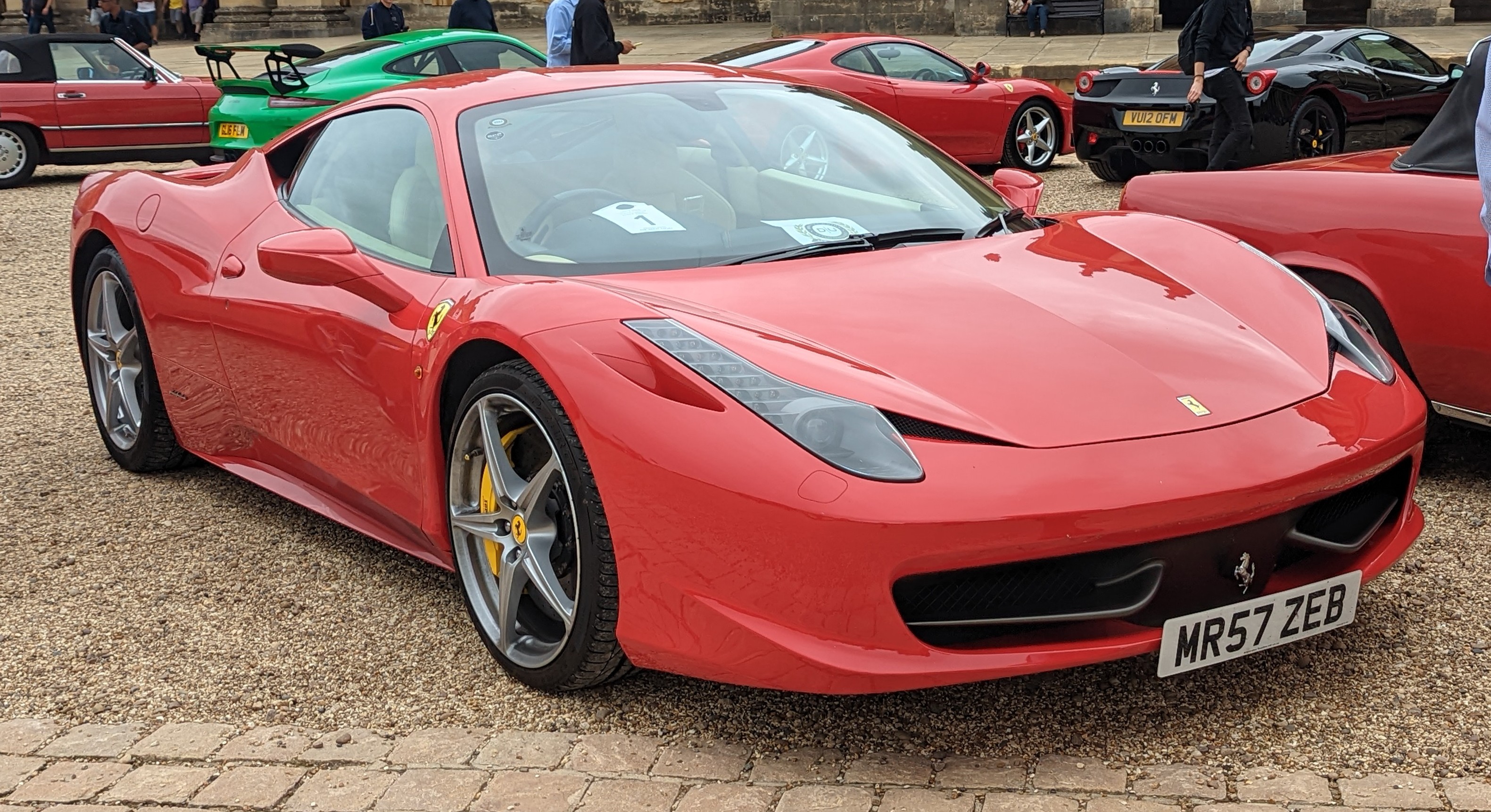
Ferrari 458 engine
"You've built the FRS slash 86 with the Ferrari 458 engine."
That’s a Ferrari V8 (from the 458) being used in a non-Ferrari build. It’s a big deal because it usually requires lots of custom work to make it fit and run correctly.
The Ferrari 458 engine is the powerplant from the Ferrari 458 (a V8 used in multiple 458 variants). Swapping a Ferrari engine into an FRS/86-style chassis is a major engineering project because it changes everything from cooling and wiring to drivetrain fitment and weight distribution.
SEMA
"...until we bumped into you at SEMA a few years back."
SEMA is a big car show in the U.S. where custom and modified cars—and the parts that make them possible—get showcased.
SEMA is the Specialty Equipment Market Association show, a major annual event in the U.S. focused on aftermarket parts, custom cars, and fabrication. It’s a common place for builders to debut projects and network with the industry.
taking a chassis and putting modern running gear in it
"And for me, it's like a pretty common theme of taking a chassis and putting modern running gear in it, so to speak. Well, besides the Stout, that was just older and then slightly older."
It means keeping the car’s body/chassis, but upgrading the important mechanical parts like the engine and drivetrain. Builders do this to get newer performance and easier parts support without starting from scratch.
This describes an engine/drivetrain swap philosophy: keeping the original chassis while updating the “running gear” (engine, transmission, differential, suspension components). It’s a common approach in tuned builds because it can modernize reliability, parts availability, and performance while retaining the original car’s character.
spare parts for that
"Is it still around? Is it still live and have a life and are there spare parts for that and so on and so on?"
They’re saying that before you commit to a build, you need to make sure replacement parts are actually available. Otherwise, the car can become hard to maintain or repair.
The speaker emphasizes parts availability as a key constraint when planning a swap or build. Before choosing an engine/drivetrain combination, they check whether the donor components are still around and whether spare parts can be sourced reliably.
engine combination
"So I think you first just come up with these ideas and you do research and you do homework and you find out what is available to you as far as engine combination. And chassis combinations and then go from there."
They mean choosing which engine and drivetrain parts to use together. It’s not random—builders research what will fit and work reliably with the rest of the car.
“Engine combination” refers to selecting a compatible powertrain setup (engine + transmission + supporting components) that can be made to work with the chosen chassis. The speaker frames it as a research-driven process based on what’s available and supportable.
chassis combinations
"And chassis combinations and then go from there. And that's really what drives me because I think that's the most exciting part is like finding out what you can get your hands on and then coming up with some recipe for that to all work together."
They’re talking about making sure the car’s body/chassis works with the drivetrain you want to install. It’s about fitment and compatibility so the swap can actually be done.
“Chassis combinations” highlights the compatibility side of swaps: matching the chassis to the drivetrain and the practical mounting/fitment requirements. It reinforces that successful builds are about system integration, not just picking a fast engine.

Subaru WRX
"...an. And so the Mitsubishi Evo's, the Subaru STI, WRX and the Toyota Celicas were common and still are ..."
The Subaru WRX is a sporty car with a turbo engine and usually all-wheel drive. It’s popular with people who like fast driving and upgrades. In the podcast, it’s mentioned as one of the well-known performance cars people still talk about.
The Subaru WRX is a compact performance sedan/wagon platform built around rally-style driving, including all-wheel drive and a turbocharged engine. It’s frequently discussed alongside other turbocharged “enthusiast” models because it’s a common choice for modification and motorsport-inspired setups. The podcast groups it with cars like the Evo, STI, and Celica as well-known performance staples.
JDM
"Yeah, so I first got a JDM. My first JDM purchase from Japan through an importer here in the States."
JDM means the car was made for Japan’s market. It can have different parts and specs than the same model sold in the U.S., so enthusiasts sometimes seek them out for that reason.
JDM stands for Japanese Domestic Market, meaning cars originally sold in Japan rather than for the U.S. market. These often have different engine/transmission setups, trims, and sometimes more performance-oriented options than what you could buy new in the States.
all wheel drive donuts
"It ripped the heck out of my driveway doing all wheel drive donuts and just having fun with it."
Donuts are when you spin the car in a circle on purpose, usually by breaking traction. With all-wheel drive, the car can often put power down more easily while you’re doing it.
“Donuts” are tight, circular slides that test traction and tire grip. Doing them in an all-wheel-drive car highlights how AWD can help maintain control and deliver power to multiple wheels while you break traction.
NA engine
"We have an ST202... and it's just a front wheel drive car with an NA engine and pretty boring besides."
NA engine means the engine doesn’t use a turbo or supercharger. It relies on normal airflow into the engine, which often feels less punchy than forced induction.
“NA” means naturally aspirated, referring to an engine that makes power without a turbocharger or supercharger. In the context of this segment, the host contrasts the NA ST202 with the more performance-focused JDM approach they wanted.
donor
"We were going to cut it up anyways and build it into a race car. So I was like, this is the perfect donor to have."
A donor car is a car you buy mainly to take parts from it or use it as the starting point for a project. It’s often cheaper than starting with the most desirable version of the model.
A “donor” car is a cheaper base vehicle you buy specifically to harvest parts or use as the foundation for a build. In this segment, the host prefers a front-wheel-drive donor to avoid cutting up a more valuable JDM ST205.
homologation
"Yeah, and the GT4 that I got was one of the homologation ones, so the one of $2,500."
Homologation is the process of building a limited number of road-legal (or otherwise eligible) cars so a race version can compete under the rules. It’s common in rally and touring-car racing because the regulations require a production link to the race car.
World Rally Championship
"there was something odd about that ST205 when they were running in the World Rally Championship."
The World Rally Championship is the biggest global rally racing series. Teams build and tune cars to follow the rally rules, and that’s why you’ll hear about specific technical limitations.
The World Rally Championship (WRC) is the top-level international rally series run by the FIA. Cars like the Toyota ST205 Celica were engineered to meet WRC rules, which can include constraints on components and fitment.
16 inch wheel
"Were they the only manufacturer running on a 16 inch wheel?... I believe it was something to do with the front suspension, maybe front suspension and brakes and they couldn't fit a 15 inch wheel on it."
Wheel size affects what tires and brakes can physically fit on the car. In rally, teams sometimes can’t use smaller wheels because the suspension or brakes take up space.
Wheel diameter matters in rally because it affects tire size, brake clearance, and how the suspension geometry fits the car. This segment suggests the ST205 had packaging/clearance constraints that made fitting smaller wheels (like 15-inch) difficult.
Rally New Zealand
"I do remember watching rally New Zealand back when those ST205s were the current weapon of choice."
Rally New Zealand is a famous rally event in New Zealand. They’re using it as a memory anchor for when those Toyota rally cars were the top competitors.
Rally New Zealand is a well-known event on the WRC calendar (or related FIA rally series depending on the era). Mentioning it anchors the discussion in a specific place and time when ST205 Celicas were actively competing.
anti-lag
"I remember standing on the start line, this was when anti-lag was just coming in."
Anti-lag is a turbo trick that keeps the turbo “spooled up” even when you lift off the gas. That way, when you press the throttle again, you get power faster—very useful in rally driving.
Anti-lag is a turbocharging strategy used in rally to keep boost pressure available during throttle transitions, especially between gear changes. It helps reduce turbo lag so the driver can stay responsive on corner exits and sudden throttle inputs.
rally drivers
"But I do genuinely think rally drivers are the sort of top of the top. F1, sure it's faster but Formula 1, it's the old story of circuit racing... for a rally driver you see a thousand corners one time."
The segment argues that rally drivers are uniquely skilled because they must adapt to changing surfaces and unfamiliar stages, often using pace notes while managing traction limits. Unlike circuit racing where the same corners are repeated, rally drivers encounter many different corners in a single event, demanding rapid learning and precise car control.
pace notes
"And being able to read the road like that, despite obviously yes, you've got pace notes, it's just the skill set is incredible, hats off to them."
Pace notes are like a rally “cheat sheet” the driver uses during the stage. They describe what’s coming up next so the driver can go fast even though they haven’t driven the route before.
Pace notes are written (or sometimes recorded) instructions used in rallying to tell the driver what the road will do next—like turn type, severity, and timing. They allow drivers to attack stages at high speed on unfamiliar roads while still preparing for grip changes and corner geometry.
drift car
"You drive the car so, so, so differently than a drift car. I can, maybe because I've been doing it for 20 plus years, I can just drive a drift car so easily..."
A drift car is built and driven to slide on purpose while staying in control. The driver uses throttle and steering in a very specific way to keep the car sideways without spinning out.
A drift car is set up and driven to intentionally oversteer and maintain a controlled slide through corners. The driving inputs emphasize balancing slip angle with throttle, steering angle, and (often) power delivery characteristics—skills that can transfer to other motorsport disciplines but not always directly.
four-wheel drive, you know, rally based car
"Like the differences between a rear-wheel drive drift car and a four-wheel drive, you know, rally based car?"
Four-wheel drive sends power to all four wheels. That can make the car feel different in turns because it grips more and the driver has to plan the corner earlier instead of just pivoting like in a drift car.
Four-wheel drive (4WD) rally cars distribute power to both axles, which changes how the car rotates and how quickly it responds to steering and throttle. The added traction and front-wheel involvement mean drivers must set up for corners earlier and adjust depth perception and braking/throttle timing.
pivot the car
"Yeah, I think in a drift car it's a lot easier, I think, to pivot because you don't have the front steering, there's less to take into consideration..."
Pivoting is basically turning the car’s direction quickly by getting it to rotate. The point here is that the same “quick rotate” feeling doesn’t happen as easily when you switch from a drift setup to a 4WD rally setup.
“Pivoting” in performance driving refers to rotating the car around its axis to change its direction quickly—often by combining steering input with throttle (and sometimes braking) to manage weight transfer. The segment contrasts how pivoting is easier in RWD drifting versus slower/less immediate in 4WD rally setups due to different traction and drivetrain response.
3S 5S combination
"I wanted to, after the experience that I've had with the Stout and the 3S 5S combination that I've had in that car, I just, I really wanted to have a modern engine that was more"
This sounds like mixing parts from two different Toyota engine families to make a setup that works better for the build. It usually means custom work and tuning so everything fits and runs correctly.
“3S” and “5S” refer to Toyota’s engine families (the 3S series and 5S series). Combining parts from different engine families is a common hot-rodding approach to get better performance or packaging, but it requires careful matching of components and tuning.
cam control
"I really wanted to have a modern engine that was more efficient, had cam control and yes, I could have put a beams head on the 3S"
Cam control is a system that helps the engine open the valves at the right times for different speeds. It can make the car feel smoother and more efficient without sacrificing power.
Cam control typically refers to variable cam timing (and sometimes variable valve timing) that adjusts when the camshaft opens the valves. That improves efficiency and drivability across different engine speeds, compared to older fixed-cam setups.
OEM setup
"something that already produced quite a bit of horsepower from the factory from the OEM setup so you knew it was going to be potentially really reliable"
“OEM setup” refers to the factory configuration engineered by the automaker, including calibration, materials, and component matching. Starting from an OEM design can improve baseline reliability because the engine was validated to run that way under real-world conditions.
engine project
"even at a higher level with some rods, pistons and the usual parts that you would throw at an engine project."
An “engine project” in this context means a planned upgrade path—often involving internal components (like rods and pistons) plus supporting changes and tuning. The goal is to balance reliability with higher performance while keeping the engine’s modern control systems working correctly.

GR Corolla
"I mean, I've driven it in factory form and a GR Corolla's here in the States and I love that car. I think even as a road car that car is phenomenal."
The GR Corolla is Toyota’s performance hatchback that uses a modern turbo engine. The host is using it as proof that this engine makes enough power for fun without being uncontrollable.
The Toyota GR Corolla is a hot hatch built around the G16E turbo engine, tuned for strong street performance and enthusiast driving. In the segment, it’s used as a reference point for how the engine feels in factory form—especially its torque and turbo response.
longer stroke
"It was grunty, it has a longer stroke for 1.6 liter so it still spools the turbo really well and it makes good torque"
Stroke is how far the piston moves inside the engine. A longer stroke can help the engine make more “pull” at lower speeds, so the car feels torquey and easier to drive.
A longer stroke means the piston travels farther up and down, which can increase torque characteristics—often improving low- to mid-range pull. In turbo engines, that can help the car feel responsive even before peak boost is reached.
spools the turbo
"It was grunty, it has a longer stroke for 1.6 liter so it still spools the turbo really well and it makes good torque"
When you accelerate, a turbo needs time to build boost pressure. “Spooling the turbo” means how quickly it ramps up, which affects how responsive the car feels.
“Spooling the turbo” describes how quickly the turbocharger builds boost after you press the throttle. Faster spool generally means less turbo lag and a more immediate surge of power.

BMW G16S
"...ean the numbers they're seeing out of these stock G16s is just absolutely out the gate. On paper, it ki..."
The BMW 8 Series is a luxury car designed for comfortable, fast driving. It’s meant to feel smooth and capable, including on longer trips. The podcast mentions it while talking about performance results and engine output.
The BMW 8 Series is a luxury grand touring car, built to combine high performance with comfort and long-distance capability. In the podcast snippet, it’s tied to discussion of engine numbers and performance figures, suggesting it’s being referenced in the context of measurable output. That makes it a relevant topic when talking about what modern powertrains can achieve.
GR engine
"I don't know, I think they just, I think it's, you know, it's a GR engine so they put a lot of extra time in a building a performance based motor..."
“GR” is Toyota’s performance brand. Saying “GR engine” usually means it’s part of Toyota’s racing-focused lineup, designed to handle more performance than a basic engine.
“GR” refers to Toyota’s Gazoo Racing performance line. When someone calls it a “GR engine,” they’re usually pointing to a modern Toyota performance engine family that’s designed with motorsport-derived development and tuning in mind.
three cylinder
"It being a three cylinder and still making a lot of power out of a 1.6, I mean the, our engine, so we built it..."
A three-cylinder engine has three combustion chambers instead of four. The surprising part here is that, with the right turbo and tuning, it can still make a lot of power.
A three-cylinder engine has fewer cylinders than a typical four-cylinder, which changes how power is made and how the engine behaves under boost. In this segment, the key point is that a 1.6-liter three-cylinder can still make very high power when engineered and tuned correctly.
Kelford Cams
"...built it with, you know, rods and pistons from Nidda Performance Engineering and SuperTech Valtrain, Kelford Cams and the engine does 500 at the wheels..."
Kelford is an aftermarket camshaft brand commonly used in performance and motorsport builds. Camshafts control valve timing and lift, which helps an engine breathe better—especially important for boosted setups targeting high power.
SuperTech Valtrain
"...rods and pistons from Nidda Performance Engineering and SuperTech Valtrain, Kelford Cams and the engine does 500 at the wheels..."
SuperTech Valtrain is mentioned as the source for valvetrain components. Valvetrain upgrades (like valves, springs, retainers, and related parts) are often used to maintain control of valve motion at higher RPM and boost.
Nidda Performance Engineering
"...we built it with, you know, rods and pistons from Nidda Performance Engineering and SuperTech Valtrain, Kelford Cams..."
This is a company that makes performance engine parts like rods and pistons. When you’re pushing big boost, these parts are chosen to handle the extra stress safely.
Nidda Performance Engineering is referenced as the supplier for rods and pistons used in the build. In high-boost engines, stronger rods/pistons help the rotating assembly survive higher cylinder pressures and reduce the risk of failure.
Garrett G3770 Turbo
"...the engine does 500 at the wheels or 505 at the wheels at 32 PSI boost at about Garrett G3770 Turbo. Now it's the same turbocharger I'm running on the stout..."
The Garrett G3770 is a specific turbocharger model used for high-power applications. Turbo sizing affects spool characteristics and airflow; the G3770 is typically chosen when the goal is strong power at higher boost levels.
32 PSI boost
"...the engine does 500 at the wheels or 505 at the wheels at 32 PSI boost at about Garrett G3770 Turbo."
“PSI boost” is the amount of extra pressure the turbo forces into the intake manifold. Higher boost increases airflow and potential power, but it also raises stress on the engine—so supporting parts and sealing (like head gaskets/studs) become important.
head gasket
"I'm definitely not a specialist on that engine but maybe a head gasket and a set of head studs."
The head gasket is a seal between the engine block and the cylinder head. With high boost, it can be the first thing to fail if the engine isn’t built to handle the pressure.
A head gasket seals the combustion chambers to the engine block and cylinder head. On boosted engines, the head gasket is a common weak point because higher cylinder pressures can cause leaks or combustion gases to escape if the gasket isn’t up to the task.
head studs
"I'm definitely not a specialist on that engine but maybe a head gasket and a set of head studs."
Head studs are stronger fasteners that hold the cylinder head down tighter. They help keep the head gasket sealed when you’re running a lot of boost.
Head studs replace or supplement factory head bolts to clamp the cylinder head more securely to the block. They’re often used on high-boost builds to help prevent head lift and protect the head gasket under extreme cylinder pressure.
stock engine headroom
"...made insane power but then it was pretty quickly proven that people were doing much the same without changing any of the internals which is absolutely wild that there is that much headroom in that stock engine."
“Headroom” here means the margin of safety in the factory engine design—how much power it can handle before components become a limiting factor. The speaker notes that the community discovered surprisingly high power capability without changing many internal parts, which is a big deal for cost and build strategy.
G16E engine
"I can only assume there's also a benefit with moving to that G16E engine in that it's"
The G16E is referenced as a newer engine platform the build may be moving toward. The key idea is that changing engine architecture can affect how much power is possible and what supporting modifications are needed.
oil pan
"[2001.7s] The other thing though is that the engine's really tall. [2004.5s] So from the oil pan all the way up to the valve cover..."
The oil pan is the part at the bottom of the engine that holds the engine oil. They’re measuring how tall the engine is from the bottom (oil pan) to the top (valve cover) to explain why it takes careful fitment.
The oil pan is the lower sump that holds engine oil and helps manage lubrication. The hosts describe the engine’s height “from the oil pan all the way up to the valve cover,” which is a key packaging constraint when fitting an engine into a tight engine bay.
valve cover
"[2004.5s] So from the oil pan all the way up to the valve cover, it's actually a really tall engine"
The valve cover is the top cover on the engine that helps protect the moving parts inside. They mention it to explain how tall the engine is, which matters for fitting everything under the hood.
The valve cover is the top housing that protects the valvetrain and seals the top of the engine. In this segment, it’s used to define the engine’s overall height, which affects how the engine can be positioned in the bay.
engine bay packaging (tilted toward the firewall)
"[2008.4s] so the only thing that we had to really take into consideration was the vertical placement [2012.2s] but it does free up space in the engine bay... [2024.1s] ...tilted backwards towards the firewall [2033.1s] I think it's like 15, 10 or 15 degrees."
Packaging is about fitting the engine where it needs to go without hitting other parts. Tilting the engine toward the firewall can create more room and make it easier to work on the car later.
Engine bay packaging refers to how an engine is positioned to fit within the available space while still allowing clearance for components and service access. Tilting the engine backward toward the firewall (around 10–15 degrees here) can improve space management, reduce interference, and make certain service tasks easier.
vertical placement
"[2008.4s] so the only thing that we had to really take into consideration was the vertical placement [2012.2s] but it does free up space in the engine bay..."
Vertical placement means how high the engine sits in the car. If the engine is tall, you have to place it carefully so it doesn’t run into the hood or other parts.
Vertical placement is how high or low the engine sits relative to the chassis and bodywork. The hosts emphasize it because the engine is “really tall,” so the build must manage height from the oil pan to the valve cover to avoid clearance issues.
serviceability in the engine bay
"[2019.4s] So we've had room to where you can service it a little bit better in some areas [2024.1s] but we've had to, you know, I'm pretty sure it's tilted backwards towards the firewall"
Serviceability is how easy it is to get to parts for maintenance. They’re saying the way the engine is fitted creates more room, so certain jobs are less annoying.
Serviceability refers to how easily mechanics can access components for maintenance and repairs. The hosts note that the packaging decisions free up space, allowing easier servicing in some areas even though the engine has to be positioned carefully.
drive trailer
"[2057.6s] Talk us through the rest of the drive trailer. [2059.5s] Again, is it all stock or stock Toyota or where have you gone with that?"
This sounds like they meant “drivetrain,” which is the parts that send power to the wheels. They’re asking whether those parts are stock or modified.
“Drive trailer” appears to be a transcription error for “drivetrain,” which is the system that delivers power to the wheels. The context immediately asks whether it’s stock, indicating they’re discussing what’s been changed in the powertrain components.
Toyota engine
"[2064.7s] No, no. [2065.5s] This is where things get a little murky for me and so I'm using a Toyota engine."
The hosts clarify they’re using a Toyota engine for the build, which matters because Toyota powertrains have well-known fitment paths and aftermarket support. In this segment, they’re setting up a discussion of what’s been swapped and how it affects the overall build.
Hollinger MFE gearbox
"I'm using a Hollinger MFE gearbox, so full six speed sequential gearbox. We're using a transfer case from Mitsubishi and then a rear-end also from Mitsubishi to complete the package."
Hollinger makes race-focused transmissions. “Sequential” means you shift one gear at a time in order, which helps keep the car accelerating smoothly during hard driving.
A Hollinger MFE is a purpose-built racing gearbox known for durability under high torque and for precise shift control. In this build it’s described as a full six-speed sequential setup, meaning the driver shifts through gears in order with minimal interruption to power delivery.
six speed sequential gearbox
"I'm using a Hollinger MFE gearbox, so full six speed sequential gearbox. We're using a transfer case from Mitsubishi and then a rear-end also from Mitsubishi to complete the package."
Sequential means you can only go to the next gear up or down, one step at a time. Racers like it because it’s fast and consistent when you’re driving hard.
A sequential gearbox lets you move through gears in order (typically up or down one step at a time) rather than selecting any gear directly. That design is common in motorsport because it can reduce shift time and help maintain traction and acceleration during repeated launches and hard corner exits.
transfer case
"We're using a transfer case from Mitsubishi and then a rear-end also from Mitsubishi to complete the package. That's an interesting combination."
A transfer case is the part that routes power to the wheels in an AWD-style setup. If you’re building a custom drivetrain, picking the right one helps the car put power down the way you expect.
A transfer case splits power between the front and rear axles in many all-wheel-drive layouts, and it can also provide different gearing ratios. In a custom drivetrain swap, the transfer case choice is critical because it affects how torque reaches the wheels and how well the system behaves under load.
rear-end
"We're using a transfer case from Mitsubishi and then a rear-end also from Mitsubishi to complete the package. That's an interesting combination."
“Rear-end” is shorthand for the rear axle assembly, including the differential and final-drive gearing. In drivetrain builds, matching the rear-end to the transmission/transfer case is essential so the gearing and torque delivery work together without driveline bind or mismatched ratios.
Request an Explanation
Heard something you'd like explained? We'll add it to this episode.
Sign in to request explanations for terms you heard.
Want to learn more?
Browse our glossary for plain-English explanations of automotive terms, jargon, and concepts.
Help improve this episode
See something that's not quite right? Our annotations are AI-generated and can sometimes miss the mark. Click the flag icon on any annotation to suggest a correction.