ROI is a way to measure whether something you spend money on is paying you back. The idea is: did the marketing effort bring in enough results to justify the cost?
This is a message from the FTC (a U.S. consumer-protection agency) telling car dealers how they’re allowed to show prices in ads. The big point is that the main price you advertise has to be shown clearly and consistently.
A DMS is the computer system a car dealership uses to manage everything—like cars in stock and customer leads. If two dealers use different systems, their websites and listings can show information differently.
Cars.com is a website where people shop for cars and where dealers post their inventory. It can show dealer pricing and vehicle info differently than other sites.
TrueCar is a site that helps people find cars and see pricing information from dealers. It’s mentioned as part of the ecosystem that shows dealer inventory details.
This means dealers send their car listings to other websites so those sites can show the cars too. Different websites might present the same listing data in different ways.
An “all-in price” means the full amount you’ll pay for the car, not just the sticker price. It usually includes the fees and taxes so you can compare offers more easily.
“Used car book value” is a reference estimate of what a used car is worth. If it swings, the “worth” changes fast, which affects trade-in offers and used-car prices.
Term
credit gone
“Credit gone” means an incentive (like a government discount) is no longer available. When that happens, fewer people may buy EVs at the same price, so dealers often need to change how they price and stock cars.
Fixed operations are the dealership’s money-making activities like repairs and maintenance, not selling the car itself. This is the part of the business that keeps customers coming back for service.
Hyundai of Cottonwood is another dealership location mentioned in the intro. It helps explain where Michael Ross’s service/parts leadership experience comes from.
A “fixed-op study” is research about the service and parts business at a car dealership. It looks at how much money dealers make from repairs and how they’re doing compared to others.
An employee pricing campaign is a special sale where the company offers a discount like employees would get. Dealers and shoppers often see it as a way to get a better deal than usual.
Term
Q1
Q1 is just the first three months of the year. So when they say Ford had a strong Q1, they mean the company did well financially during that time.
Term
IEPA tariff refunds
IEPA tariff refunds are payments back to the company connected to tariffs (taxes on imported goods). The point here is that those refunds helped Ford’s profit numbers.
They’re saying overall sales were down by 8.8% compared to last year. The hosts’ takeaway is that you shouldn’t panic without understanding what changed.
Term
4Q2
This looks like a shorthand way of talking about a future quarter. They’re basically saying they want to see how the employee pricing change might affect sales later on.
They’re talking about a proposed law that could block certain Chinese-made items from being brought into the U.S. That includes not just cars and parts, but also the software that runs in the vehicle.
The “Connected Vehicle Rule” is a government policy about cars that can connect to networks. It’s about requirements for how those connected systems are handled, especially around security.
F&I is the part of the dealership that handles financing and extra products. When they say “F&I gross,” they mean the money the dealer makes from things like insurance sold during the deal.
Poly Insurance is the company that published the report being quoted in this segment. They looked at what happens when dealers offer insurance during the car-buying process and how that affects dealer profit.
They’re talking about when a dealer brings up insurance details during the car-buying process. One side thinks it makes things clearer for the customer, and the other side thinks it can make the transaction harder to complete.
Concept
life cycle of trade
“Life cycle of trade” is a dealership/retail operations phrase for how long the trade-in process takes from initial discussion to completion. The implication is that earlier information (like insurance) may reduce delays and speed up the overall transaction.
Carvana is a company that sells used cars, mostly through an online buying process. They’re talking about how well Carvana is doing financially this quarter.
Company
Daily Deal Alive
They mention “Daily Deal Alive” as the place they’d like to bring someone on to talk about business results. It’s basically the podcast/show they’re discussing on.
“Fixed Ops Friday” is the part of the show that focuses on the dealership’s service and parts business. It’s basically the “repair side” of running a car store.
Berkshire Hathaway is a huge company that owns lots of other companies. When it comes up in car-dealer talk, it usually means they own part of something connected to dealerships or the auto business.
CPO means “certified pre-owned.” It’s a used car that’s been checked and approved by the dealer/manufacturer, usually with extra protections like a warranty.
They’re talking about a specific dealership, “U's Cars,” and giving credit to the staff for doing really well on both new cars and certified used cars.
A “scoreboard” here means a daily chart or dashboard that shows how each salesperson is doing. It helps everyone see progress and goals, not just the final results.
This is a sales productivity metric that counts how long a salesperson has gone without a retail sale. It’s often used to spot stalled activity early and prompt coaching or process changes.
Gross profit is the money the dealership makes from selling a car, after the direct costs of that sale. It’s a key number because it shows whether deals are profitable, not just busy.
A tax credit is a government discount that reduces your taxes. If it goes away or changes, it can make EVs more or less attractive to buyers overnight.
This is a New York program that gives buyers extra money back for buying certain cleaner vehicles. It can make an EV cheaper even if the federal tax credit isn’t available anymore.
The Honda Prologue is an all-electric SUV, meaning it runs on a battery instead of gasoline. In the podcast, it sounds like the discussion is about extra charges that can be added on top of the listed price. That’s important because the final cost you pay can be higher than the starting price.
Margin compression means the dealership is making less profit per vehicle than it used to. Prices and costs can squeeze profits, so they look for other ways to earn money.
Leasing is like renting a car for a few years with payments based on the car’s expected value. You usually don’t own it at the end unless you choose to buy it.
A vehicle exchange program is a dealer process for bringing vehicles into the store—often by swapping or taking in eligible vehicles that can then be reconditioned and sold through a used/CPO channel. It’s described here as a key source for inventory.
Finance rates are the interest rates on an auto loan. Lower rates can make the payments cheaper, which is why they’re highlighting them for CPO buyers.
When a lease ends, the car gets brought back—this is called a lease return or turn-in. Dealers can then sell it again, usually after inspecting and fixing it up.
Sales rate just means how fast the dealership sells cars. If they sell more quickly, they can plan inventory and keep the business moving.
Concept
trace cycle management
This sounds like a process for managing how customers move through the lease experience—when they sign up, when the lease ends, and what happens next. The goal is to keep the dealership getting good lease trade-ins and sales.
Certified pre-owned cars are used cars that have been checked and fixed up to meet a program’s rules. They usually come with extra coverage compared to a regular used car.
A service lane is the part of the dealership where cars go in for service and inspection. They’re saying lease-return cars are handled there to get ready for resale.
In dealer terms, an “auction” is a marketplace where dealers buy vehicles from other sellers (often other dealers, fleet operators, or lease remarketers). Saying they bought zero cars from the auction means their inventory strategy is relying on lease turn-ins instead of purchasing through auctions.
The service drive is the part of the dealership where you pull in for service—like oil changes or repairs. Cars are usually checked in and lined up for the work to be done.
Concept
repair in advance
“Repair in advance” means fixing problems before the customer’s appointment. The goal is to avoid delays so the car can be handled faster when it shows up.
An equity mining tool is software used to identify customers who may have built up equity in their current vehicle (often by comparing payoff amounts to estimated market values). Dealerships use that data to target customers for trade-in or upgrade offers.
In dealership sales, an appraisal is the estimated value of a customer’s current vehicle, usually based on condition and market data. That number is then used to build the customer’s next proposal (trade/upgrade or lease terms).
BDC means the dealership’s lead-follow-up team. They help manage phone calls and online inquiries so potential buyers get contacted and scheduled to come in.
Car sourcing is how a dealership finds cars to sell. It’s not just finding a listing—it’s getting the right car at the right price and making sure it can be sold profitably.
Service retention just means: do customers keep bringing their cars back to the same dealership for service. Higher retention usually means the dealership is doing a good job and customers trust them.
COX is a company that studies how car dealerships are doing. They publish reports that help dealers compare their service business to what’s happening across the industry.
“General repair” means regular repair shops that aren’t the car dealership. The point here is those shops are competing for the same service customers.
It’s how a dealership tries to time and encourage when customers will switch to a newer car. The goal is to keep the dealership getting new business consistently over time.
Service effectiveness is a way to measure how productive the service department is. Higher numbers usually mean the shop is using its technicians’ time well and getting more work done.
Term
indexed over
This is a comparison score. It tells you how the dealership’s results stack up versus an industry or internal benchmark.
Warranty and recalls are types of repairs that the manufacturer covers. Recalls are required safety fixes, and warranty work is covered because of the car’s warranty—both can change how busy the service shop gets.
It’s a productivity measure for the service shop. It compares how much work the technicians get done versus how much time they’re available, and higher usually means the shop is running more efficiently.
PVR is a dealership scorecard number that tries to measure how much profit the store makes per retail car sold. People use it to judge whether the dealership is “doing the job,” but it can be misleading if it’s the only thing they focus on.
The Honda Ridgeline is a midsize pickup truck. The host is saying it’s very reliable—basically the kind of truck people expect to keep running without big problems.
“CDG circles” just means the community of people who follow Car Dealership Guy and talk about dealership topics. It’s not a car tech term—more like a dealer group.
Term
filing
Here, “filing” means paperwork dealers have to submit or keep up with to follow the rules. It’s part of staying compliant, not a car repair process.
These are websites that send car shoppers’ questions to dealerships. If different sites show different pricing details, it can confuse buyers and make it harder for dealers to keep offers consistent.
They’re talking about setting up one consistent way of doing things. That way, the deal information stays accurate when it’s shown on different websites.
“Feeds” are the structured data streams (often pricing/availability details) that dealerships provide to lead platforms. When a feed is interpreted differently, the platform may display the offer with different inclusions (like down payment or discounts), leading to inconsistent advertised pricing.
Dealers send pricing information to websites. If the website reads that information differently, the price you see online might not match what the dealer intended.
A discount is money taken off the price of the car. If a website includes the discount in the advertised price (or doesn’t), buyers may see different numbers.
Term
viato
They’re talking about a software system they use to handle pricing and leads. The question is whether the price shown online includes all the required fees.
A dock fee is an extra charge dealers add for moving the car from where it arrives to the dealership. Some places limit it or require it to be clearly shown.
Term
one way
They’re saying different places or websites may require prices to be shown in different ways. So the dealer has to follow each rule so customers see the right total.
A profit participation program is a deal where a dealership gets a share of profits from certain sales or services. The podcast is saying Zurich can review how that sharing is set up so it may work better.
The Honda Passport is a larger Honda SUV meant for carrying people and gear comfortably. It’s the kind of vehicle people talk about when they want something practical for daily driving and road trips. In the podcast, it’s mentioned as a favorite vehicle.
Green Automotive Group is the company that runs the dealerships the speaker is talking about. It’s basically the dealership business he’s helping manage.
LIVE
We're doing better as a result of social media presence.
It doesn't do those three things, then it's on the chopping block.
It's in return on investment discussion.
Hey, everybody, welcome back to another episode of The Daily Dealer Live.
I'm your host, Sam Dark, and thanks for choosing to be here on this Friday, May 1.
It's the beginning of another month.
It's the end of one.
I'm out of breath today running around as we close out April,
and we get ready to kick off a huge month of May, Memorial Day and all.
But today here on The Daily Dealer Live, it's Fixed Ops Friday.
And before we get into service, I want to talk about an item, the FTC letter.
97 auto groups cost the country, got one.
But the entire industry, this was shot over the bow by the FTC,
on the April 17th webinar with NADA, FTC made it crystal clear.
It's got to be in your most prominent advertised price, all 50 states, no exceptions.
So that's easy, right?
Well, you would think the problem nobody's solving.
Every dealer runs a different DMS.
Every dealer runs a different website provider, a different feed.
And every lead provider, yes, cars.com, auto trader, car gurus,
admins, all of them pulls and displays that data a little differently.
So next week, we're opening the door.
I want cars.com on the show.
Auto trader, car gurus, admins, true car.
Anyone syndicating dealer inventory, come on this show,
Daily Dealer Live for a roundtable.
Let's figure out together how we push the all in price Dock v. Included downstream,
uniformly, to every listing site in the country.
So want to join, reach out.
We'll make that seat available.
You can message Hannah.
In fact, Hannah, if you can give me your email address in the chat, I'll put it out here.
Message Hannah, or myself, you can DM me on LinkedIn, Sam Dark.
We'll make sure to get you in the show.
And today's guest, Jason Graciano, returns from White Plains, Honda.
He's been on the show before.
Last time he was on, he was the number four Honda EV dealer in the country.
We're getting an update, EV strategy with the credit gone, used car book value swings
and his outlook for the rest of 2026.
Plus, I'll ask him, how did the FTC letter reshape how you price and advertise, if any.
Then, Michael Ross, fixed-op director at Larry Green Chevrolet in Hyundai of Cottonwood.
Cox just dropped the 26 fixed-op study, record service revenue.
But we learned dealers are losing market share to general repair.
Michael's going to tell us how he's fighting for fixed.
Drop your questions in the chat because as a reminder, we are streaming across all
CDG social media platforms everywhere across the internet.
We'll bring your comments into the chat.
I see Hannah Farmer.
She's got a smiley face.
So you can actually, you can DM me on LinkedIn.
And I know that there's like an email address that we can send you to as well.
I'll get that by the end of today's show.
Supervisor Dan comes into the chat says,
Happy fixed-ops Friday to all who celebrate.
F-O-F. Hopefully we all do.
Everyone is in fixed-ops today.
All right.
First, let's dive into today's auto industry headlines.
First up today, Ford this morning announced the return of its employee pricing campaign
as part of its 250th anniversary celebration,
which lands on the heels of a relatively strong Q1.
For context, the automaker posted $2.5 billion in profit on $43.3 billion in revenue.
That's a 6% increase year-over-year with a $1.3 billion in IEPA tariff refunds contributing
to that number.
Wait, how are people cashing in those refund checks even before that's a hit?
I'm not sure.
Total sales were down 8.8% versus last year through March.
March 2025 created a tough comparison for the entire industry,
so the decline needs context more than concern.
Interested to see the lift of the return of employee pricing might bring
4Q2.
You'll remember Ford kicked off a big upswing.
I think it was last year by announcing employee pricing,
and Donald Trump actually tweeted it first.
We brought that to you as well.
Hannah at CardiolaShipGuy.
I'm looking at this, Hannah.
I think it's CardiolaShipGuy.org.
So to all the lead providers that want to be part of this round table,
Hannah at CardiolaShipGuy.org, post it into the comments.
Look forward to or reach out to Hannah.
We look forward to having you on the show next week.
Also, this week a bipartisan pair of senators introduced legislation Wednesday to ban Chinese
vehicles, parts and vehicle software from being imported into the United States,
including anything developed through partnership with China or other adversarial nations.
The bill builds on last year's Commerce Department Connected Vehicle Rule
and comes the same week 70 House Democrats separately urged Trump
to keep Chinese automakers out of the market entirely.
President Trump has an upcoming meeting with Xi Jinping,
but the administration's current position isn't fully settled.
Trump has previously floated the idea of Chinese automakers building plants stateside,
and there have been reported discussions about partnership frameworks
with domestic brands.
We'll keep you up to date on all the news related to this.
On the topic of affordability,
Poly Insurance's Q1 report found that dealers presenting insurance quotes during the purchase
process averaged an additional $343 per transaction in F&I.
With dealers who actually closed an insurance sale,
seeing $564 boost in F&I gross, a 35% increase.
This comes as average insurance rates have also dropped from $202
at the end of 2024 to $168 now.
That's the fifth straight quarter of declines after massive increases coming into and out of COVID.
Still, it's worth noting that some dealers push back on the idea of insurance conversations,
arguing that it stalls and complicates transactions at the dealer level.
Curious to hear what you think?
And you know, this is a fascinating conversation.
The fear has always been you could mess up the deal if the insurance ends up being sky high.
I formally am on the side of transparency.
So I think the more information a customer has earlier,
the better the entire process is served.
And it probably shortens the life cycle of trade for that customer as well.
So I like the idea of providing insurance early, though I understand both sides.
All right, back to the news.
Up closing out the news today,
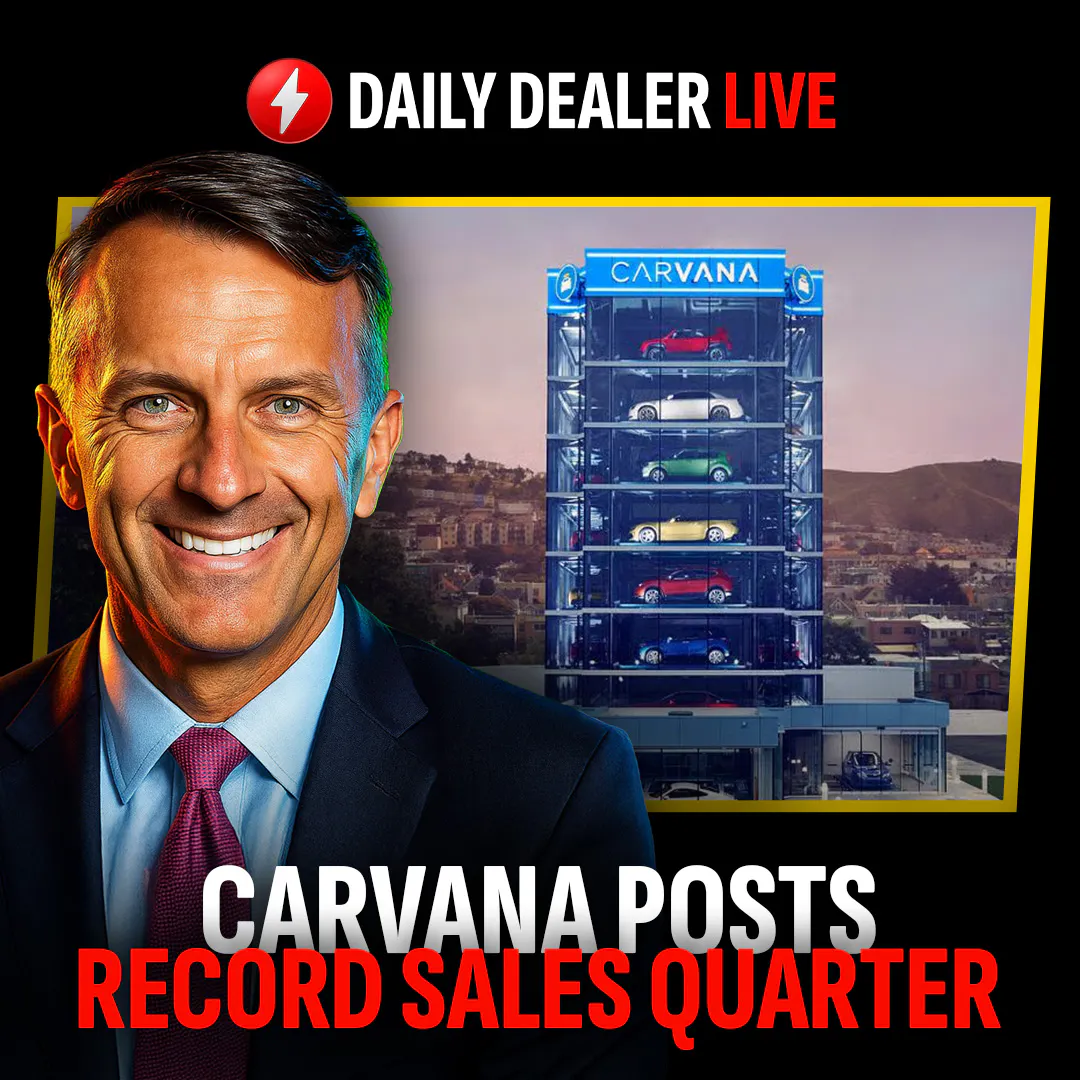
Carvana this week posted another record quarter with 187,000 vehicles sold in Q1, 2026.
This is a 40% increase from Q1 last year
and the sixth consecutive quarter of 40% plus retail unit growth.
Revenue meanwhile came in at $6.4 billion with net income of $405 million.
CEO Ernie Garcia's message to shareholders was simple.
The model, it's working and Carvana is not slowing down.
Love it or hate it.
This is the competitive reality heading into the back half of 2026.
And we'd love to get Mr. Garcia on Daily Deal Alive to talk about those results.
Carvana, not only is it an astounding turnaround story
from where they sat at the bottom of COVID,
but also a case study for all of automotive on used car execution, timing, and pipeline.
And that, folks, is a wrap on today's auto industry headlines.
Welcome to Fixed Ops Friday, everybody.
And just as a reminder, we're streaming live across all social media platforms.
Push your comments in.
Marv48 says, I think Berkshire Hathaway owns 50% of BUID along with 100 franchises in the U.S.
How does that work?
That's fascinating.
I did not know this.
Hannah, if you can fax checked it, somebody can fax check that and shoot it to me in the comments.
I'd love to see that.
That's fascinating.
All right, let's go straight to our first guest.
First up today, Jason Grasiano,
partner and general manager at White Plains Honda.
Repeat return guest, Jason.
Welcome back to the show.
Thank you so much.
I appreciate you guys having me.
It's always a pleasure to be here, Sam.
It's always great to connect with you.
It's great to have you on the show.
You've been on twice now.
The second time you were on our GM roundtable,
and the first time we were introduced to you,
as a business partner of Brian Benstock, who's been on that show a couple times.
So for our audience that may not know you,
tell us who you are, where you are, and what you do, Jason.
Well, my name is Jason Grasiano.
I started in car sales 23, almost 24 years ago now.
I'm on my 24th year.
It's super, super exciting to be a part of this industry.
I still consider myself a rookie.
I'm learning and learning and learning and every single day.
I'm looking to see where can I grow more,
where can I get a little bit more efficient,
get a little bit more effective.
I started my career at Paragon over in Woodside Queens,
alongside of Brian Benstock, who after 20 years,
we were able to be partners now at White Plains Honda,
which is an absolute, absolute privilege.
People ask me all the time, how's it going?
How are things?
And sometimes I'm a little too animated, too excited,
but it's like, how can you not be excited?
How can you not be animated when I'm literally living the dream?
Like you start off selling cars and be able to make it to a point
where you're partners with your absolute mentor
that I'm super grateful for, all the lessons and all the time
that he spent just coaching and developing me.
So Brian Benstock, famously, I'll see his post early in the morning,
going to the gym, still doing that.
Any updates on the gym policy?
All right, very good.
That's awesome.
All right, so last time, Jason, you were on,
you'd broken 14 records in 16 months,
and you were the number four Honda EV dealer in the country.
The markets changed a little bit in the last 10 months.
Update the scoreboard for us.
Are we still breaking records or?
Oh, man, we're still, I am so excited.
I am so excited.
And let me take a moment to say a big congratulations
to the team at White Plains Honda.
I am so excited.
This is probably one of the most meaningful records for me.
So in the month of April, we had an all-time record month
in new car sales, an all-time record month in CPO sales as well.
So all across the board, all-time record months.
And the reason that I say it's a little bit more meaningful
for me is because when you're a leader,
you want to work on your team, you want to develop your team,
and you want to make sure that you develop a bench and a deep bench.
So when there's moments that you have to step away,
that you can, and the store won't miss a beat.
So some other news is that I just walk on my first son.
I have three daughters, and I just walk on my first son.
Congratulations.
Thank you on Tuesday.
So of course, because I'm in the car business,
all my kids are born at the end of the month.
It's just how it works.
So I took a couple of days off
to be able to walk on my new son to this world.
And I gave the team, thank you so much.
I appreciate that.
I'm still over the top, over the moon, really excited.
And for me, what was awesome is that I gave the team a challenge
because I was going to be out for a couple of days
to be able to close off a month and set a target,
set a bonus, and say, hey, if you hit this, we're going to get it.
And it was an aggressive challenge.
The goal.
It was a good goal.
It was a hefty goal.
And based on our sales rate and what we normally sell,
it was about 40% or 50% higher than what we normally do.
And lo and behold, they crossed the finish line.
I had tons of people pouring out and reaching out to me
and telling me, we got this for you, boss.
We're going to take care of this.
You can count on us.
Take care of your family.
Take care of everything that's going on over there.
We'll handle the rest.
And sure enough, we just finished the month yesterday.
And it was an all-time record month, which not all dealers
are having record months.
And I'm aware of that.
And not only was it record in new, it was also record in Certified Pre-On,
which being top 15 in America for Certified Pre-On vehicles
is a huge achievement.
So a huge shout out to the team over at U's Cars, Ivan, Alex, Eddie,
you guys are doing amazing.
All right.
So you can't be on the show and throw a record out like that
without letting us break it down a little bit.
And even though it's Fixed Ops Friday,
we'll bring it to Fixed Ops in a moment.
But a record in new cars and a record in CPO, give us one thing,
and I get you are out as part of it, the team rally,
to which I know that is a huge deal.
But one thing process-wise that has brought you to this moment
where you've had this record that others could learn from, Jason.
So I think one of the things that we do really well is the energy.
The energy in the store, the vibe, the culture.
How do you do that?
What do you do to create the energy?
How do you preserve that?
Even in tough times.
It starts off with awareness.
I know that there's a lot of GMs or a lot of owners
that try and withhold information.
Instead of withholding information, what I like to do
is just let the data set it free.
Just let the numbers show I'm a really big fan of scoreboards.
I'm a really big fan of showing everybody where they're at.
And those are reports that go out every single morning
between 7, 7.30, 8 o'clock in the morning.
What are those reports show, Jason?
So they're going to show sales so far, month to date.
And that's every single salesperson.
So we have it on a chat and the whole entire company
gets to see your business, where you're at.
They get to see how many days you have without selling a car.
They get to see where you're at in relation to your target
that you set in the beginning of the month.
So what percentage of attainment are you at?
It also shows, obviously, gross profit where you're at
in those same metrics, a percentage to your forecast.
It also shows as a store, we don't hide the numbers.
You can ask any person in the store at any moment
where are we at month to date, whether it's new or whether it's used.
And they'll be able to tell you.
And if they don't remember the number from the morning,
they can simply look on their cell phone
and in about 10 seconds be able to scroll, click on it and show you.
And what technology do you use to deliver the scoreboard?
So my favorite right now, it's WhatsApp.
It's the most user friendly.
It's the one that I don't have to onboard somebody,
train them on how to use it.
Usually, everybody that comes here already has WhatsApp.
It's encrypted.
It's easier to share files like PDFs or screenshots
and also be able to have a lot of fun with emojis and the memes
and stuff like that, which do happen often.
Which do happen often.
A lot of content, customer photos, video testimonials.
And who puts together the scoreboard daily?
So I communicate a different set of scoreboard
to all the managers.
And then the managers, they take the information
and then disseminate that to the rest of the team.
And one of the leaders, whoever's manager on duty
for the morning, whoever opens up shop
is responsible for sending all those reports.
And I think that that awareness has been tremendous for us.
I love the WhatsApp.
So CDG circles, are you in a CDG circle?
Are you part of that?
Yes.
So that is driven by WhatsApp.
And you say, hey, most people know it.
I don't know it as well.
But I love being able to be part of watching and contributing
to conversations along the way.
I think that's a cool process to bring into the dealerships.
And to your point, there's some privacy there
where there's encryption and protection and whatnot.
DNC comes into the text, the chat says, Jason,
how do you pump up the people on the bottom of the list
without embarrassing them in front of coworkers?
Well, so that's a coaching opportunity.
And everybody's been at the bottom at some point.
And I think that what also allows us to coach,
motivate those people is not coming from a place of like,
you, you, you got to fix this.
It's in us.
It's the leader's responsibility.
It's the manager's responsibility to train and develop people.
And I hope the manager is accountable
if someone's struggling or someone's not doing well.
But we're not going to go point at that person.
Well, who's that person's leader?
Who's that person's, you know, the direct line,
the direct supervisor?
And it's, you lead with empathy.
Like if you're speaking to somebody who's at the bottom
and you're trying to get them to, I guess,
perform at a different level, it needs to start with the feeling
that you care.
And in order for someone to feel like you care,
you actually have to care.
One of the other great things, if you talk about awareness,
the other great thing that has helped us achieve
so many records.
And this is back to back coming off of March,
having an all-time record month.
I'm going into April, having all-time record month.
May will absolutely be an all-time record month.
But what's helped us is, is the people, right?
Making sure that we get the right people in the place.
Like who's in the building?
Like who's in charge?
And who's, who's, who's, who's overseeing what?
And who, who's taking care of my people, right?
Because I happen to have a little bit of a different setup
where I'm not in store all day, every single day,
throughout the week.
So I, I get an opportunity to sort of step away
and allow the leaders that are there to lead.
I get an opportunity to also watch things
from a different perspective.
And, and when I, when I, when I swoop in and say,
hey, this person right here, they need help.
Like who's, who's, who's paying attention to this person?
They're an absolute rock star.
So Jason, you do make an interesting point.
So you come from Florida, you fly up and out
on a regular basis, right?
If I remember right.
So what's the first thing you do when you walk into the store
after you've been away for a few days to take a pulse check
and kind of get things back and running?
Make sure.
Well, I mean, when you, when you're at a store for a certain
level of a certain amount of time, when you're over 20 years,
you don't need, you don't need five hours in a store
to see what's going on with the store.
You can tell as soon as you walk in, in about two minutes,
I walk in, I just like when I was a sales person,
when I was a team leader, when I was test manager,
when I'm anything, I walk in, I say good morning,
I say hello to everybody, right?
Hi, how's it going?
Hey, how's it going?
How's it going?
You can tell a lot by, by how they say hi to you, right?
Whether they shake your hand, whether they're excited to see
you, whether they stand up, or whether they're shying away.
Oh no, here comes Jason.
Now they're trying to hide.
I'm not doing that great.
And then I walk around, look at the facility,
because you have sort of fresh eyes.
So you can see if there's a bulb that's out.
You can see if there's something that's a little messy
or something that's broken, something that needs attention.
And, and, and what's the energy like in the store?
What's the music?
What's it smell like?
What's, what's, is the place set up?
Are we set up to win?
Like is the stage set up so that when people walk in here,
we're not embarrassed of what they see.
Like they're coming over to visit.
What does the place look like?
Take care of that.
Yeah.
All right.
I want to swing just gently to EVs.
So last time we talked, you were going all into EVs.
I think you were number four in the country for Honda sales.
Now that tax credit's gone.
Tell us where you sit on the EV front.
Are you still leaning in or has the math changed?
So the math did change a little bit.
And one of the other reasons why the record in April
is so meaningful is because last April, it was EVs were rocking.
They were on a roll.
And although they slowed down a bit, I'm still bullish
and I'm still excited about EVs.
We do still have a good inventory level of EVs.
And in New York state, I know this is national,
but in New York state, we just got a New York drive clean rebate,
which in addition to a $7,500 MSRP reduction that Honda just did,
there is an additional $2,000 for every prologue.
So for all of our EVs, which is the Honda prologue,
there's an additional $2,000.
And right now, the numbers are pretty wacky
and you can get a really, really fantastic deal on a prologue.
Okay.
So you still see a future at the EVs.
Even though Honda is backing off of their production,
do you wish Honda would lean more into EVs longer term
or do you think the demand is about where it was supplied?
I think that they were maybe a little bit too early.
Too much.
I think they realized that.
And I'm going to support Honda on their decision,
but we still have cars to sell.
And my job is to sell everything that we have.
And as long as we have those cars in an inventory,
I love them all.
You got to go for it.
Yeah, yeah.
I love it.
I love it.
All right, CPOs.
Let's talk that.
March CPOs nationwide were down 11% year over year.
So the market was down.
You set a record.
Give us one thing on the CPO front that caused your Honda store
to break a record in April of 26.
Again, I think awareness is really important
and just knowing where the market is shifting.
And if you're feeling some sort of a margin compression
on the new vehicle side,
well, let's focus our efforts on increasing
our profitability in other areas.
And the more new cars we sell because of our strategy
with inventory on the new car side and our terms
that we focus on leasing.
So we're able to sort of manufacture certified pre-owned cars
as well as our vehicle exchange program over in the service
lane is the best place to hunt.
So we're able to source the vehicles.
And if you're able to source the vehicles,
you have a great opportunity to support the manufacturer
in the certified pre-owned program.
Like there are tons of people that maybe a new vehicle,
the price point is a little bit too high,
and a certified pre-owned vehicle one, two, three years old
with excellent, excellent finance rates,
you can get yourself a really good vehicle
that's going to last you a really long time.
So top three sources for CPO used vehicles at your store today.
So it'll be lease returns or lease turn-ins that are coming in.
And then-
There's not as many of those as there used to be
because there was the drought during the-
Not as many as there used to be,
but luckily for us in our wonderful oasis
and our wonderful bubble in white planes,
we've been breaking records for over two years now.
So we increased or we accelerated our sales rate
and now we're reaping the benefits of all those increased sales rates.
So if you have a good trace cycle management
and you're training the staff and telling the people
why it's best to lease and get a new where we to,
new where we to, we're in a really good position
that although as an industry and in the market
used vehicles are decreasing,
we have a bigger opportunity to increase that retention
and increase our certified pre-owned inventory.
So lease return to be number one and number two
would be right in our service lane.
And those are the two main areas of focus.
We buy a total of zero cars.
We bought zero cars from the auction.
Wait, really? No cars.
Zero, not one.
Wow, okay.
Not one.
So 100% between lease return and service drive.
How many vehicles did you buy out of the drive last month as an example?
Last month we did 70 cars out of the service.
Wow, okay.
So Brian Benstock has been on the show before
and he shared that process.
Is it the same that he uses in his other store?
Oh, correct.
What is the process?
Tell us what it is.
Well, we want to, without giving away the Kool-Aid,
the recipe to the Kool-Aid, but...
We want the Kool-Aid.
We want it all.
We want the recipe.
Everybody wants a sip of the Kool-Aid.
So it's what you know in advance,
repair in advance and if you have a customer
that you have an appointment set up for service
and I know this is fixed ops Friday,
so going a little bit into fixed ops,
if you have a 50, 40, 30, whatever,
10 appointments that are coming in tomorrow,
it's in your best intelligence, best self-interest
to make sure that you go into your systems
because every database you have,
whether it's your CRM, your DMS,
or you have an equity mining tool,
you're able to dive in there and see who's coming in tomorrow.
Oh, Jason's coming in with a 2024 CRV
and he's paying $400 a month.
Hey, let me take his car,
based on the amount of payments that he's already made,
based on what he's got left over,
what was that car worth
and what is a lease proposal
on a brand new version of what he's driving now?
And it all starts off with these initial conversations
where you make a presentation.
The presentation leads to an appraisal.
An appraisal leads over to a proposal
and then that proposal leads over to
whether you have a deal or not a deal.
Do you have a dedicated staff
that works the service driver?
Do you have your salespeople?
100%.
There's a separate team that works there.
There are six salespeople
and one sales manager that worked that team.
And is that kind of an entry-level sales position
or are you pulling for more veteran salespeople to fill that?
So I personally prefer entry-level positions.
The team that's there,
some of them already have a couple of years under their belt,
but they started off in the service drive.
And for us, we're in New York,
so it's not like down in Florida
where you have a big space
and everything's all contiguous
and you got the new car showroom next to the service department
and you can walk one over to the other.
We're actually physically not anywhere one another.
We're about a mile and a half away from each other.
So it has to be a completely separate, dedicated team.
The service drive is far from the sales floor,
is what you're saying, right?
Is that what you're saying?
Or the BDC where that-
The service, no, the service department.
Our service department is not continuous to our showroom.
Got it.
Okay, it's separate.
All right.
So you have a dedicated team.
What do you say?
Use car sourcing is the toughest topic in automotive today,
one of them.
And everybody in automotive knows, work your service drive.
And yet, I'll tell you, Jason, stores I go into,
there's a difference between,
hey, we have salespeople that hang out there
and try to find opportunity,
and then having a real process for the service drive.
What do most dealers get wrong in April of 26
about working the service drive that causes failure?
And then you've gotten right,
causing you to buy 70 cars last month.
So one of the things that I've seen in dealerships
is that the salesperson that's either struggling
or not performing at the level
that they need to perform in the showroom,
and it's like the last-ditch effort,
let's say, hey, let's try and see
if they'll make it over in the service drive,
co-work at the service drive.
And it's not necessarily a dedicated team.
I see it the exact opposite.
Why don't you take your best trained,
don't want the best personality and put them in service
because they're going to be meeting
with the highest number or the highest volume of customers.
They're going to be meeting with the people
that is going to have the biggest impact on your retention.
So you sell 100, 200, 300 cars out of the new car showroom,
but you're going to be meeting with 1,000, 1,500,
almost 2,000 customers in the service drive
in the course of a month.
So where do you want to have the person
that has the highest batting average?
Just put them in front of more people.
Yeah, yeah.
I tell you, props to you for setting the standard
and raising the standard with the process.
And we'd love to have you back on to talk
about that a little bit more.
But let's talk, let's dive into fixed ops a little bit.
COX just released their 26 fixed ops study.
Dealers losing or losing market share to general repair
on two to five-year-old vehicles according to that study.
What's your service retention number?
And what are you doing to defend that in April of 2026?
I think the retention or the trade piece has got to be big
because that creates communication with customers.
What else are you doing on retention?
So I think that, again, going back to the,
it's all one store, right?
It's all one store and how you handle the business up front
is going to have a major impact on how you handle the business
back end.
And our trade cycle management and our heavy focus on leasing
allows us to have a fresh book of business
and our service effectiveness is through the roof.
We're almost double what the standard is for service effectiveness
or what's expected.
So we're at about 94, 95% indexed over.
And as far as fixed is concerned, year to date, again,
we're having a record year in fixed ops, total gross.
Although we're seeing a big pickup in warranty and recalls as well,
and it's still customer pay, there's a lot of stores
that are struggling in that.
And what we did is we doubled down on our people
and we were able to go from like 1.6, 1.7 hours per hour
to about 2.3, 2.4 hours per hour.
So that also makes a huge, huge difference.
It's just similar.
I grew up in the car business in the front end, right?
So in the sales side and learning sales and finance
and used cars and et cetera.
So one of the things that you always learn is,
you know, present 100% of the products to 100% of the people,
100% of the time.
And so if you're over in the service drive
and you have a service advisor who feels like,
they're not going to buy that.
They're not going to take that.
Well, did you present it?
Did you offer it?
And making sure that we offer everything to everyone.
And it's been, it's been a game changer for us.
And we've been able to absolutely,
absolutely skyrocket our service department.
All right.
Just a few rapid fire questions as we wrap,
and then we'll bring you back for the round table at the very end.
What's the most overrated KPI in retail automotive today,
in your opinion, Jason?
PVR.
PVR, okay.
Yeah, everybody looks at, everybody looks at,
everybody looks at PVR and they feel,
they feel like you're doing the job.
Some people, I've spoken to some people at stores
where they have an exceptionally high PVR,
but they're leaving so much money on the table
because they're not focused on market share.
They're not focused on retention.
They're not focused on their, the zip codes of what their,
their area of statistical analysis,
what's in their own backyard.
So they feel good.
Meanwhile, but they're getting a small portion of the pie.
Got it.
That's, I love that.
So best Honda model in the lineup right now and why, Jason?
Well, I think that the, I've been driving a Ridgeline
for a while now.
I've been driving a Ridgeline and absolutely love it.
Absolutely love it.
I think that, that the Ridgeline is literally bulletproof.
It's like driving on the pilot with an extra,
with just the bed in the back.
I think the CRV is our number one selling car
and there's a reason.
I think it's so compact.
My mom has a CRV, my aunt has a CRV,
my grandma has a CRV, my cousins have CRV.
Everybody in my family has CRVs.
They're awesome.
I think they're, they're, they're really, really good,
a really reliable car.
And I think Honda knocked the cover off the ball with that car.
One dealer on LinkedIn, in your opinion,
everybody should be following an automotive.
Oh, absolutely.
Besides Brian Benstock.
Ah, heads down, Brian Benstock.
No, heads down, Brian Benstock.
That was a layup, easy.
You want to wrap it far, boom, there you go.
And after that, car dealership guy.
Love it.
Thank you.
And one thing, one thing you've learned in the last month
on CDG circles, and then we'll wrap,
have you back at the round table.
Well, being able to stay aware and in tune with,
with the FTC, with filing and all the confusion
and what do we do and how does that work and,
and what's next.
And, and you know, dealerships,
should they title tell on one another or push it like this?
It's, it's a lot of information.
So next week, I want to do a round table
and have these lead providers come in
and just talk about what the standard process should be.
Because from my vantage point,
I'm seeing all these different processes.
Feeds are getting interpreted a different way.
People are having to like sort of,
you know, make up a way that the pricing shows right
all across the different lead provider sites.
Do you see that challenge trying to get everybody
to the right price on all the provider sites?
I think we need a standard way of doing it.
And I think we need to get everybody together to do that.
I agree with you that they're, that they're,
there needs to be a standard.
But I think that they just allow also needs,
it's on both ends.
I think that the dealer,
the dealer body also needs to come to the table
and, and, and not put on a used car here.
This price is 20,000.
And then, oh no, but when you come in,
that would, that included a down payment,
that included a discount, that included,
if you were to speak tall or if you were to,
like no playing those games.
No, no question.
They need to, they need to disallow,
remove the ability of doing that.
And anybody who's playing in that, in that sandbox
should not be allowed to advertise on those,
on those platforms.
What I'm, what I'm talking about is,
how do you get the price out of your viato
or whatever system you use into the digital lead provider,
so that it includes dock fee and the fees
that are required to be there.
Not, not, you know, some are requiring one way,
others are requiring another.
We're just, we're, we're full disclosure
and our prices are prices.
And then let's say, for example,
if we're at MSRP, we're at MSRP on all cars.
And it's plus our dock fee, which in New York,
we're lucky because our max is 175.
But I know that there's other states
that are either regulated or not regulated.
Although they need to disclose the amount of dock fee,
even though they have to disclose,
every dealer has a different amount of dock fee.
So, so that's where I think it falls back
on the dealers to sort of be full transparent.
Jason Graciano, partner and general manager at White Plains.
Honda, thanks for coming on and sharing your perspectives.
We'll have you back for the round table.
Thanks for being here.
I appreciate that.
Thank you.
Thank you.
All right.
We're going to dive straight into Zurich.
Today's episode is brought to you by Zurich.
If you're a dealer and have ever wondered
whether your profit participation program
could be performing better,
Zurich offers a no obligation
profit participation checkup.
It's a simple pressure free way
to get clarity on your program structure.
Request your profit participation checkup
at ZurichNA.com forward slash checkup.
You can also check out the industry pod
that I did with Zurich last week.
Popped last Saturday.
I learned a couple things,
including the importance of making sure
your teams are aware of reinsurance,
all the levers to pull in profitability there,
and to gamify it
because it's an important profit center,
gamify getting everybody a row
in the same direction to make it as profitable
as it can be.
A lot of great comments in the text.
Paul Salisman, I'm sorry, Dave Rogers says
passport to his favorite vehicle,
bunch of fire from my Honda guy
and official blessed,
and eager cases.
It's very easy to be compliant
if you just do what's right.
It's simple and you don't even need
FTC's rules and guidelines.
Just be ethical, transparent,
do the right thing.
I agree 100%,
but here's the problem.
And one of our guests last week
brought this up.
You could have the right price
in your own system
and then how the lead providers pull that
could actually unintentionally
make you non-compliant
if they don't pull the doc fee,
if they don't pull license fee
or any one of those others
that are required now
to be part of that advertised price.
And my call is for the industry,
let's get together,
have a conversation
about how to unify that as a standard
so everybody's working off the same page.
Let's turn now,
Michael Ross, Fixed Operations Director
at Larry Green Chevrolet.
Michael, welcome to the show, Mike.
Thank you, appreciate the opportunity.
All right, for everybody that doesn't know you,
this is your first time on the show.
Tell us who you are,
where you are, what you do, Mike.
So Michael Ross,
I've been in the industry for,
it's my 23rd year now.
So started out as a porter,
you know, I had a Toyota dealership,
worked my way up to Express Advisor,
Mainline Advisor,
opportunity to become Service Manager
and then Fixed Operations Director
and then the opportunity
to take over multiple stores.
So now we're in Arizona,
Cottonwood, Arizona,
for the Green Automotive Group,
amazing group to head up their Hyundai Store
and their Chevrolet Store.
Awesome.
So Cottonwood, Arizona,
is a long way from Phoenix, right?
And from, and a long way from Flagstaff.
What is running a fixed ops operation
in a small market look like?
The operators in big metros
wouldn't understand
because yours is a different gig
a little bit, right?
It's a little bit different.
That small town field,
we're in touristy town,
small town field,
not as much competition,
still the same challenges
of keeping those guests, right?
We have to,
we still have to maintain the high professionalism
and the customer retention tools
we have to use them
just like we would in the big city.
We're about an hour away from Flagstaff,
we're about an hour and a half away from Phoenix.
Still the same emphasis
on keeping our guests happy
and retaining those guests.
So Cox came out with recently
a fixed ops study.
And as I said earlier on,
there's some brutal data in there
and it's talking about
how dealerships are pulling record revenue
but we're losing market share
to general repair
on the exact cars
they sold five years ago.
Are you feeling that?
Are you the exception
and what are you doing to solve for that
if you are?
So we're just keeping the process alive
with how we treat our guests, right?
So it's adapting
to how those guests want to be treated.
Doing the video MPI
is something that guests in a small town
may not be used to
giving them the nurturing
that they need, right?
So we're providing
the same exceptional service,
quick timeframe.
We can't have that logic
from 10 years ago
that the guests have nowhere else to go.
They have a million places to go.
We have to do what we do,
what we know how to do
and do it right and do it well.
Keep them here.
We're doing great.
It is a small town
but we have probably
a dozen shops around us
that are not OEM
and they do fantastic as well.
But we're holding on very tight
to our guests
by the way we treat them.
Yeah, very good.
So your intake form
when you fill it out said
your top priority
is creating and maintaining processes
for advisor and customer success.
Walk us through one process
you've installed recently
that actually moved the needle
here in 2026.
So big process
that we brought to this group
is video MPI, right?
And just the way
that the advisors interact
and that starts with
pulling up on the service drive.
Let's get excited for the guests
to come in,
do the same process
at 100% of the time.
Do your walk around with the video.
Keep that relationship going
with the guests.
Once it goes into the shop
it's a natural transition.
Technicians are doing
an amazing video MPI
with pictures using our system.
What product are you using
for the video MPI?
Using dealer logics.
It's an amazing tool
that's led them.
What it does is it gives time
back to the service advisors
to do what they do well.
Let's utilize our tools
while our pictures, our videos
send them to the guests
and that's much more clear
than sometimes
we can explain verbally.
What percent of the time
is that happening video MPI?
100% of the time.
Okay.
That's a reality.
They're doing it.
And how do you validate for that?
So we run reports.
We keep them accountable, right?
So I run reports in the background
that they don't know until
I bring it up.
I go over with the team
about once a week
and sometimes it's a Tuesday,
sometimes it's a Friday.
They don't know.
I'll hit them hard.
So we look at
the effectiveness.
Something as simple as
how many pictures did you take?
How many videos did you take?
What's the percentage?
What you're and then showing
them the math of that,
we can show the percentage of upsells
from repair orders
without video MPIs
to what they are now.
And it's an amazing jump.
You could jump up three,
four, five, 10ths of an hour
just by using that one tool.
And they see that and they love it.
Is your process to have the technicians
send that video direct
or does the service advisor
check it and then hit send?
The service advisor will check it first.
That's one of my big buttons.
I like to have that oversight.
So we want the advisors to double check.
That way we can also check the history.
We're all here to back up each other.
There's no finger pointing.
So we're here to back up the tech.
They make a mistake.
They're here to back us up if we make a mistake.
So the advisors will double check
before we send out.
And so what would you support
an advisor doing?
Is there a situation where you would say,
hey, the advisor shouldn't send the video, right?
Obviously a mistake.
Or what are the other situations?
We haven't ran into that yet.
Using the video, it's actually a failsafe of its own.
So once the technician knows
that they're accountable for that,
then they're less likely to just throw something in
where they would normally recommend it.
Now they're thinking about,
is this an ethical sale by time or mileage
or a conditional sale that we need to make
because the condition of that part warrants?
So they're holding themselves accountable
by knowing that the guest is going to see that.
They're going to hear their voice,
their name on the multi-point inspection.
So that puts almost a face to the person
working on their vehicle and they know it.
So trust is the number one driver for repurchase.
Again, back to that Cox study.
60% say it's the top reason they buy
from the same dealer again.
How does an advisor who's behind on their hours
actually build trust on an early morning oil change
as an example?
So what we teach the advisors is,
once again, the magic word of process.
They faster they master their process,
it becomes habit.
It becomes just muscle memory,
which gives them more time in their day
and it becomes a natural product of what they do.
So as they have more time with the guests
and they follow that process
and now that guest understands the process
and what to expect when they come in.
The advisors are much more comfortable.
They have more time to do,
to look over their multi-point inspections,
to speak with the guests and explain items.
It's when they see that the advisor
is much more at ease and natural,
that customer naturally builds that trust
and it's been working fantastic.
So your job is interesting
because you deal with Chevy and Hyundai.
Those are two completely different OEMs.
Domestic on the Chevy side, obviously,
import South Korea on the other.
From a fixed-op standpoint,
where do they help and where do they make your job harder,
Chevy and Hyundai?
So it's a little different in the way we have to go about
receiving permissions to do certain warranty claims
or larger repairs require different documentation,
whereas one manufacturer may be a little more relaxed
on documentation needed versus the other.
And it's keeping those in line.
So what we've tried to do is kind of mirror each other.
So no matter what repair we have,
we require the same documentation.
So if you have a large engine failure
or powertrain failure,
let's gather the same document,
whether it's Chevy or Hyundai.
That way I have all the information,
no matter what, to proceed in an efficient manner
to get the advisor and technician in answer quickly.
Service absorption.
It's a stat we debate a lot about on the show.
Tully Williams from Neal Auto Group says,
hey, I don't care, I want retention.
What's the big KPI you're driving towards?
Is it service absorption or is it retention or what?
Service absorption is always huge, right?
You always wanted to meet your goal on that.
Retention for me is number one.
It was driven into me by my early mentors
that the customer is the reason we're here,
and I wholeheartedly believe that.
So retention, keeping our guests happy,
it's not always agreeing with the guests as we know, right?
Sometimes it's just presenting the facts,
so they understand why certain decisions are being made,
and they respect that,
and they will trust your decision.
It's all about keeping the guests here and keeping them happy.
All right, so what's your service absorption right now, currently?
So right now we're right around the 80%, 85%.
And what's your goal?
What do you want?
You want to be over 100, for sure.
I mean, I'm doing this group back in January with the opportunity,
and we've done nothing but grow the team,
so I'm excited about where we're going.
All right, I want to take us to one area
that everybody's talking about right now,
and we're still all working how to work through it.
So everybody's saying AI is going to revolutionize the service drive,
AI phones, scheduling, service estimating.
Is that real or is it a vendor-funded fairy tale for stores like yours?
And where is it?
I think it's a bit of a fairy tale.
I prefer the human factor.
I mean, we've had companies come out with the self-checking kiosks
and things like that.
I prefer the human interaction, right?
We're able to digest things mentally
that a computer may not be able to.
We have that empathy and the ability to handle
the multiple different scenarios that we're faced with with guests.
I prefer the human, for sure.
We love technology as far as the multi-point inspections
and the videos, pictures, and AI can assist in many ways.
But I think that human interaction,
I don't know if you can replace that.
All right, based on your experience,
if a GM came to you and said,
hey, you got 50 grand to spend on the service drive,
no rules, no approvals, what do you spend it on today, April of 26th?
Best money spent.
Best money spent, something I'm big on is
it would still fall under retention.
I mean, if your shop is in order with all the tools you need
for success, retention is goal.
One of my challenges that I love is loss souls.
If a guest hasn't been here in 12 months
and I want to know why, let's figure it out.
Let's get him back.
So we have a pretty aggressive campaign
to get our loss souls in here.
And let's have a chat.
We're not afraid of it.
We'll find out why they stopped.
And let's see what we can do to start it again.
Where do you get that data from?
The OEM or is there another collection tool?
And what tool do you use to outreach?
So we can get that from the OEM.
An amazing tool we use is C4 Analytics.
So we have them really crunching our data
and dissecting it to get our clients back in here.
And that's been working fantastic.
Let's send out some, it's not buying their love, right?
You're not going to send out a 995 oil change.
I don't believe in those.
Let's send out something that's going to start a relationship
and keep it not.
They're going to come in for a 995 oil change
and then never come back again.
All right, you're recruiting a tech April of 2024.
What's one question in the interview
that tells you whether the tech will stick long term?
Where do you want to be?
And I ask that when I go to recruiting events
at these automotive schools, you get these kids
that are super excited, which is amazing to see
because it's not common nowadays
for some of them to want to become a technician.
But some of these kids are saying,
hey, I'm going to be a diesel tech in 10 years,
10, 15 years from now.
I say, well, that's fantastic,
but your body might disagree.
So what else excites you?
Are you great with people, great with computers,
great with marketing?
There are lots of places in a dealership
where we can use your talent.
So let's figure out how you can still be successful
five, 10, 15 years down the road.
All right, lightening around a few questions.
And we'll go to our round table here.
Most overrated tool in fixed ops in April, 2026.
Most overrated, you know, the overrated tool,
I would say is as simple as automated phones.
And the reason I say that, I mean,
it can be a vicious circle of customers
getting lost in this frustration.
Let's just get our team excited and through the phones.
Yeah, it can be so frustrating.
CDK has that stat where they say
average wait time in service for the phones is nine minutes,
which is just insane.
Like to think that the customer has to sit on the phone
for nine minutes.
And then you do think that's a good use of AI technology
to help answer those phones, respond,
and engage with the customer.
And then give it back to a service writer
who then hopefully isn't overburdened.
But we are challenged.
We get so many calls in service.
What's the most underrated KPI?
Underrated KPI.
Underrated?
Yeah.
You know, I think they're all pretty great.
Wow.
I would say OEM CSI.
I don't know, overrated or that might be over underrated.
Yeah.
I mean, from the OEM side, maybe contact after service,
right?
Because we all do it.
They still, it's, you know, that can be a misconstrued statistic.
I think one of the most overrated KPI's in a dealership
is I'm going to get hate for this,
but effective labor rate, your ELR.
Oh, OK.
Why don't you like ELR?
What's your beef with ELR?
So there are so many things that can alter ELR
that are out of the service advisors control.
You know, if we're doing certain marketing campaigns
for lost souls, if we're being aggressive on services,
that's going to affect the ELR that the advisor has no control over.
Let's focus on, hey, let's get our repair orders.
Let's get the cars in.
That's number one.
You can't do anything without a car.
Now let's work on hours per hour.
And I do a study with all of my advisors,
so they understand the numbers behind what we do.
I don't want to just give them a number, say,
hey, let's hit 700,000 across.
That means nothing to them.
Let's break it down.
Hey, let me show you how to work these numbers.
Because a lot of the advisors, it hurts me to say that.
They don't understand how these numbers work
and correlate with each other.
Yeah.
So I break it down and show them,
hey, if you focus on hours per hour,
this is where you'll be.
If you focus on ROs, if you focus on ELR,
and ELR is going to be the least amount of change for them.
So I show them how to focus and build into that.
I love it.
All right.
Michael Ross, Fixed Ops director at Larry Green Chevrolet.
We're going to bring you back as part of the roundtable.
Oh, but the producers let the secret go.
I was going to have Jason and I sing to you in the roundtable.
Thank you.
Happy birthday, Mike.
Appreciate it.
Thank you.
Lucky to have you on the team.
We had a ton of your team members there.
I'm going to see you in the roundtable
if we can get Jason to sing.
But we'll have you back here momentarily.
Thanks, Mike Ross.
All right.
Sorry for the tech issues.
Tech issues pop up everywhere.
The automotive retired guy says Cadillac dealerships here
in South Florida are almost near a $400 hourly rate.
The dock fee in Florida is crazy, too.
All right.
Let's go to our roundtable.
We've got both Jason Grasiano and Mike Ross joining today.
Welcome back.
Welcome back.
Jason, are you up for singing?
I'm not singing.
Oh, I'm down for singing.
Birthdays are really special.
They're really important.
I'm down for singing.
All right.
Let's do it.
Happy birthday to you.
Happy birthday to you.
Happy birthday, Mike.
Happy birthday, dear Mike.
Happy birthday to you.
That was amazing.
Thank you.
Happy birthday, brother.
Happy birthday.
Thank you.
By the way, Jason props to you because there's
not a lot of GMs that are OK, you know,
being funny, being silly, being ridiculous,
coming on a big show, doing something like that.
That's how you connect.
Yeah.
Most of my time, I'm not a clown,
but I'm over there making sure that everybody
gets a smile out of everyone.
Get everybody to just switch real quick
and sort of pattern interrupt their day.
Yeah.
All right.
Question roundtable.
Let's dive into it.
Both of you are running cultures where energy
and accountability matter.
Who has the harder culture build?
Sales or service and why?
I would say it might be harder in sales.
And the only reason I say that is they may tend to have
more turnaround in a service department.
So it's little, it's more challenging and big props
to those teams that can keep the culture up
where you constantly have new faces.
So they may have a little more challenging,
and I give them a lot of credit for that.
All right, Jason, what do you say?
That's awesome.
And I happen to think it's over on fixed ops.
I think it happens to be in the service department
and in particular,
either between technicians and advisors,
they're like sort of right there.
It's very difficult to get somebody
riled up and super excited about presenting breaks.
Or hey, you card needs an alignment.
How do you get pumped up?
I think over on the sales side,
when you have a family that you see every two years,
three years, four years,
and in some cases that's their first purchase,
it's very easy to get pumped up and excited for them
if you have that empathy.
And then just to be devil's advocate,
again, I know what it's like when you test drive five cars,
speak to a customer for several hours,
and at the end of the day, end up with zero,
and you make zero dollars.
Most of the time, that's the case.
So where is required more?
I think it's required more to pump up
and have motivation on the sales side,
where it's more difficult to create that culture
and that winning and that being able to gemify everything
because I'm big into games and fun and excitement.
It's over, in my opinion, on the service side.
Yeah, and from my perspective, and I am skewed to our sales,
I think service is tougher because
so much hits service every single day.
It's so easy to feel kind of beat down for service.
Jason, why do so many GMs miss that in service?
They don't pay that homage or spend that time back there.
No, I got tons of respect
for my service team.
My service team right now, they're rocking.
We're pacing.
We already have year-to-date, a record year,
which is above a record year last year
and above a record year before that.
So it's growth over growth over growth.
And I think that one of the reasons
that a lot of GMs or people that are working
with service advisors is there's not that understanding.
Just to go on both sides,
somebody walking into the show to buy a car,
it's a happy moment, and it's normally an exciting moment.
Service is out.
When they're coming over to service,
something's broken, and they have an unexpected bill
that they thought the car was supposed to be
problem-free for their whole entire life.
They bought the car.
It's three years old.
It has 70,000 miles, and they don't understand
why they have to spend 600 bucks on it.
Right?
They're like, oh, no, this is not fair.
What's so so advisors tend to have to have a little more charisma
and deal with a bunch of different situations
that happen in life where it's not.
Ideal. Nobody wants to miss work.
Nobody wants to jump off their kids in a hurry.
Nobody wants to show up at 7 o'clock in the morning.
Nobody wakes up super excited.
I get to service my car today.
So you have to deal with a different type of clientele.
So what's one thing you do at April 26
to make that service experience better, more celebratory,
to transition that from sales to service?
Anything you do?
And then, Mike, Jason, Mike.
Yeah, so I do very similar.
So I send motivational videos every single morning.
I send pump-up messages.
There's also the same.
Wait, are they on your chat group as well?
Fixed stops?
Yeah, they would go crazy.
I don't mix them together.
They would lose their mind.
I have the service team on OneChat, which is all service advisors,
managers, BDC reps, anybody, an appointment set,
anything that's on there, everybody's fully aware.
If it's a CSI concern or if it's something that needs awareness,
somebody's getting a hold of someone.
Like Mike said, sometimes people are on hold
and they can't reach the advisor that they need.
But guess what?
You send a text message into that WhatsApp
and one of the advisors sees it and say,
hey, get the phone.
They're calling you for an ex-customer or whoever it is.
I love that.
So it's effective for us.
Again, I'm big into motivation.
I'm big into pump-ups.
So every single morning at about between 6.10 and 6.25,
they receive a video that's usually between 12 to 15 minutes,
20 minutes.
And all they need to do is just click it.
Just click it.
Do you know the percent that listened to it?
Are you able to track that?
They all say they do and I know they all don't.
They don't.
I send it daily.
I send it.
I would like to continue to lie to myself and say that they all do.
They all check it.
They all check it.
In my world, in my world, I think that they click it
and they're either getting ready and listening to it
or they're in the car and they have a volume on blast
and they're getting hyped up before they get into.
I don't think that that's the case though.
I'm going to be real.
All right, Mike, what's one thing you do in your world
to help create that culture, that culture of enthusiasm
that results in a better customer experience on the flip side?
It's being out there with your people.
Don't sit behind the desk and just crunch numbers.
We have computer programs that do that for days.
You have to be out there willing to get out there
if they're having a tough time with a guest situation
or they're overwhelmed and they've been on hold
with an extended warranty or factory wants to jump in.
Help them out.
The happier team is, that's naturally going to flow over to the guest
and when they know they have the support,
they're willing to take on any challenge
because everything, listen, six o'clock comes every day.
Let's get through it together.
Let's make some people happy.
Let's keep each other happy.
Let's keep enough gas in your personal tank
for you to go home and give it to your families.
And they know that's where our goal is,
so just be out there with your team.
All right, three last questions.
Three last questions.
What's one dealer myth you're both tired of hearing about?
One myth about automotive that you're like,
has got to go away in 2026.
We're more expensive than the non-OEMs.
Yes.
And that's why we're losing a lot of business to non-OEMs
when it's actually not the case.
So let's say it realized GM has a two-year parts labor warranty.
Once they realized, I'm more than happy if a guest comes in.
I tell them, I'm more than happy to give you a stress-free.
Tell me what you're needing.
I'll email it to you.
I won't even bother you.
There's a great data point from CDK
that says most of the current younger generation don't
service and get recall work done at the dealership
because they think that the dealership is
going to charge for recalls, which is crazy.
Part of it's got to be an education piece.
So what's one myth, Jason?
You're tired of chasing down an automotive that needs to die in 2026.
I think in automotive in general, not just in fixed,
that in order for you to be a dealer, you have to have a PhD.
Your pop has to have a dealer.
So it's not the case if you work your butt off
and you do the right things early on and you stay consistent,
you stay disciplined, and you continue to learn,
and you continue to grow, and you continue to become
a student of the game, a student of the math.
And more importantly than anything else,
always, always deliver the goods.
You'll be able to climb and you'll be able to reach whatever height.
I mean, I started off, I grew up in a rough neighborhood,
and I started off selling cars at 20 years old.
And within 15 years, 16 years, I was able to become a partner GM
and operator of a store.
And the mistake that some people also myth
is that you can do it in two years,
or that you can do it in one year.
And it takes time.
It takes a lot of time.
And you've got to make sure that you go through the proper steps
and the proper channels so that when you do get the position,
you're not overwhelmed or you're not in a position
where you need to take a step back.
Once I stepped into the role, I've never looked back,
and it's been every single year has been better than the prior year.
All right.
Playing on the tension of fixed and sales.
Second to last question.
You both wake up one morning.
You're GM owner of the same store.
Mike, you've got service.
Jason, you've got sales.
What's the first thing you fight about?
Reconditioning on used cars.
Yeah.
All right.
Recondition on used cars, internal.
And it's not because I don't want the number to be high.
It's just that we're adding, we're replacing certain parts
which takes away from the actual profitability of the entire store.
So everybody loses.
But that's my pet peeve.
I'm all over that.
I'm in rapid recon.
And I'm looking at all those reconditioning estimates.
I'd rather have a higher growth.
Charge me more for what it actually needs
than putting something that is just to make it brand new.
What do you make it the car brand new for?
It's a used car.
I love that.
I love that.
All right, used car recon.
Mike Ross, what's the first thing?
Listen, I love recon.
I don't mind it at all.
I know you do.
Honestly, it's probably recon as well.
I mean, we're on the same boat.
Once you get the team to realize, let's all make a little bit of money
and do what's good for the store.
Let's source the part.
Let's look to get the car done quick for a reasonable price.
Treat it right.
And then let's just go quantity and we'll be safe.
I would want to fight about customer pay.
So I think customer pay is a number that's getting covered up
by increasing cost of warranties, inflation, and everything else.
And I think a lot of stores, we don't focus enough on customer pay in 2026, Mike.
We're being on customer pay.
I mean, my guys know that that's the one thing we have control over.
We can't control warranty.
We can't control internal, right?
All of a sudden sales goes up.
Customer pay, you focus on the process of those MPIs.
But you can hide a lot of customer pay mistakes in warranty and internal.
Sure, you can.
If your team is on board with what you have going on and using those tools
like dealer logics, then your customer pay does great.
For the first time in a while, we've had to have hot shot runs up here for parts
because we're on point.
Yeah, all right.
Last question for both of you.
We'll start with you, Mike and then Jason.
So final word, what's one prediction for retail automotive between now and the end of 26
that maybe no one else is talking about out loud, Mike?
You know, EVs was a big one.
I think I know where we're going with EVs, but service-wise, I don't really have any.
I think we're doing great.
All right, just keep rolling.
Just keep rolling.
Yeah.
All right, Jason.
I think a lot of people get caught up with the doom and gloom and what's going on in the economy,
and what's going on in geopolitics, and what's going on in the world,
and all the stuff that they can't control.
So I like to focus on things that I can control.
I can't control what goes into my ears, into my brain,
and I can't control my attitude and what I do about the things that are going on.
So from now to the end of 2026, we have eight months left,
and I suspect we're going to have eight more records.
Yeah, love it.
All right, Jason Graciano, partner and general manager,
White Plains Honda and Mike Ross,
fixed-ups director at Larry Green Chevrolet.
Thank you both for being on this roundtable this Friday.
Fixed-ups.
Thank you.
Thank you so much.
Appreciate it.
Thank you for having me on.
Thank you.
You know what?
I love Jason's energy.
I love Mike's perspectives.
I've heard this.
I love the idea of this group that he's got going with his team,
sending out messages every single day.
I'd love to know the percent of open,
because I know there's some emails I'll send out on my own scoreboard,
which I do probably 90% of the time, every time, every day.
And sometimes people open stuff.
Sometimes they don't.
You can't force the open.
Great comments from everybody out there.
The automotive retired guy says,
every director loves recon.
Eager case says, Paul, you're right.
We need to improve.
Paul's saying, surprisingly, most stores spend less money
on fixed education outside of text.
The most profitable part doesn't spend on the customer-facing side
as much as necessary.
And I think you're right.
And by the way, that's why we're here every Friday,
Fixed Ops Friday, casting light on the areas
that are most challenging and confusing in the fixed ops world.
Angelica comes in.
Focus on what you can control.
And to you, our Daily Deal Live audience,
thanks for watching Daily Deal Live today,
where we break down the biggest moves in the car biz as they happen.
Don't forget we're here live every Monday, Wednesday, Friday,
coming up next Friday.
We've got a special guest, head of Nissan.
Tiago's going to be here, a special CDG episode Wednesday
celebrating our one-year anniversary.
So if this is your world, hit like, hit subscribe,
turn on those notifications so you never ever miss a beat.
And we'll see you next episode.
Thanks for being here, everybody.
About this episode
Jason Graciano and Michael Ross dig into fixed ops from the ground up, starting with FTC pricing pressure and moving into White Plains Honda’s record sales, daily scoreboards, and unusually transparent management style. The conversation then gets practical: EV incentives on the Prologue, sourcing CPO inventory from lease returns and the service drive, and using video MPI to lift labor efficiency. They also debate the right KPIs, the value of human interaction, and how culture and accountability drive retention and growth.
Today's show features:
- Jason Graciano, Partner & General Manager at White Plains Honda
- Michael Ross, Fixed Operations Director at Larry Green Chevrolet
This episode is brought to you by:
Zurich – Zurich delivers The Zurich Advantage to dealerships nationwide by combining comprehensive F&I products, consultative training, revenue‑generating programs, and wealth‑building profit participation strategies. Grounded in our mission to provide clarity, confidence, and certainty, we help dealers protect what matters, strengthen performance, and build a legacy for the road ahead. Learn more at https://carguymedia.com/4cNTwyu
Check out Car Dealership Guy’s stuff:
CDG Circles ➤ https://cdgcircles.com/
CDG News ➤ https://news.dealershipguy.com/
CDG Jobs ➤ https://jobs.dealershipguy.com/
CDG Recruiting ➤ https://www.cdgrecruiting.com/
My Socials:
X ➤ https://www.twitter.com/GuyDealership
Instagram ➤ https://www.instagram.com/cardealershipguy/
TikTok ➤ https://www.tiktok.com/@guydealership
LinkedIn ➤ https://www.linkedin.com/company/cardealershipguy/
Threads ➤ https://www.threads.net/@cardealershipguy
Facebook ➤ https://www.facebook.com/profile.php?id=100077402857683
Everything else ➤ dealershipguy.com