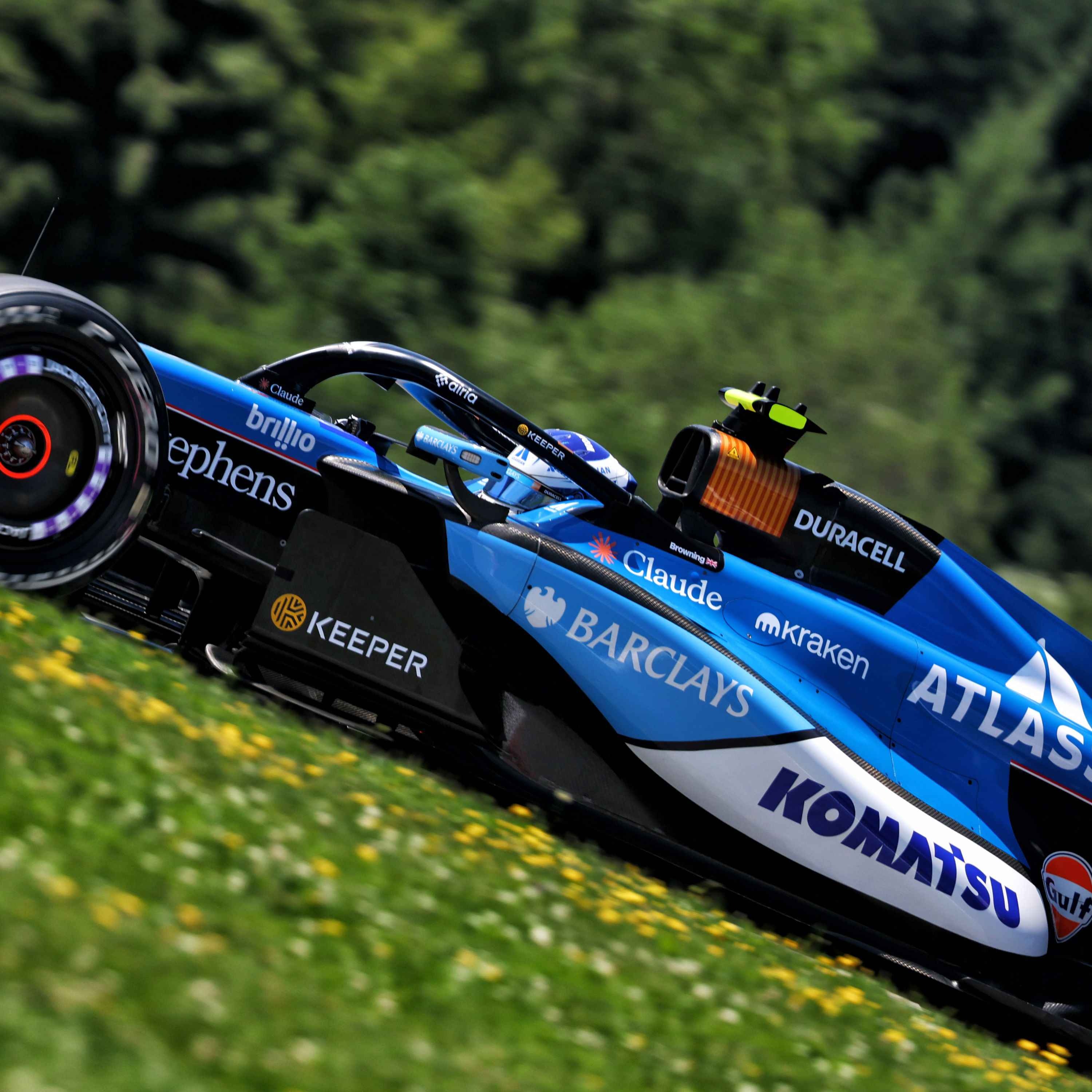
Race Business: How Williams went from $200 million sale to being worth $2.5 billion
About this episode
Matthew Savage, chairman of Doralton Capital and Williams F1’s investment lead, explains how Williams was bought for about $200M during COVID and is now valued around $2.5B. He argues the rise is tied to F1 becoming a global entertainment/content product (Netflix’s Drive to Survive, Liberty’s growth) plus scarcity and “stable asset” appeal. Savage details the COVID-era acquisition, the importance of the cost cap as a condition precedent, and why the cost cap reshaped team economics—forcing trade-offs between upgrades and infrastructure while making historic “sunk” spending hard to catch up on.
In the latest exclusive 'In Conversation With...' interview from The Race Business, The Race co-founder Darren Cox sits down with Matthew Savage, Chairman of Dorilton Capital, to uncover the business strategy behind transforming the legendary Williams F1 team. From the $200 million acquisition in 2020 to a staggering $2.5 billion valuation today, Savage explains how a long-term investment horizon, the impact of the cost cap, and the "Netflix" effect turned the team’s fortunes around.
We dive deep into the reality of private equity in Formula 1. Why are institutional investors and high-net-worth families rushing into the sport? Is F1 the new NFL? Savage discusses the challenges of transforming a 50-year-old family business, the "siloed" nature of modern F1 teams - acting as media, hospitality, and engineering entities simultaneously - and why he continues to reject multiple buy-out offers every single week.
Beyond the financials, we explore the team’s bold ambition to win two championships within the next six years, the importance of retaining the Williams heritage, and the role of team principal James Vowles in navigating the team’s technical and cultural evolution. Whether you’re an F1 superfan or a business strategist, this conversation reveals what it truly takes to build a contender in the most competitive sport on Earth.
Hosted on Acast. See acast.com/privacy for more information.
Atlassian Williams Formula One team
"And today's conversation is with Matthew Savage, who is the chairman of Doralton Capital and of the Atlassian Williams Formula One team."
Atlassian is a company name attached to the Williams F1 team as part of sponsorship. The episode uses that to talk about how F1 teams make money beyond racing.
Atlassian is a sponsor/partner name attached to the Williams Formula One team in the way F1 teams are branded for commercial purposes. This matters because the episode is about the “new commercial business” around F1 teams, not just racing performance.
Doralton Capital
"And today's conversation is with Matthew Savage, who is the chairman of Doralton Capital and of the Atlassian Williams Formula One team."
Doralton Capital is an investment company. The episode brings it up because the host is talking about how investors think about buying and growing an F1 team.
Doralton Capital is the investment firm Matthew Savage chairs. In this episode it’s relevant because the discussion is about how investment logic (valuations, horizons, and risk) applies to buying and growing a Formula One team.
Netflix effect
"We're going to talk everything including valuations of Formula One teams, the new commercial business and of course we'll have to talk about the Netflix effect"
The “Netflix effect” means that when Netflix shows a sport to a huge audience, more people get interested. In F1’s case, that extra attention can increase fan growth and make teams more valuable.
The “Netflix effect” is the idea that Netflix’s F1 documentary series (and similar streaming coverage) boosts mainstream interest in Formula One. The episode frames it as a driver of new fans and commercial growth, which then feeds into team valuations and investor interest.
valuations of Formula One teams
"We're going to talk everything including valuations of Formula One teams, the new commercial business and of course we'll have to talk about the Netflix effect"
“Valuation” here means how much money investors think an F1 team is worth. They’re discussing how that number can rise over time as the team and the sport become more valuable.
“Valuations of Formula One teams” refers to how investors estimate what an F1 team is worth financially. In this episode, it’s tied to the Williams ownership story—how a purchase price can grow as commercial value and global audience increase.
Drive to Survive
"I think it reflects a lot of things, what the sport has done itself, what the Liberty folks have been able to do in growing it, things like Drive to Survive and then what the team itself has done over the last five years in terms of pulling itself out of the abyss."
“Drive to Survive” is the Netflix F1 documentary series. The guest is saying it helped bring in new viewers by making the sport easier to follow and more entertaining.
“Drive to Survive” refers to the Netflix documentary series about Formula One. In the conversation, it’s used as an example of how media storytelling can expand the sport’s audience—especially in markets like the United States.
institutional investments
"I think it's right across the board from institutional investments and investors to high net worth families, we have the odd conversation with automotive companies along the way"
“Institutional investments” means big-money investments from professional organizations, not just individuals. The guest is saying both big institutions and wealthy families are looking at F1.
“Institutional investments” are large, professional investments made by organizations like pension funds, banks, or asset managers. The guest contrasts them with other investor types (like high-net-worth families) to explain the breadth of interest in F1 team ownership.
institutional investors are raising money
"I think it's right across the board from institutional investments and investors to high net worth families, we have the odd conversation with automotive companies along the way, so I think sport as a whole is a hot investment area and people continue to raise money, the financial institutional investors are raising money and they're looking for ways to invest it."
It means big investors collect money from others and then have to invest it somewhere. The guest is saying that helps drive interest in F1 teams.
The phrase points to a common investment-cycle dynamic: institutions collect capital and then need to deploy it into assets. In the episode’s context, that capital flow helps explain why investors were looking for new places to put money, including Formula One.
stable asset class
"I think it's seen as content, it is content, at one sense it's a competition but we're also an entertainment show in more ways than one and I think it's also seen as a stable asset class that will keep on growing."
A “stable asset class” means investors see it as a relatively dependable kind of investment. The guest is saying some investors view sports like F1 as something that can keep growing rather than collapsing in value.
A “stable asset class” is an investment category expected to hold value and grow more predictably than riskier assets. The guest argues that sport—especially Formula One—gets treated this way by investors because it has strong global reach and long-term commercial potential.
scarcity around it
"I think in particular with Formula One there's a lot of scarcity around it and very few sports if any have the same global platform as we do here in Formula One"
“Scarcity” here means there aren’t many sports that are as globally visible as Formula One. The guest is saying that because F1 is rare at that scale, investors want in.
“Scarcity around it” means there are very few comparable global sports properties with the same worldwide platform as Formula One. The guest uses this scarcity to explain why investors see F1 as a rare opportunity and why demand for exposure can be high.
private equity shop
"We started out really as a normal private equity shop, we also have a venture business and that's how we met James Matthews so we were co-investing with him in some venture type things."
A “private equity shop” is a type of investment company that buys businesses with the goal of making them more valuable. The guest is saying their background was in that style of investing before F1.
A “private equity shop” is an investment firm that buys companies (or stakes) and tries to grow their value over time. The guest says they started in private equity before moving into sports-team investing, which frames the Williams story as an investment thesis rather than a racing passion project.
venture business
"We started out really as a normal private equity shop, we also have a venture business and that's how we met James Matthews so we were co-investing with him in some venture type things."
A “venture business” usually means investing in newer companies that could grow fast. The guest mentions it to describe how they met James Matthews and worked on deals together.
A “venture business” refers to venture capital-style investing in newer or higher-growth companies. In the transcript, it’s part of the guest’s background and explains how they connected with James Matthews for co-investing opportunities.
James Matthews
"We started out really as a normal private equity shop, we also have a venture business and that's how we met James Matthews so we were co-investing with him in some venture type things. James in the middle of, when would it be, 2000 I guess was when COVID hit?"
James Matthews is the person who introduced the deal to the investors. In this episode, he’s important because he helped bring them into the F1 team investment.
James Matthews is mentioned as the person who “bore the deal” to the investment group, helping connect them to the Williams/F1 opportunity. In this segment, he functions as a key intermediary in the investment story.
one times revenues
"We also saw that valuations were around one times revenues at the time for Formula One teams."
“One times revenues” means the price was about equal to the team’s yearly income. The guest is using it to show that F1 looked cheaper than other sports investments during that period.
“One times revenues” is a valuation multiple meaning the purchase price is roughly equal to the company’s annual revenue (a 1.0x price-to-sales style metric). The guest uses it to argue that Formula One team valuations were relatively low compared with other sports at the time.
B team
"One was to go all in and we spend behind the valuation increases or if valuations stall out at some point you take on more of a Haas model as they were at the time which is more of that sort of B team taking a lot of kit from a manufacturer..."
A “B team” model is when a smaller team depends on support from a bigger partner—like getting parts and technical help—so it doesn’t have to pay for everything itself.
In F1 business terms, a “B team” model refers to a smaller or lower-budget team that relies heavily on technical and parts support from a larger manufacturer-backed outfit. The idea is to reduce costs by taking “a lot of kit” (equipment/technical resources) from elsewhere rather than building everything independently.
due diligence
"Traditionally in an acquisition, you can do a whole bunch of due diligence, you send in an army of accountants, lawyers, so on and so on. We couldn't access the site. We couldn't come on site here."
Due diligence is the careful research you do before making a big purchase. It’s how buyers try to confirm what they’re getting and spot risks—here, they couldn’t do the usual on-site checks because of COVID.
Due diligence is the structured investigation an investor does before buying a company—checking finances, legal issues, contracts, and operational risks. In this case, the hosts note they couldn’t do the traditional on-site version due to COVID, so they relied more on scenarios, forecasts, and valuation runs.
cost cap
"I think that's a really important point, the fact that the cost cap has completely changed the economics of the sport, hasn't it? ... Probably not. I mean, we knew it was coming of course because during due diligence we were talking to Claire on the team here and knew how close it was."
The cost cap is a rule that limits how much F1 teams can spend. It matters because it changes how teams like Williams can plan their budgets and compete, since richer teams can’t simply spend unlimited money to pull ahead.
In Formula 1, the cost cap is a spending limit on team operations, designed to control budgets and reduce the financial gap between top and mid-field teams. For a team like Williams, it changes the economics by making it harder for wealthier teams to outspend everyone else, and it can improve predictability for planning and investment.
Concorde agreement
"And if I recall correctly, you announced that you'd bought Williams three days after the cost cap was finalised in the Concorde agreement. So if that hadn't happened, you don't buy Williams?"
The Concorde Agreement is the big multi-year deal that sets the rules for how F1 teams and the sport’s management work together. It’s where major money rules—like the cost cap—get formalized.
The Concorde Agreement is the long-term contract framework between Formula 1’s commercial rights holders and the teams. It governs major financial and sporting rules, including how revenue is shared and how regulations like the cost cap are implemented.
condition precedent
"But no, that was a condition precedent effectively for us doing this or making this investment. And just for those that might not understand the economics of that, just explain a little bit about what the cost cap means..."
A condition precedent is a “must happen first” requirement. In this deal, the cost cap was treated like the key prerequisite before they would go through with the investment.
A condition precedent is a requirement that must be satisfied before a deal can proceed. Here, the speaker says the cost cap being in place was effectively that prerequisite for their investment in Williams.
capex
"So the cost cap coming in at least made it equal among all the teams in terms of how much you could spend annually on people, on systems, on capex and upgrades."
Capex (capital expenditures) refers to money spent on long-term assets—like equipment, facilities, and major development investments. In F1 budgeting, it’s one of the categories teams must manage under the cost cap.
trade-offs
"So, for example, we're still making trade-offs between, you know, do we put in a new accounting system or parts of an accounting system, or do we put an upgrade on the car?"
Trade-offs are the compromises you have to make when you can’t fund everything. The example is deciding whether to spend on internal systems or on upgrades for the race car.
Trade-offs are the forced choices teams make when limited resources must be allocated between competing priorities. Here, the discussion is about choosing between investing in systems (like accounting) versus spending on car upgrades.
sunk investment
"So one of the reasons you bought Williams now is actually working against you. It's seemingly unfair. As you say, you've got that historic sunk investment that's sat elsewhere, you can't then catch up."
Sunk investment means money that’s already been spent and can’t be undone. The point here is that teams can’t easily “reset” what they built before the rules changed.
Sunk investment is money already spent that can’t be recovered, even if the strategy changes later. The host argues that teams’ pre-cost-cap spending on processes and systems still “sits there,” making it harder to rebalance within the new rules.
new regulation set
"But last season, I think we were all within a second of each other. And I thought it was a brilliant season. ... But I thought that was what the cost cap delivered. I mean, obviously we've spread out with the new regulation set."
A new regulation set means the sport changes the rules for the cars. That can change which teams are competitive and how close the field becomes.
A new regulation set is a major rules change that reshapes how cars are designed and how teams compete. The host suggests the cost cap helped tighten performance, and that the new rules may influence how quickly the order can change.
Silverstone
"And, you know, she was in our motor home over the last couple of days at Silverstone. And, you know, it's great that we're still in touch."
Silverstone is a famous race track in the UK where Formula 1 events are held. When the team is there, it’s a busy time for both racing and business meetings.
Silverstone is a major Formula 1 circuit in the UK, best known as the home of the British Grand Prix. Teams use weekends there to run operations, hospitality, and sponsor/partner activities alongside on-track testing and race prep.
Cadillac
"Haas has now picked up Toyota. Obviously Cadillac has come in. Okay, three in my head."
Cadillac is mentioned as another car brand getting involved with F1 teams. The discussion is about how these manufacturer partnerships can provide extra support.
Cadillac is mentioned as another car company entering the F1 manufacturer relationship landscape. The segment frames this as part of why Williams is considering whether it should align with a manufacturer for long-term competitiveness.
Haas
"I think we're now the only team that does not have a car company relationship. Haas has now picked up Toyota. Obviously Cadillac has come in."
Haas is another Formula 1 team. The point being made is that some teams have manufacturer partnerships that can bring extra technical help.
Haas is mentioned as another F1 team that has formed a manufacturer relationship (in the segment, “picked up Toyota”). In F1, these team-manufacturer links are a big part of how teams secure competitive engines and technical support.
Red Bull
"Okay, three in my head. Red Bull would be the obvious and VCar, but they're in a different business selling caffeinated lemonade in a way."
Red Bull is mentioned as a likely example of a team with a strong backing relationship. The host is using it to illustrate how some teams have big support behind them.
Red Bull is referenced as an “obvious” car company relationship candidate. In F1, Red Bull is known for its strong internal engineering and manufacturer-style approach, which is why it’s brought up in a discussion about what it takes to win championships.
Mercedes
"Having said that, we've had a great relationship with Mercedes and they've provided a lot of support to the team and have made some great engines in the past."
Mercedes is a major F1 engine and technology supplier. The host is saying Williams has worked with them before, and that support included engines that helped the team.
Mercedes is referenced as a Formula 1 manufacturer partner that has supported Williams and provided engines in the past. In F1, manufacturer engine support can strongly influence a team’s pace because the power unit is a core performance component.
concord agreement
"You're on record as saying your objective is to win championships for the length of a concord agreement, which is an amazing statement, so that could be maybe five years worth of championships."
A concord agreement is the big multi-year contract that sets how Formula 1 teams share money and follow the sport’s structure. Saying “for the length of” it means aiming to be at the top over several years.
The concord agreement is the long-term contract framework that governs how Formula 1 teams and the sport share commercial revenue and set key rules. When someone says they want to win championships for the length of a concord agreement, they’re talking about a multi-year competitive window tied to that governance deal.
engine programme
"What an ambition that is. Could you do that as a customer team then while we're talking about the manufacturers or does Williams need to have a works programme, an engine programme of your own?"
An engine programme is the team’s long-term plan for its engine/power unit—whether it’s developed in-house or sourced from a partner. The discussion is whether Williams needs its own plan to compete at the top.
An engine programme is the structured effort to develop, procure, and manage an F1 team’s power unit/engine strategy over time. In this context, it’s about whether Williams needs its own engine development path versus relying on a manufacturer partnership.
works programme
"What an ambition that is. Could you do that as a customer team then while we're talking about the manufacturers or does Williams need to have a works programme, an engine programme of your own?"
A works programme means doing more of the development work directly with manufacturer support, rather than just using supplied parts. The question is whether Williams needs that kind of deeper involvement to win.
A works programme in F1 generally means a manufacturer-backed, team-in-house development effort where the team (or its partner) does more of the engineering work directly. The host is contrasting this with being a customer team, implying that a works-style approach could be needed for sustained championship-level performance.
customer team
"What an ambition that is. Could you do that as a customer team then while we're talking about the manufacturers or does Williams need to have a works programme, an engine programme of your own?"
A customer team is a team that buys or receives key parts from a bigger manufacturer instead of building everything themselves. The discussion is whether that approach could still be enough to win titles.
In F1, a customer team is one that competes using a manufacturer’s supplied technology (most notably engines/power units) rather than developing everything in-house. The question here is whether Williams could still win championships without running its own full “works” technical program.
James Vowles
"You mentioned the great relationship with Mercedes. James Vowles, your current team principal, came from Mercedes."
James Vowles is the team principal mentioned as coming from Mercedes and leading Williams in the present. In F1, the team principal role is central to setting strategy, managing technical direction, and driving organizational change.
wind tunnel
"We completely retooled the wind tunnel, for example, and I think today we probably have a world class wind tunnel that's very close to what Mercedes have."
A wind tunnel is a testing setup that lets engineers study how air flows around a car. In racing, better aerodynamic testing helps teams make faster, more stable cars.
A wind tunnel is a facility where engineers test car aerodynamics by running air over a scaled model or full-size components. In F1, upgrading or retooling a wind tunnel can directly improve how accurately teams predict downforce, drag, and overall efficiency—key factors for lap time.
culture change
"You're dealing with culture change, a lot of process and systems change, and yes, Williams are world champions multiple times, but that was 30 years ago."
“Culture change” means changing how a team works together—how decisions get made and how people follow processes. In racing, that can affect how quickly the team improves and fixes problems.
“Culture change” in a racing team refers to shifting how people work—decision-making style, accountability, communication, and day-to-day processes. In F1, that matters because performance depends on coordinated engineering, operations, and continuous development, not just one-off upgrades.
process and systems change
"You're dealing with culture change, a lot of process and systems change, and yes, Williams are world champions multiple times, but that was 30 years ago."
It means changing the team’s routines and tools—how they plan work, track progress, and make engineering decisions. Those improvements can be real even if they don’t show up immediately in race results.
This phrase points to reorganizing the team’s internal workflows and technical systems—how data is collected, how engineering decisions are made, and how development work is tracked. In F1, these changes can take time to show results, even if the team is improving behind the scenes.
JB
"But it's also the case that, it was interesting, JB told me the other day that he would not have taken the job in 2000."
“JB” is referenced as a person giving an opinion about joining the team in 2020. The transcript doesn’t provide a full name in this segment, so the annotation focuses on the identity as a named individual rather than a specific automotive role.
BMW
"big car companies, you go back to 2008 and we get a downturn and on the Toyota and BMW were just gone."
BMW is mentioned as another big company that left Formula 1 during the 2008 downturn. The takeaway is that big money backing can vanish when times get hard.
BMW is referenced as another major manufacturer that disappeared from Formula 1 during the 2008 downturn. It’s used to illustrate how team survival depends on financial conditions and sponsor commitment.
Toyota
"big car companies, you go back to 2008 and we get a downturn and on the Toyota and BMW were just gone."
Toyota is mentioned as a large auto company that left Formula 1 during a tough economic period. It shows that even big brands can step away if it doesn’t make financial sense.
Toyota is referenced here as a major car manufacturer that exited Formula 1 around the 2008 downturn. The point is that big automakers can pull out when the economics stop working.
Peter Kenyon
"Peter Kenyon's come in, got a football background, him and his team including James Bauer who do a fantastic job."
Peter Kenyon is a person brought in to help the team, and he previously worked in football. Here, he’s being credited with improving the team’s business side.
Peter Kenyon is mentioned as a key figure who joined the team and brought a football background. In this context, he’s credited with helping build the off-track commercial and operational structure.
James Bauer
"Peter Kenyon's come in, got a football background, him and his team including James Bauer who do a fantastic job."
James Bauer is mentioned as someone working with Peter Kenyon. The host is saying he’s doing great work, especially on the team’s business side.
James Bauer is named as part of Peter Kenyon’s team. The speaker praises him for doing a fantastic job, tying his work to the team’s commercial/off-track success.
James Vowell
"him and his team including James Bauer who do a fantastic job. James Vowell said that they had an amazing off season this year."
James Vowell is quoted as saying the team had a great off season. That sets up the question of whether business improvements show up in race performance.
James Vowell is referenced as the person who said the team had an amazing off season. He’s used to set up the discussion comparing off-track improvements to on-track results.
on track performance
"James Vowell said that they had an amazing off season this year. Does the on track performance reflect the off track performance?"
On track performance means how well the team performs in actual races. It’s about race results, not business or marketing.
On track performance refers to how well a team does during races—results like speed, reliability, and finishing positions. In this discussion, it’s being compared to the team’s off-track business success.
off track performance
"Does the on track performance reflect the off track performance? It seems that you are fantastically successful off track with the commercial department that you've built."
Off track performance means how well a team does away from the race track. That includes things like sponsorships and business growth.
Off track performance is the team’s success outside racing—commercial growth, partnerships, and brand building. The speaker argues that strong off-track performance can correlate with better on-track outcomes through resources and momentum.
partnership agreements
"Performance on track leads to larger and longer partnership agreements. So if you're in the top three or Mercedes right now, you're structuring five year plus deals at top dollar."
Partnership agreements are long-term business deals between a team and companies that support it. In F1, better results can help teams negotiate bigger sponsorship deals.
Partnership agreements are long-term commercial deals between a Formula 1 team and sponsors or other partners. The speaker notes that better on-track results can lead to larger, longer deals.
McLaren
"And look at the job that Zach's done at McLaren, it's fantastic. We aspire to that and so we do need to bring performance along."
McLaren is brought up as an example of a team that does a great job with the business and fan experience side. The speaker says Williams wants to learn from that.
McLaren is cited as a benchmark for how to execute off-track commercial strategy. The speaker credits Zach’s work at McLaren and says Williams aspires to that approach.
hospitality
"I've challenged them to be world champions at hospitality as another goal and thinking those terms."
Hospitality in F1 means how teams treat guests at races. It’s about creating a high-end experience for sponsors and fans, not just racing.
In Formula 1, hospitality refers to the premium guest experience teams and sponsors provide at events—things like lounges, catering, access, and curated experiences. The speaker frames it as a competitive goal alongside winning races.
lap time
"and so I sort of threw it back to him and said well what's the payoff, what are the options how much lap time do we save and so on"
Lap time is how long it takes to drive one full lap around the track. In racing, teams use it to judge whether a change actually makes the car faster.
Lap time is the total time to complete one circuit lap, and in racing it’s the core performance metric. When F1 teams discuss “how much lap time do we save,” they’re estimating whether a technical or strategic change will translate into measurable speed on track.
fantasy F1 manager
"I've seen you quoted saying it felt like you were playing fantasy F1 manager I never want to be doing that but no, we've all been around this sport now for probably longer than me"
It’s a comparison to a game where you “manage” a team by picking what seems best. The point here is that real F1 decisions should be grounded in data and expert input, not just game-like guessing.
“Fantasy F1 manager” is a metaphor for making driver/team decisions like a game—picking options based on perceived value rather than engineering reality. The speaker contrasts that with real F1 decision-making, where technical staff and data drive choices.
analytics
"So we have analytics on all the drivers out there like every team and we also have a view, JV knows a lot of them because he's dealt with them over the years"
Analytics means using data and numbers to judge things. In this context, it’s how teams assess drivers using evidence instead of just opinions.
In F1, “analytics” refers to data-driven evaluation of drivers and performance factors rather than relying purely on reputation or intuition. Here, it’s used to support driver decisions by comparing candidates using measurable indicators.
grid
"through his Mercedes days elsewhere or just chatting to them on the grid"
The “grid” is where the cars and drivers line up around race time. It’s basically the paddock/starting area where you see everyone regularly.
The “grid” is the starting area and lineup for an F1 race weekend, where teams and drivers gather before sessions and races. Mentioning the grid signals that JV’s knowledge comes from direct, repeated exposure to drivers in the paddock environment.
JV
"but effectively JV and the team will run the analysis [1935.0s] and come to us with options and a recommendation"
“JV” means a joint venture—two groups working together under one shared plan. Here, it’s describing how partners collaborate to analyze options and decide what to do next.
“JV” stands for joint venture, meaning two parties cooperate under a shared arrangement. In this context, the team and JV run analysis and then propose options and a recommendation, reflecting how technical and commercial decisions can be coordinated across partners.
gearbox
"looping back to that gearbox example [1943.4s] that's what I'd like the team to be able to do is to come to me with a recommendation"
A gearbox is the part that helps the engine deliver power to the wheels efficiently. It changes gears so the car can accelerate and keep the engine in the right operating range.
A gearbox is the transmission unit that changes engine speed to match the car’s needs. In Formula 1, it’s tightly integrated with the drivetrain and is a major performance and reliability factor, so teams often discuss it when explaining how technical decisions get made.
silly season
"and as you know these things silly season evolves [1965.3s] you actually have to stay on top of a lot of the rumours and what have you"
In F1, “silly season” is the time when teams and drivers are negotiating contracts, so you hear a lot of rumors. It’s basically the off-season chatter period when nothing is fully confirmed yet.
In Formula 1, “silly season” is the period when driver contracts and team lineups are in flux, leading to lots of speculation and rumors. It’s become broader in recent years, extending beyond drivers to include team ownership and business deals.
Request an Explanation
Heard something you'd like explained? We'll add it to this episode.
Sign in to request explanations for terms you heard.
Want to learn more?
Browse our glossary for plain-English explanations of automotive terms, jargon, and concepts.
Help improve this episode
See something that's not quite right? Our annotations are AI-generated and can sometimes miss the mark. Click the flag icon on any annotation to suggest a correction.