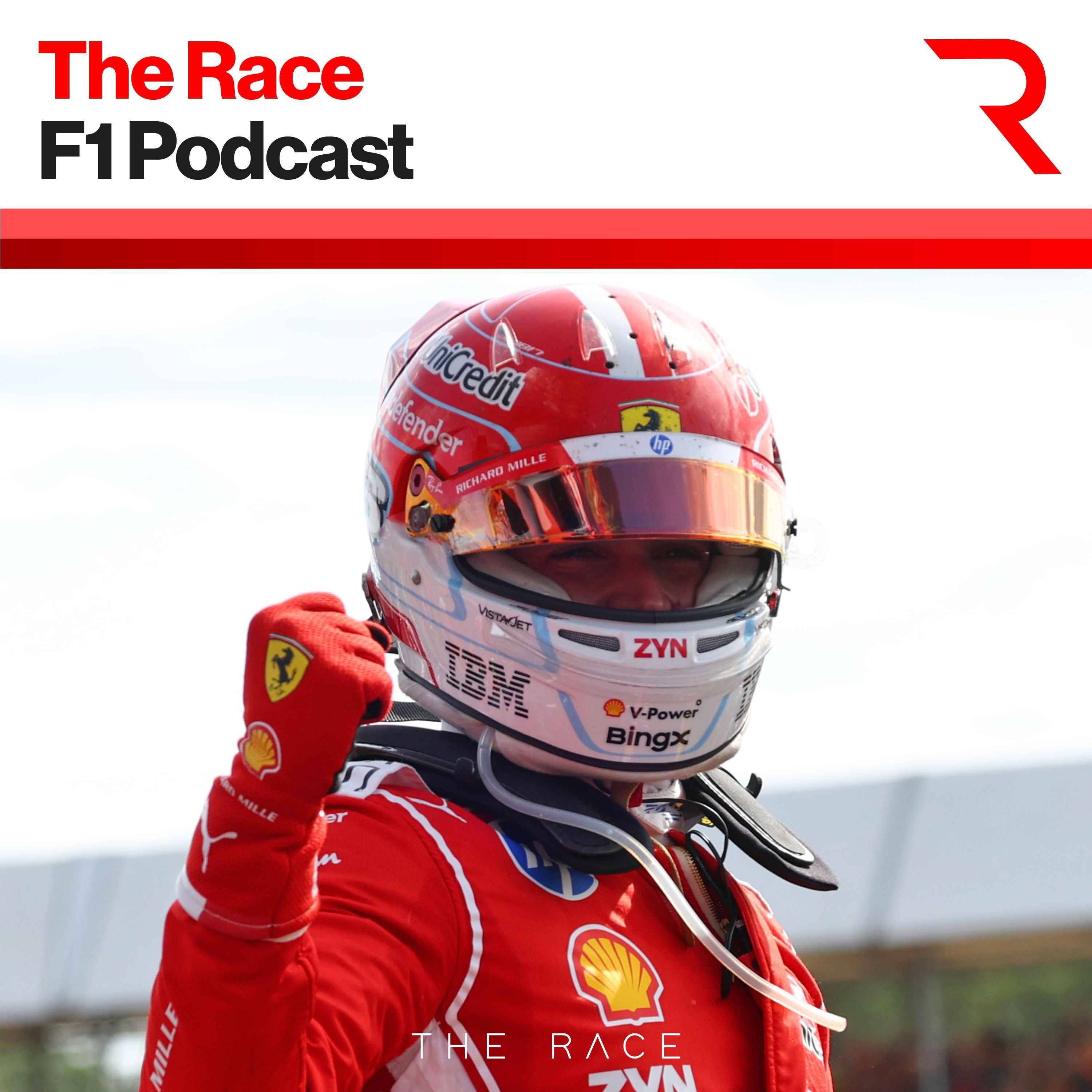
Leclerc's return to form, Verstappen's worries, SC changes & Stroll's strange driving
About this episode
Ferrari’s Charles Leclerc looks like he’s finally found form again after a tough start, with his Silverstone win framed as his most complete, consistent performance so far. The hosts debate whether it’s true driver “return to form” or the result of Ferrari’s upgrades and Leclerc adapting to Lewis Hamilton’s preferred setup approach—especially around braking feel and rear-end control. Conor Daly adds a driver’s perspective on coping with frustration and making incremental adjustments. The chat also touches on Verstappen’s growing worries, recent SC-related race dynamics, and a strange Stroll driving moment.
After a tricky start to the season, Charles Leclerc showed Ferrari what they were missing as he returned to top form at Silverstone. But how did he haul himself out of the hole he was trapped in, and does this mean Leclerc is now finally on top of this generation of cars? In the latest episode of The Race F1 Podcast, Edd Straw is joined by Ben Anderson and IndyCar driver Conor Daly to answer those questions and more.
Edd, Ben and Conor also discuss Max Verstappen's mindset following his latest 'super dangerous' off in Britain, plus there's chat about how F1 should amend its safety car rules, whether Kimi Antonelli's aggressive driving approach will cost him in the long run, and what was behind Lance Stroll's strange Silverstone showing.
Get bonus F1 podcasts, extra content and ad-free listening, sign-up to The Race Members' Club on Patreon today.
Hosted on Acast. See acast.com/privacy for more information.
reverse grid race
"So, my claim to fame, fame, I mean, it's not really fame, is it, the MRF challenge? ... But claim to fame in that series is a reverse grid race where I led from Paul and was on"
In a reverse grid race, the usual starting order gets flipped. That means drivers who would normally start near the back may start up front, so it’s harder to just cruise to the front.
A reverse grid race is a format where the starting order is flipped from the usual results—often the slower drivers start up front and the fastest start further back. The goal is to create more overtaking and tighter racing by reducing the advantage of qualifying or prior finishing order.
full start
"to win until they pulled me in with a black and white flag for a drive-thru for a full start."
A “full start” means the whole launch at the beginning of the race—how the car gets moving right away. Getting it right helps you gain position early.
A “full start” in F1 context refers to the complete launch and initial acceleration phase at the beginning of a race. It’s often discussed because small differences in reaction time, clutch/launch behavior (where applicable), and traction can determine early position.
drive-thru
"to win until they pulled me in with a black and white flag for a drive-thru for a full start."
A drive-thru penalty means you have to go through the pit lane and follow the speed limit, without stopping. It costs you time, which can drop you down the order.
A “drive-thru” penalty in F1 requires the car to enter the pit lane and pass through at the pit-lane speed limit without stopping. It’s used for certain rule infringements and costs time rather than ending the race immediately.
black and white flag
"to win until they pulled me in with a black and white flag for a drive-thru for a full start."
The black-and-white flag is a warning from race control. It usually means the officials think there’s a problem or rule issue, and you may get a penalty if it continues.
The black-and-white flag in F1 is a warning flag shown to a driver to indicate a specific issue or rule concern. It’s typically followed by a penalty if the problem persists or if the driver doesn’t comply with the race direction’s instructions.
British Grand Prix
"And I will say it was more microscopic than even Lewis Hamilton's full start in the British Grand Prix."
The British Grand Prix is a major Formula 1 race in the UK, usually at Silverstone. Drivers and teams care a lot about it because it’s a big test of how fast the cars really are.
The British Grand Prix is a Formula 1 race held in the United Kingdom, traditionally at Silverstone. It’s one of the sport’s marquee events and often used as a benchmark for car development and driver form.
track limits
"I've seen you on track limits at the Red Bull Ring and that kind of thing. [184.4s] We know what we're dealing with here."
Track limits are the edges of the track you’re allowed to use. If you go over the line, race control can penalize you because it can make you faster by cutting corners.
“Track limits” refers to the boundaries of the circuit that drivers are not supposed to cross. In F1, exceeding them can trigger penalties because it effectively gives an advantage by cutting corners.
Red Bull Ring
"I've seen you on track limits at the Red Bull Ring and that kind of thing. [184.4s] We know what we're dealing with here."
The Red Bull Ring is an F1 race track in Austria. It’s known for being fun to drive and for places where drivers sometimes run close to the track boundaries.
The Red Bull Ring is an F1 circuit in Austria known for its flowing corners and overtaking opportunities. It’s also a track where track-limits enforcement can be a talking point because of how close drivers run to the edges.
Fred Versailles
"Ferrari team boss, Fred Versailles, feels that he was always there and it was just a few circumstantial things going against him, some unlucky unreliability, a lot of changes on the car that he's had to have some time to get used to."
Fred Versailles is being quoted as the Ferrari team boss. He’s basically explaining why Leclerc’s results have varied, pointing to things like reliability and changes to the car.
Fred Versailles is referenced here as the Ferrari team boss commenting on Charles Leclerc’s season. In F1 coverage, team bosses’ statements often reflect how the team interprets performance swings—like reliability issues and setup changes.
unlucky unreliability
"Ferrari team boss, Fred Versailles, feels that he was always there and it was just a few circumstantial things going against him, some unlucky unreliability, a lot of changes on the car that he's had to have some time to get used to."
It means the car had problems that caused bad luck for the driver. Even if the driver is fast, a broken or unreliable car can ruin the result.
In F1, “unlucky unreliability” means the car suffered failures or mechanical problems that were not the driver’s fault and weren’t easily avoidable. Reliability issues can erase strong qualifying or race pace by forcing retirements or limiting performance.
Leclerc
"So I think we can be gently encouraged by what we saw from Leclerc, particularly the consistency in the race... I think if he nails it in Budapest, then we can say, OK, this is more like the Leclerc of old."
Leclerc is a top Formula 1 driver, most associated with Ferrari. Here, the hosts are talking about how he’s been driving more consistently and closer to his best again.
Charles Leclerc is a Ferrari Formula 1 driver known for strong qualifying pace and racecraft. In this segment, the hosts discuss his recent form and consistency, framing it as a return toward his earlier performance level.
wheel shield failure
"He would have made life difficult for Kimmy Antonelli without the kind of wheel shield failure thing that happened on the Merc that cooled off the chase and obviously the safety car."
The wheel shield is a small aerodynamic panel near the tire. If it fails, it can break off and become dangerous debris, which is why it can lead to a safety car.
A wheel shield is a bodywork component near the wheel designed to manage airflow and reduce aerodynamic drag. A wheel-shield failure means that piece came off or broke, which can force a caution because it creates debris and affects safety.
safety car
"He would have made life difficult for Kimmy Antonelli without the kind of wheel shield failure thing that happened on the Merc that cooled off the chase and obviously the safety car."
A safety car is used when something goes wrong on the track. It slows everyone down so marshals can fix the problem safely before racing resumes.
The safety car is deployed when there’s an incident on track, such as debris or a car needing recovery. It neutralizes the race by controlling the field’s speed until the track is safe again.
heavy braking
"Not a lot of heavy braking in the brakes is one of the big things Leclerc has been battling with."
Heavy braking means the track has places where you slow down very hard and often. It’s a big test of how well the car and tires handle stopping and turning at the same time.
Heavy braking refers to sections of a circuit where drivers repeatedly decelerate hard, often testing tire grip, brake stability, and how well the car rotates under load. The hosts say Leclerc has been battling this, implying it’s a key area affecting his race performance.
Spa
"So I'd like to really get a better sample set through Spa, which has a few more kind of braking events and certainly Hungary..."
Spa is a famous Formula 1 track in Belgium. The hosts are saying it’s a good place to judge Leclerc because it has more braking situations than the earlier venue.
Spa-Francorchamps (often shortened to Spa) is a Belgian circuit famous for elevation changes and a mix of slow corners and high-speed sections. The hosts want a better sample of Leclerc’s performance there because it includes more braking events than the earlier track.
Hungary
"So I'd like to really get a better sample set through Spa... and certainly Hungary, where we know it's a much slower track and also one where Charles has been really impressive in the past."
Hungary is a Formula 1 race track that tends to be slower and more about braking and traction. The hosts think it’s a great place to see if Leclerc’s performance is really returning.
The Hungarian Grand Prix venue is known for being relatively slower and more braking-focused than many tracks. The hosts connect this to Leclerc’s past strength there and suggest it’s a good test of whether his form is truly back.
combination of parameters
"you're just trying to find that it's not necessarily a magic button, but you're looking for that combination of parameters that just gets everything in line in terms of the car and how you're driving it."
In F1, a driver’s performance depends on a set of setup and driving variables—like braking points, traction, steering feel, and balance. The hosts describe searching for the right combination of these parameters so the car and the driver work together.
break issue
"you know, the break issue at Monaco."
They’re talking about a problem with braking. If your brakes aren’t working right, you can’t slow down as confidently, and you lose time right away.
In F1, a “break issue” here refers to a braking problem—something wrong with how the car slows down or how the brake system is behaving. That kind of issue can cost lap time immediately and can also force the driver to change their approach for the rest of the stint.
Monaco
"you know, the break issue at Monaco."
Monaco is a famous Formula 1 track in a city. It’s very twisty and hard to pass, so if something goes wrong—like braking—it can really hurt your race.
Monaco refers to the Circuit de Monaco, a street circuit in Monte Carlo known for tight corners and limited overtaking opportunities. Because of that, mechanical issues (like braking problems) and qualifying/race execution can have an outsized impact on results.
energy starvation
"Silverstone, especially in this era with the energy starvation, very much that, but Connor, I'm kind of interested"
Energy starvation means the car runs low on the extra power it can use from its hybrid system. When that runs out, the driver has less boost available, so it’s harder to go fast or make moves.
“Energy starvation” in modern F1 refers to running low on usable electrical energy (from the hybrid system) during a race. When that happens, the car can’t deploy as much power when needed, which affects overtaking, defending, and overall lap time.
team dynamic
"but Connor, I'm kind of interested in what you make of the team dynamic there between Lewis and and Charles, because it's felt from what they've been saying over that weekend that through the sort of rocky patch,"
Team dynamic is basically how the two drivers and the team work together. It can affect who gets the best strategy calls and how smoothly the drivers cooperate or compete.
“Team dynamic” is how a Formula 1 team manages relationships and priorities between drivers—especially when both are capable of winning. It can include how engineers communicate, how strategy is coordinated, and whether one driver is favored during tight races.
brake material
"if you like, since Monaco, the clerk adopting Hamilton's favoured brake material, obviously [424.9s] bought the upgrades chassis and engine that the clerk is kind of having to live Hamilton"
Brake material is basically what the brake pads are made of. In racing, the exact compound can change how well the brakes work and how consistently they perform lap after lap.
In F1, “brake material” refers to the compound used in the brake pads (and related friction material). Different compounds can change how consistently the brakes work across temperatures, which affects braking stability and lap-time potential.
Formula three
"You are able to make little [489.4s] driving style adjustments. You know, this starts all the way back in Formula three. [493.8s] If you go to the best team, I'll never forget going to ART, they're like, Yeah, you got"
Formula Three is a stepping-stone series for young drivers. The idea is that drivers learn how to adapt to different cars early on, before reaching F1.
Formula Three is a junior single-seater ladder that many F1 drivers use to develop racecraft and car-setup understanding. The host points out that Charles Leclerc’s ability to adapt driving style “starts all the way back” there.
setup philosophy
"where he slightly changed his setup philosophy. And he tried to get the car just fractionally more to how he wanted it as well."
A car “setup” is the tuning choices made for how it drives. “Setup philosophy” means the overall plan for what the car should feel like—like whether it should turn in easily, stay stable under braking, or rotate more at corner exit.
In Formula 1, “setup philosophy” is the driver/engineer approach to configuring the car—what balance they’re aiming for and how they want the car to behave under braking, turn-in, and corner exit. When the host says Leclerc changed his setup philosophy, it implies a shift in how the car is tuned to match his driving style.
wing angles
"it's so hard with these cars to tell because you're not just talking about wing angles, you can be talking about diff settings or that kind of thing."
Wings on an F1 car can be adjusted to change how much downforce they create. More downforce usually means more grip, while more drag can affect speed—so wing angles strongly influence how the car feels and performs.
“Wing angles” refer to the aerodynamic adjustment of the front and rear wings, which changes downforce and drag. In F1, small wing-angle changes can noticeably affect grip, stability, and how the car responds in different corners and on different tracks.
diff settings
"because you're not just talking about wing angles, you can be talking about diff settings or that kind of thing."
The differential decides how power goes to the two drive wheels. In racing, adjusting it changes how the car grips and turns—particularly when you’re accelerating out of a corner.
“Diff settings” are the tuning choices for the differential, which governs how torque is split between the left and right wheels. In F1, changing differential behavior can strongly affect traction and rotation—especially at corner exit—so it’s often a key lever for making the car feel controllable.
rear end controllability
"it does seem to have given him that greater confidence in the car, it does seem to have given him sort of the rear end controllability once because it snapped on him a few times"
This means how easy it is to keep the back of the car stable. If the rear is controllable, the car is less likely to suddenly slide or spin when you’re turning or accelerating.
“Rear end controllability” is the driver’s ability to keep the car’s rear stable and predictable—especially under throttle changes, braking, or mid-corner load. When the host says the changes improved rear-end controllability, it suggests the car was less likely to snap or over-rotate unexpectedly.
confidence in the car
"it does seem to have given him that greater confidence in the car, it does seem to have given him sort of the rear end controllability"
The host is describing how driver confidence can change performance even if the car’s hardware hasn’t dramatically changed. In F1, once a driver believes the car will behave as expected, they can push closer to the limit—often improving consistency and corner-exit traction.
brake steering overlap
"he likes a responsive car, he likes a fair bit of brake steering overlap into the corner, he likes to kind of live on the edge at the corner exit."
“Brake steering overlap” describes the overlap between braking and steering inputs where the car’s behavior is influenced by both simultaneously. In F1, that overlap can help the car rotate and turn more predictably, but it also requires precise control to avoid snapping the rear end.
corner exit
"Mainly it was the corner exit thing. Like he just seemed to have a lot more confidence to boot the throttle and it would work and wouldn't cost him on the next straight."
Corner exit is what happens right as you leave a turn and start accelerating. If the car feels good on corner exit, the driver can press the throttle sooner and the car stays stable.
Corner exit is the phase of a turn where the car is transitioning from cornering to accelerating down the straight. In F1, having confidence on corner exit often means better traction and stability so the driver can apply throttle earlier and harder without upsetting the car.
throttle
"Like he just seemed to have a lot more confidence to boot the throttle and it would work and wouldn't cost him on the next straight."
The throttle is how much engine power the driver asks for. More throttle means more acceleration, and here they’re saying Leclerc could use it confidently when leaving corners.
In racing, the throttle is the driver’s control of engine power delivered to the wheels. When the hosts say Leclerc could “boot the throttle” on corner exit, they mean he could apply more power without losing balance or speed immediately afterward.
Lewis
"But it also was kind of interesting that he, well, Lewis said, you know, I've been going against the simulated direction a bit more, kind of trusting my instinct a bit more."
“Lewis” here is another top F1 driver. The discussion is about how his driving approach and setup preferences influence how Leclerc compares and adapts his own style.
In this context, “Lewis” refers to Lewis Hamilton, another elite Formula 1 driver. The hosts discuss how Hamilton’s approach—trusting instinct more and following a setup direction—relates to how Leclerc is adjusting his driving and working with engineers.
setup direction
"Lewis said... I've been going against the simulated direction a bit more... And Charles has been following my setup direction."
Setup direction means the team’s plan for how to adjust the car so it drives the way the driver wants. It’s basically choosing what to change and in what direction to improve how the car feels.
Setup direction is the team’s chosen direction for adjusting the car’s setup (balance, aero, and mechanical behavior) to suit a driver’s needs. The segment contrasts Hamilton’s approach of not following the “simulated direction” as closely with Leclerc following Hamilton’s setup direction.
simulated direction
"Lewis said... I've been going against the simulated direction a bit more, kind of trusting my instinct a bit more."
Simulated direction is what computer modeling suggests you should do with the car setup. The idea here is that Hamilton wasn’t following the simulation as strictly and trusted what he felt instead.
Simulated direction refers to guidance derived from simulation tools (and/or predicted behavior) used to decide what setup changes should improve performance. The hosts say Hamilton has been deviating from that simulated guidance and relying more on his instincts.
reinvent the wheel
"So he hasn't had to reinvent the wheel. But obviously the big test now is whether he can adapt that same philosophy to other tracks..."
This phrase means not having to start from scratch. The hosts are saying Leclerc could keep using a working approach because the car was adjusted to match his preferences.
“Reinvent the wheel” here is a metaphor for starting over with a driver’s approach rather than building on what already works. The segment says Leclerc didn’t have to completely overhaul his driving because the car was brought closer to how he wants to drive.
adapt that same philosophy to other tracks
"But obviously the big test now is whether he can adapt that same philosophy to other tracks and retain the same feeling that makes him so impressive."
This is about whether a good approach at one race track can work at different tracks too. Different circuits behave differently, so drivers and teams have to adjust their plan.
This refers to the challenge of transferring a successful driving/setup approach from one circuit to others with different characteristics. In F1, what feels right at one track may not translate directly because grip, braking zones, and corner types change.
social media
"He said how important it was to kind of shut out the outside outside noise, the narratives on social media about obviously, you know what it's like people basically one minute you're a hero the next minute they think you're useless."
Social media is where people post opinions and react to results. The host is saying Leclerc tries to block that noise so it doesn’t mess with his focus.
Social media is referenced as a source of public narratives that can swing quickly between praise and criticism. In F1, that kind of external pressure can affect a driver’s mental focus, so the segment highlights the importance of shutting it out.
Formula One
"And so that world, the formula one just atmosphere is very difficult to deal with with 100% from from what you can see from from how you interact with some of the drivers now."
Formula One is the highest level of open-wheel race car racing. It’s also very public and media-driven, so drivers can feel pressure when results dip.
Formula One (F1) is the top tier of open-wheel racing governed by the FIA. It’s a media-heavy sport where driver performance is constantly evaluated, and public perception can swing quickly after a few races.
Ferrari
"And so I can't imagine what that's like because guess what he also drives for Ferrari, which is probably one of the most popular teams"
Ferrari is a famous Formula 1 team with a huge fan base. If you drive for them, you’re under a lot of pressure because everyone watches and expects results.
Ferrari is one of Formula 1’s most historic and recognizable teams. In F1, driving for Ferrari comes with intense global attention and pressure because the brand is closely tied to the sport’s legacy.
IndyCar
"But yeah, it's very difficult. We're obviously on the IndyCar side. It is not formula one, of course, but it still is a category that would be at a top level."
IndyCar is a major open-wheel racing series in the U.S. The point here is that the spotlight and pressure at the top level exist in IndyCar too, not just in Formula 1.
IndyCar is a top-level American open-wheel racing series. The hosts contrast it with Formula 1 to highlight that even outside F1, the pressure and media environment can still be intense at the highest level.
sprint
"So this was a very decisive kind of turnaround, particularly with how it was in the sprint component of the weekend. He was three tenths off in sprint quality."
A sprint in F1 is a shorter race weekend event. It affects where you start for the main race, so it’s a good clue about who’s actually quick.
In F1, a sprint is a shorter race held during a race weekend that determines starting positions for the main Grand Prix. Because it’s run under race conditions, it can reveal whether a car is truly fast or just looks good in qualifying.
three tenths off
"He was three tenths off in sprint quality. He was clearly a step behind on race place as well."
“Three tenths off” means the driver was about 0.3 seconds slower than the benchmark. In racing, that’s a meaningful gap even though it sounds small.
“Three tenths off” refers to a time gap measured in tenths of a second, commonly used in F1 to describe how far a driver or car is from the pace. In sprint context, it’s a precise way to quantify performance differences even when the cars look close.
tires
"because of the different variables, the tracks, the tires, the temperatures, the outside atmosphere, all the things that can affect the car"
In F1, tires aren’t just “rubber”—their grip changes with heat and track conditions. That’s why tire behavior can swing results even if the car is similar.
In F1, tire performance is a major variable because grip and degradation change with temperature and track conditions. The segment lists tires alongside temperatures and atmosphere, emphasizing that the same car can behave differently from one race to the next.
podium
"but you never want to get off that top step of the podium. So he's going to be working extra hard to be like, all right, I don't want to"
The podium in F1 is the top-three finish positions (1st, 2nd, 3rd) where drivers are awarded trophies. The host’s point is that even after a strong turnaround, drivers must keep pushing to avoid slipping out of those top spots.
jumpstart
"And I don't know if this was this was deliberate by Lewis as well. I'd like to the cynic in me would say it is because he's a wily operator and very experienced, but in the press conference afterwards, obviously he was asked about the microscopic jumpstart that I mentioned earlier."
A jumpstart means the driver moves off before the race start is officially allowed. It’s a mistake that can lead to penalties and can change how the rest of the race plays out.
A jumpstart in F1 is when a driver launches before the official start signal. It’s treated as a rules violation and can put the driver at a disadvantage, often requiring a penalty or forcing them to manage the race differently.
front wing angle
"But he said that he came off on the front wing angle to protect the rear tires. He felt the car was too overstere and qualifying."
The front wing helps push the front of the car onto the road. Changing its angle can change how the car feels in corners—whether it turns in too little or rotates too much.
The front wing angle is the setting of the front aerodynamic element, which strongly affects front downforce. In this context, adjusting it to protect the rear tires also changes the car’s balance, influencing understeer/oversteer behavior.
oversteer
"He felt the car was too overstere and qualifying. And char went the opposite way and added some wing angle."
Oversteer is when the back of the car slips more than the front. That can make the car feel twitchy or rotate too much in corners.
Oversteer is when the rear of the car loses grip before the front, causing the car to rotate more than intended. Drivers and engineers tune setups to manage oversteer because it affects stability and tire wear.
Austria type circuit
"Yeah, I'd be very interested to see Leclerc going to an Austria type circuit again, where it could be that he just be cooking the rears when it comes to race pace with that approach."
This refers to the kind of track layout and characteristics seen at F1’s Austrian venue (commonly the Red Bull Ring). The point is that certain setups and driving styles can work better on tracks with specific corner types and braking/traction demands.
race pace
"Yeah, I'd be very interested to see Leclerc going to an Austria type circuit again, where it could be that he just be cooking the rears when it comes to race pace with that approach."
Race pace is how fast you can go consistently during the race, especially as the tires get used up. It’s different from just being quick for one lap.
Race pace is the speed and consistency a driver can maintain over a stint during the race, not just a single fast lap. It’s heavily influenced by setup balance, tire management, and how the car behaves as tires wear.
power delivery
"because he still had a car that was in that direction in Austria, which is why you start thinking about all these diff settings and the power delivery and all of that kind of thing."
Power delivery is how the car’s power comes on when you press the throttle. Some setups feel smooth and controllable, while others feel abrupt or harder to manage.
Power delivery describes how the engine’s torque reaches the wheels over time—how smooth, aggressive, or delayed it feels. In F1, it’s closely linked to traction and balance, so changes can make a car feel dramatically different even if peak power is similar.
Budapest
"So over the next few races and Spa and Budapest, that's two pretty different tracks, a good chance for us to measure where he's really at."
Budapest here means the Hungaroring track in Hungary. It has a different layout than Spa, so it’s useful for checking whether a car’s strengths (or weaknesses) carry over.
Budapest refers to the Hungaroring circuit in Hungary, which features a mix of medium-speed corners and long straights. Because it’s different from tracks like Spa, it helps teams compare how a car performs across varying demands.
rear wing
"Verstappen had that off at Stowe during the race. This issue with the rear wing, they have confirmed that there was a problem. Obviously, Max Verstappen was pretty negative about it."
The rear wing is the big spoiler on the back of an F1 car. It’s there to push the car down onto the track so the tires can grip better, particularly at high speed.
The rear wing is an aerodynamic device mounted at the back of a Formula 1 car. Its angle and effectiveness help generate downforce, which increases tire grip—especially in fast corners where the car needs stability.
Stowe
"Let's move on to Max Verstappen and Red Bull now, Connor. Verstappen had that off at Stowe during the race. This issue with the rear wing, they have confirmed that there was a problem."
Stowe is a famous fast corner at Silverstone. If something’s wrong with the car’s aero, that kind of corner can make the problem show up quickly.
Stowe is a high-speed corner at Silverstone Circuit in the UK. It’s known for being demanding on aero and stability, so problems like rear-wing issues can be especially risky there.
turn in
"it'll be in the back of your mind that there's a potential problem here and the car could just that the rear could just go just like that when you turn in."
Turn-in is when you first start steering into the corner. That’s a critical moment because the car has to rotate correctly right away, and aero problems can make it go wrong instantly.
Turn-in is the moment when the driver initiates steering input to start the car rotating into a corner. F1 cars are extremely sensitive here, so any rear-aero malfunction can show up immediately as instability when the driver turns in.
downforce
"Like the high speed corners with the speed that these cars are carrying and the amount of downforce that's produced, you know, in our cars on the IndyCar side, yeah, we have a little bit of entry oversteer."
Downforce is the “suction” effect that makes the car press harder onto the road. More downforce usually means better grip, but if aero parts aren’t working right, the car can become unstable fast.
Downforce is the aerodynamic force that pushes the car toward the track. In F1, higher downforce generally improves grip and stability, but it also makes the car more sensitive to aero problems—like a rear-wing issue—at high speed.
yaw
"There's, you know, there's some movement, there's a little bit of yaw with how much downforce and how, you know, how perfect the balance of all these Formula One cars are."
Yaw is the car twisting left or right around its center. If the car yaws too much, it can feel unstable and harder to control through a fast corner.
Yaw is the rotation of the car around its vertical axis—essentially how much the car’s nose and tail “twist” left or right. In racing, controlling yaw is crucial because excessive yaw can indicate instability, especially when aero balance is compromised.
rear let you down
"But if you have the rear let you down like that and something like that happens at a high, that becomes then dangerous for him too because like he obviously didn't hit the wall at Silverstone..."
“Rear let you down” means the back of the car doesn’t behave the way you expect—like it loses grip. At high speed, that can quickly turn into a dangerous situation.
“Rear let you down” is shorthand for the rear of the car losing grip or behaving unpredictably. In this context, it’s tied to instability caused by an aero problem at high speed, where there’s little margin for error.
locking mechanism
"Because obviously they had the problem in Austria. They thought there was maybe a sort of mechanical related problem to it as in something, the locking mechanism or whatever in the wing, wasn't working properly."
A locking mechanism is the part that holds something firmly in position. In this case, it’s related to how the rear wing is secured. If it doesn’t lock correctly, the wing can behave unpredictably.
A locking mechanism is the hardware that secures a component in place—here, referenced as part of the rear wing system. If it isn’t working properly, the wing can move or fail to function consistently, creating both performance and safety concerns.
aerodynamic problem
"But there is the potential. This is an aerodynamic problem, just the airflow, not reattaching in certain conditions when it's just not there."
An aerodynamic problem is when the car’s shape and wings aren’t moving air the way they should. That can change how much grip the tires have. In F1, even small airflow issues can make the car suddenly feel wrong.
An aerodynamic problem means the car’s airflow isn’t behaving as intended around the bodywork and wings. In F1, that can affect downforce and stability, especially when the airflow doesn’t stay attached or changes under certain conditions.
airflow
"But there is the potential. This is an aerodynamic problem, just the airflow, not reattaching in certain conditions when it's just not there."
Airflow is the way air moves around the car’s surfaces, especially near the wings and bodywork. In F1, airflow quality directly affects downforce and drag, and problems like separation can cause the car to lose grip abruptly.
reattaching
"This is an aerodynamic problem, just the airflow, not reattaching in certain conditions when it's just not there."
Reattaching is when the air flow that got disrupted manages to “stick back” to the surface again. If it doesn’t reattach, the wing may stop working the way it should, and the car can lose grip. That’s why it can feel like the car suddenly snaps away.
Reattaching refers to airflow rejoining the surface after it separates, which is crucial for maintaining predictable aerodynamic performance. If airflow doesn’t reattach in certain conditions, the wing can produce less downforce and the car can become unstable.
lock the rears
"maybe backing off a little bit because it might, it might lock the rears or some, you know, the,"
It means the back tires lose grip while braking and stop rolling normally. When that happens, the car can get unstable and spin or slide, which is dangerous at speed.
“Lock the rears” means the rear wheels stop rotating and slide because braking force exceeds tire grip. In a race car, that can destabilize the car and trigger oversteer or loss of control, especially under heavy braking.
rear arrow
"the rear arrow might disconnect and I crash in a massive way. You never think about that."
They’re talking about the rear wing that helps press the car down for grip. If it comes loose, the back of the car can suddenly lose traction and become unstable.
“Rear arrow” is a colloquial way to refer to the rear wing/wing element that generates downforce at the back of the car. If it “disconnects,” the car can suddenly lose rear grip and become very hard to control.
brake failure
"that's almost, almost as bad as like having a brake failure into a, into a low speed corner because you're losing control"
Brake failure means the car doesn’t slow down when the driver needs it to. If that happens near a corner, the car can’t turn safely and can crash.
“Brake failure” means the braking system can’t slow the car as intended, which can be catastrophic in braking zones. The host compares it to a low-speed corner because losing control there can still put the car into a dangerous trajectory.
DRS
"When DRS was a thing in Formula One, you would from time to time have these reattachment airflow problems and it wouldn't shut properly"
DRS is a system that changes the rear wing to reduce drag for a short time. It can help you go faster to pass, but it only works if the rear-wing mechanism moves properly.
DRS (Drag Reduction System) is an F1 feature that temporarily reduces aerodynamic drag by opening a flap in the rear wing. It’s used to help cars gain speed and attempt overtakes, but it relies on the wing mechanism working correctly.
Macarena upside down wings
"Obviously, the rules are new and these Macarena upside down wings particularly are very new and maybe not so well understood,"
They’re talking about a new rear-wing design that’s shaped or mounted in an unusual, “inverted” way. The point is that it’s new enough that teams may still be learning how it behaves and how to keep it reliable.
“Macarena upside down wings” is a nickname for a specific rear-wing/wing configuration used under newer F1 regulations, described as inverted. The speaker implies these new aero parts may not be as well understood yet, contributing to failures or poor behavior.
simulator
"Red Bull started listening to Verstappen more as opposed to what the simulator says"
The simulator is a computer model teams use to predict how the car will behave. Sometimes it matches reality, but sometimes it doesn’t—especially when conditions or car behavior are hard to model.
The simulator is the team’s computer-based system used to model car behavior and predict performance. In F1, simulator results can differ from real-world data, so when a driver says the car isn’t matching what the simulator suggests, it usually points to setup/understanding gaps.
Silverstone
"a furious Verstappen after the Silverstone race bluntly said ask the team when he was pushed about certain choices."
Silverstone is a famous F1 race track in the UK. Because it has lots of fast corners and straights, it can highlight whether a car is strong in speed and stability.
Silverstone is a major Formula 1 circuit in the UK, known for its high-speed corners and fast sections that stress aerodynamic efficiency and engine performance. It’s a frequent benchmark venue, so performance gaps there tend to be scrutinized heavily.
new set of rules
"especially while they're trying to work through a new set of rules and a difficult car and a new set of problems."
New rules mean the sport changes how cars are allowed to be built or how races are run. When that happens, teams have to relearn what works, and problems can show up more often.
A new set of rules in Formula 1 changes the technical and sporting constraints teams design around. When rules shift, teams often struggle to find the right setup and performance direction, which can amplify issues like car balance and reliability.
straight line speed
"Max was upset all weekend that he had a small difference in straight line speed compared to his Hatchers car. It was there in the data."
Straight line speed is just how fast the car goes when the track is basically straight. In racing, a car can feel good in corners but still be slower on straights because of how it’s set up.
Straight line speed is how fast the car can go on sections without turning. In F1 discussions it often points to engine/drag efficiency and overall aerodynamic balance, since the car’s setup can make it faster or slower even if cornering feels similar.
pit lane start
"if we change the engine, it's a pit lane start. Remember before the rear wing failure happened, Max was running in third place."
A pit lane start means the driver doesn’t start from the normal grid. They start from the pit lane, which usually puts them behind other cars and makes it harder to get a good result.
A pit lane start is when a driver begins the race from the pit lane instead of the grid. In F1 it’s commonly triggered by penalties such as taking a new engine component, and it can dramatically change race strategy and track position.
car balance
"even though Max was unhappy and he wasn't just unhappy with the engine, he's unhappy with the car balance"
Car balance is how the car feels in corners—whether it wants to turn in nicely or push wide. Teams tune the setup so the car behaves the way the driver expects.
Car balance is how the car behaves at the limit—whether it’s more stable or more eager to rotate in corners (often described as understeer/oversteer tendencies). F1 teams adjust wing angles, suspension, and other setup parameters to get the balance that matches the driver’s style and the track.
SC changes & Stroll's strange driving
"Yeah, absolutely. I think there's implied in the question is, are they just ignoring him now [1847.2s] because he didn't get his way in this specific incident in the Grand Prix?"
The episode is also talking about safety-car moments and some odd driving from Lance Stroll. In this part, they shift to Verstappen and what his contract could mean after an incident.
This segment is part of a broader episode theme that includes safety-car (SC) related changes and unusual driving behavior by Lance Stroll. The discussion here focuses more on Verstappen’s contract leverage, but it’s framed around on-track incidents.
Max Verstappen
"And of course, Ben, there's all of that question mark about the future with Max [1835.3s] Verstappen. It's such a rumbling on. It's probably in Max's interest to have that rumbling on a little bit as well."
Max Verstappen is a top Formula 1 race driver. Here, the hosts are talking about how his contract and championship standing could give him power to push Red Bull for changes.
Max Verstappen is a Dutch Formula 1 driver who races for Red Bull Racing. In this segment, the hosts discuss his leverage in contract negotiations and how his championship position affects his options.
championship come the summer break
"He also, as we understand it, is in a situation [1879.9s] where, mathematically, he can't be inside the top two of the championship come the summer break."
They’re talking about where the driver stands in the season standings by the time the sport pauses for summer. That position matters here because it connects to what Verstappen can do with his contract.
This is about the Formula 1 standings at the midpoint of the season. The hosts are using the “summer break” cutoff to explain a mathematical condition that affects Verstappen’s contractual leverage.
clause
"So if what we know about his contract is correct and he has the clause that allows him to exit, [1891.9s] because he's not in the top two, he can now effectively hold that gun to the Red Bull Management Head as well."
A clause is a specific rule written into a contract. This one is described as giving Verstappen an option to leave if certain championship conditions aren’t met.
In contract terms, a clause is a specific written condition that triggers rights or obligations. Here, the hosts say Verstappen has a clause tied to championship position that could allow him to exit his deal.
Red Bull Management Head
"if what we know about his contract is correct and he has the clause that allows him to exit, [1896.9s] because he's not in the top two, he can now effectively hold that gun to the Red Bull Management Head as well."
The hosts are talking about Red Bull’s top decision-makers. The idea is that Verstappen’s contract could let him force negotiations with the team leadership.
This refers to Red Bull’s leadership overseeing the Formula 1 team’s decisions and negotiations. The hosts are framing it as the person/group Verstappen could pressure through a contract exit clause.
entertainment business
"Conor, you touched on this earlier. It's an entertainment business now. The teams and the [1918.8s] franchises are in Formula One as much to entertain, create content, satisfy fans, grow the audience [1925.8s] as they are to compete and race."
They’re saying F1 is also run like a show. Teams have to attract viewers and fans with content and marketing, not just race fast.
The hosts are describing Formula 1 as not only a sport but also a media-and-fan engagement product. They frame teams and franchises as needing to create content and satisfy audiences alongside racing performance.
sliding scale
"And that's there's a sliding scale, isn't there, of drivers of how much privilege they've got to do that."
The host is saying not all drivers have the same freedom to speak their mind. More successful or established drivers usually have more leverage, while others have to be more careful.
A “sliding scale” here means drivers have different levels of privilege to be outspoken, depending on their status and results. The host ties it to how established a driver is and how much leverage they have with teams and the media.
Valtteri
"there could be a driver at a Williams level or at Audi or even Cadillac with Valtteri and Checo..."
Valtteri is mentioned as a driver whose results depend heavily on how competitive his car is. The idea is that if the car isn’t capable of winning, it limits how much the driver can push for top results.
Valtteri is referenced in the context of a driver’s current situation and how their team’s car competitiveness affects their ability to fight for wins. The host’s point is that when the car can’t win, the driver has less opportunity to express aggressive demands.
Checo
"there could be a driver at a Williams level or at Audi or even Cadillac with Valtteri and Checo..."
“Checo” refers to Sergio Pérez. The host is using him as an example of how a driver’s influence can depend on whether their car can realistically challenge for wins.
“Checo” is a nickname for Sergio Pérez, a Formula 1 driver. The host groups him with Valtteri to illustrate how drivers at teams with less-winning machinery may not get the same freedom to be outspoken or aggressive.
world championships
"because they don't have as many world championships as Max Verstappen or Lewis Hamilton, they're not going to have the freedom..."
“World championships” means winning the top overall title in Formula 1. The host is saying drivers with more championships tend to have more power and freedom.
“World championships” refers to the Formula 1 Drivers’ Championship titles (and by extension the prestige that comes with them). The host uses championship count as a proxy for how much influence a driver has to be aggressive and outspoken.
lap cars
"the lap cars go through the pit lane. So one, you know, one lap on the, under the safety car, all the lap cars go through the pit lane. They get moved to the back."
Lap cars are cars that have fallen behind the leaders by at least a lap. Race officials sometimes move them out of the way so the leaders can race each other without being constantly blocked.
Lap cars are cars that are one or more laps behind the race leader. In series like IndyCar, specific late-race procedures can route lap cars through the pit lane so they’re moved to the back, reducing interference with the leaders.
wave around
"like with two laps to go, one lap to go, whatever it is, the procedures and the wave around, whatever it is."
A wave around is an official instruction during a safety-car situation that lets some cars rejoin in a better spot. The goal is to reduce traffic problems and keep the race order manageable.
A wave around is a race-control procedure used during safety-car periods where certain cars are allowed to pass the pit exit and rejoin ahead of others. It’s used to manage the gap between cars that have been stopped or are otherwise out of position, often involving lapped cars.
Abu Dhabi 2021
"because of the spectre of Abu Dhabi 2021, which hangs over all of this, where they did prioritize the show when against the regulations created a massive controversy"
Abu Dhabi 2021 was a controversial Formula 1 race where the final outcome was heavily influenced by late safety-car and restart decisions. Many people still talk about it when discussing how F1 should handle those situations.
Abu Dhabi 2021 refers to the 2021 Formula 1 season finale at Yas Marina Circuit, where late-race safety-car and restart decisions led to major controversy. The incident is often cited as a turning point that made fans and teams scrutinize F1’s rule enforcement and race-control procedures.
restart
"whether we can get a proper restart under the safety car..."
A restart is when the race begins moving at full speed again after a slow-down or stoppage. Who gets going first can strongly affect the outcome.
A restart is the moment racing resumes after a caution period (like the safety car or red flag). The rules around when the field can accelerate and how gaps are managed are crucial because they determine who has track position and how tires behave.
Monza
"happened at Monza a few years later, they want to say maybe 23 or 22."
Monza is a famous race track in Italy. It’s known for being fast, and restarts there can be tricky because cars get up to speed quickly.
Monza is a historic circuit in Italy (home of the Italian Grand Prix) known for high-speed corners and long straights. It’s also a track where restart timing under caution can become especially critical because of how quickly cars can accelerate back up to speed.
software glitch
"And I think it didn't help that they had this software glitch as they claimed that put the message that it was going to happen."
A software glitch is basically a computer mistake. In racing, if the system that communicates race procedures has an error, it can change what teams think is going to happen next.
A software glitch is an error or malfunction in the race-control or broadcast/communications system that can affect what teams and fans are told. In modern F1, timing and procedural messages are tightly controlled, so a glitch can disrupt expectations and strategy.
Indy 500
"And real quick on that too, like the Indy 500, for example, not two or three years ago..."
The Indy 500 is the Indianapolis 500, one of the biggest open-wheel races in the world. It’s known for long green-flag runs and dramatic late-race restarts, so changes to caution/red-flag procedures can create major strategic and entertainment swings.
late yellow
"we have a late yellow and never in the history has this ever happened."
A late yellow means a caution comes on very close to the finish. With only a few laps left, teams have fewer chances to recover and the restart becomes a big deal.
A late yellow refers to a caution period that comes near the end of the race. Because there’s little time left, it compresses strategy options and can force teams to gamble on restart timing and tire readiness.
red flag
"we exited the pits after red flag and went straight to green, no tire warming..."
A red flag means the race is stopped for safety. If it restarts soon after, the cars may not have had time to get tires up to their usual temperature.
A red flag is a race stoppage where cars must slow and wait because conditions are unsafe (like a major incident). When a race goes from red flag to green quickly, it can leave tires and brakes without normal operating heat.
tire warming
"went straight to green, no tire warming, literally nothing for the win of the Indianapolis 500..."
Tire warming is getting the tires hot enough to work well. If the race restarts without that, the tires can feel slippery for a bit.
Tire warming is the process of bringing tires up to their optimal temperature so they grip properly. If a race restarts without tire warming, cars can be slower to accelerate and may struggle for traction until the tires heat up.
Abu Dhabi situation
"And yeah, the Abu Dhabi situation, you know, that, that'll be talked about for forever."
The “Abu Dhabi situation” is a famous late-race controversy from an F1 race in Abu Dhabi. People argued about whether the race-control calls were handled correctly.
The “Abu Dhabi situation” refers to the widely discussed 2021 Abu Dhabi Grand Prix controversy involving race control decisions late in the race. It became a long-running debate about how procedures and restart rules should be applied.
lead lap
"If your top priority is you want the lap cars to be back on the lead lap so that they can race those ahead."
On the lead lap means you’re not behind by a full lap. It matters because being lapped usually takes you out of the fight for many positions.
Being on the lead lap means a car is still running with the race’s main group of cars, not a full lap behind. Race control decisions (like how to handle slower cars) can prioritize getting cars back onto the lead lap so they can compete for position rather than being lapped.
Kimmy Antonelli
"all about Kimmy Antonelli, first one from Berger Harrison, with Antonelli constantly on the verge of or getting a penalty for track limits..."
Antonelli is an F1 driver being discussed for getting penalties and possibly stressing the car too much. The question is whether his approach is costing him reliability or results.
Antonelli is an F1 driver discussed here in the context of penalties for track limits and potential reliability concerns. The hosts are evaluating whether his driving style is too aggressive for a championship contender and how that affects race outcomes.
Toto
"but surely Bono and Toto must do something to rein him in."
Toto is a top Mercedes team leader. The point here is that Mercedes might need to tell the driver to calm down if he’s causing penalties or stressing the car too much.
Toto refers to Toto Wolff, Mercedes’ team principal and a key decision-maker in how the team manages driver behavior and race strategy. In this segment, the host implies Mercedes should intervene if Antonelli’s driving is creating avoidable penalties or damage.
Mechanical and Power Unit Failures
"is this championship going to be decided by DNF's calls by Mechanical and Power Unit Failures, as Kimmy seems to have the pace advantage consistently..."
This is about races ending early because something breaks. It could be a normal mechanical part, or it could be the car’s hybrid engine system failing.
This refers to DNFs (did not finish) caused by either mechanical problems or failures in the car’s power unit. In modern F1, the power unit is the hybrid system (engine plus energy recovery and control electronics), so reliability issues can come from multiple subsystems.
DNF's
"is this championship going to be decided by DNF's calls by Mechanical and Power Unit Failures..."
DNF means the driver didn’t finish the race. In a championship, DNFs can hurt a driver’s points a lot.
DNF stands for “Did Not Finish,” meaning the driver didn’t complete the race. In championship terms, DNFs can swing point totals dramatically, especially when reliability is a recurring issue.
pace advantage
"as Kimmy seems to have the pace advantage consistently to get the better result over Russell, but the points gaps closing thanks to unreliability."
A pace advantage means one driver is usually faster than the others. Even if they’re quicker, they can still lose if the car breaks or they get penalties.
“Pace advantage” means a driver is consistently faster over a race distance—typically reflected in lap times and how quickly they can close on or pull away from rivals. The segment contrasts that speed with the possibility that reliability and DNFs could still decide the championship.
undercut
"Ferrari protected Leclerc from the undercut. Mercedes deliberately ran Antonelli long to then give him the tire advantage at the end."
The undercut is when one driver pits earlier than the other to get onto fresh tires first. That lets them drive faster and potentially come out ahead when the other driver stops later.
The undercut is a pit-stop strategy where a driver pits earlier than a rival to run faster laps on fresh tires. The goal is to gain track position when the other car pits later, often forcing the rival to rejoin behind.
tire advantage
"Mercedes deliberately ran Antonelli long to then give him the tire advantage at the end. So he's got to push to make the gap up and then attack the Ferrari"
A “tire advantage” means one car has fresher or better-performing tires than the other at a key moment. In F1, that can translate into stronger grip, faster lap times, and better braking/turn-in for overtakes late in the race.
Request an Explanation
Heard something you'd like explained? We'll add it to this episode.
Sign in to request explanations for terms you heard.
Want to learn more?
Browse our glossary for plain-English explanations of automotive terms, jargon, and concepts.
Help improve this episode
See something that's not quite right? Our annotations are AI-generated and can sometimes miss the mark. Click the flag icon on any annotation to suggest a correction.